Lesson 11 — Language Loss & Revitalization
Learners describe **how languages are lost and how they are brought back**, using four real revitalization stories — Māori, Hawaiian, Welsh, and Hebrew — and explain why protecting languages matters for humanity and the environment, through the link between linguistic and ecological knowledge. Loss is paired with hope and agency, never despair.
Objectives
Objectives
- D04.S4.09.02 Describe language loss and revitalization, and why protecting languages matters for humanity and the environment.
Essential question
How are languages lost, how are they brought back — and why does protecting them matter for humanity and the environment?
Key vocabulary
Materials
Standard materials
- Language-loss and revitalization sheet · 1 per learner A two-column organizer — how languages are lost, and how they are brought back — with a line for "why it matters for humanity and the environment"
- Revitalization story cards · 1 set per group Four short, real revitalization stories — Māori (kōhanga reo), Hawaiian (Pūnana Leo), Welsh, and Hebrew — plus a note on the link between language and environmental knowledge
Low-tech / no-cost
- A shared board or large paper Build the two columns together and read the story cards aloud; no printed sheets needed
- A community elder or speaker Where possible, invite someone who speaks an endangered or revitalized language to share a word and its world
Enriched / lab & device
- A short video on language revitalization · 1 An age-appropriate clip of a language nest, a revitalization program, or speakers teaching children
- The UNESCO language atlas (digital) · 1 Explore the map of endangered languages to see where loss is concentrated and where revival is underway
Works in different contexts
- large-group Build the loss-and-revival columns as a whole class, then small groups each take one revitalization story and report how it worked
- multi-age Younger learners match a language to its place and story; older learners analyze the common thread across the four stories and argue why protecting languages matters
- self-directed A learner reads the story cards, fills the two columns, and writes one paragraph on why protecting languages matters for humanity and the environment
- level-grouped Learners ready to extend research one additional revitalization effort (or one language near them) and add it to the map of hope
- outdoor-only Connect language to place directly: name local plants, animals, or land features, and ask which names come from which languages — and what is lost when a name is forgotten
Lesson 11 — Language Loss & Revitalization
Summary
Learners describe how languages are lost and how they are brought back, using four real revitalization stories — Māori, Hawaiian, Welsh, and Hebrew — and explain why protecting languages matters for humanity and the environment, through the link between linguistic and ecological knowledge. Loss is paired with hope and agency, never despair.
Objectives
- Describe language loss and revitalization, and why protecting languages matters for humanity and the environment. (D04.S4.09.02)
Connection
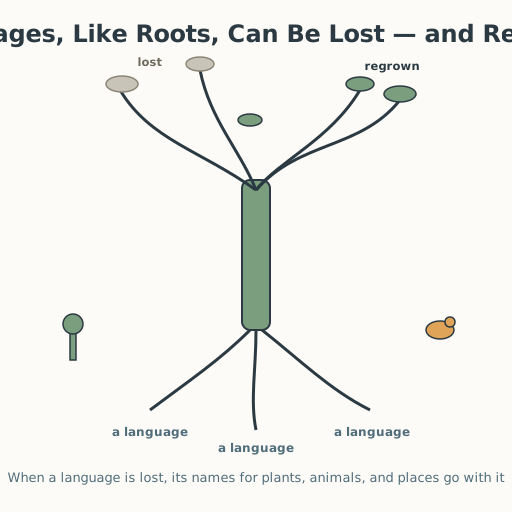
A language is more than words; it is a whole way of seeing. When a language is spoken, the world it names stays vivid — the plants, the animals, the places, the ways of being polite, the jokes, the songs. When a language stops being passed to children, all of that goes quiet, and something that took thousands of years to grow can fade in a single generation. But the story has a second half: languages can be brought back — by grandparents and grandchildren talking again, by children learning in language nests, by songs and writing and everyday use. Today you learn both halves, and why the second half matters for all of us and for the living Earth.
Materials
- Language-loss and revitalization sheet
- Revitalization story cards
Preparation
- Copy the sheet and the story cards.
- Retrieval: from Lesson 10, recall how languages carry identity; from Grade 8, recall how language can include or exclude people. Today we look outward: what happens to languages — and to what they carry — when they are lost, and how they are brought back.
Facilitator note
This lesson is written to the learner (“you”). The idea to land: languages are lost when they stop being passed to children — through colonization, forced schooling, migration, and economic pressure — and they are revitalized by restoring intergenerational transmission: elders and children speaking together again. There are about 7,000 living languages in the world (Ethnologue, S-426), and thousands are endangered; UNESCO has warned that about 40% of the world’s people lack access to education in a language they speak or understand (S-019). Loss is real, but so is revival. The four stories: Māori (Aotearoa New Zealand) — the kōhanga reo (“language nest”) movement began in 1982, putting elders and preschoolers together in te reo Māori, and helped reverse decline; Hawaiian — the Pūnana Leo (“language nest”) preschools, begun in 1984, helped grow new generations of speakers of ʻōlelo Hawaiʻi; Welsh — once pressured toward English, Cymraeg is now taught in schools, spoken in public life, and carried by media; Hebrew — revived from a liturgical language into an everyday spoken one over the twentieth century, a celebrated case of language revival (S-428). The environment link: languages carry ecological knowledge — names and classifications of plants, animals, weather, and land — so when a language is lost, knowledge of a place is lost with it; this is biocultural diversity: the diversity of life and the diversity of languages and cultures rise and fall together (S-427). Kimmerer writes of learning Potawatomi plant words and finding that the language itself encodes a relationship of respect to the living world — the grammar calls a plant a person, not a thing (S-427). The environment lens is thus literal, not a metaphor. The egalitarian lens: languages are lost unequally — through colonialism and forced schooling, the languages of Indigenous and minoritized peoples were punished, and revitalization is therefore a question of justice, not nostalgia. The ethics lens: a language is not a “relic”; its speakers are living people with a right to their own language, and protecting a language means supporting its speakers, not collecting it. The global lens: loss and revival happen on every continent, and no single region owns either the problem or the cure. Keep loss paired with hope and agency — never despair (development.md 9–12) — and hold the factual claims carefully with sources (S-019, S-426, S-427, S-428).
Procedure
- Recall (5 min). From Lesson 10: what did your language map show about what a language carries? Today: what happens when a language stops being spoken?
- Meet loss and revival (10 min). Fill the two columns together: how languages are lost (colonization, forced schooling, migration, economic pressure — the common thread: it stops being passed to children) and how they are brought back (elders and children speaking together, language nests, schools, media, songs, everyday use).
- Read the four stories (15 min). Māori kōhanga reo, Hawaiian Pūnana Leo, Welsh, Hebrew. For each, note: what threatened it and what brought it back.
- Find the common thread (7 min). What do all four revivals share? (Intergenerational transmission — children and elders speaking together again, and a community that chose to.)
- Why it matters (10 min). Write one short paragraph: why does protecting a language matter for humanity (each language carries history, knowledge, and a way of seeing) and for the environment (a language carries names and knowledge of plants, animals, and places — lose the language, lose the knowledge)? Use one of the four stories as your example.
- Close (3 min). Share one line from your paragraph. Loss is real; so is the power to bring a language home.
Differentiation
- Support: Provide a sentence frame — “The ___ language was threatened by ___, and it was brought back by ___. Protecting it matters because ___.” — and match each story to its place on a map.
- Extension: Research one revitalization effort near you (or one additional language) and add it to a class “map of hope.”
- Non-speaking / AAC: The reflection is written; a signed language is a full example of the lesson’s own point, and a learner can name a signed language they know.
- Deaf / hard of hearing: Signed languages can be endangered too, and their revitalization is part of the same story; include one signed-language example where the group has one to share.
Assessment
- Formative (observation): Can the learner name how languages are lost, how they are brought back, and why protecting them matters for humanity and the environment, with one concrete example?
- Portfolio artifact: The completed sheet and “why it matters” paragraph, kept in the portfolio.
Home connection
Ask at home: is there a word in our family’s language for a plant, an animal, or a place that you do not know in the school language? What does it name, and what would be lost if no one said it?
Resources
- On the scale of language endangerment and multilingual education: UNESCO, “International Mother Language Day,” https://www.unesco.org/en/days/mother-language (S-019).
- On the number of living languages and endangerment data: Ethnologue, “Languages of the World,” https://www.ethnologue.com/ (S-426).
- On language and ecological knowledge: Robin Wall Kimmerer, Braiding Sweetgrass (2013) (S-427).
- On language revitalization in families and communities: Leanne Hinton (ed.), Bringing Our Languages Home (2013) (S-428).
- On explicit instruction and worked examples for skills: Kirschner, Sweller & Clark (2006), https://doi.org/10.1207/s15326985ep4102_1 (S-011).