Lesson 08 — Quadratic Solutions in Real Situations
Learners **interpret quadratic solutions in real situations**, reading the roots of a quadratic as the moments when something is zero (a ball lands, a rectangle has zero area), the vertex as a maximum or minimum, and learning that a mathematically real solution can still be **meaningless in context** — such as a negative time.
Objectives
Objectives
- D05.S2.09.02 Solve quadratic equations using several methods and interpret what their solutions mean in real situations.
Essential question
What do the solutions (and the vertex) of a quadratic equation mean in a real situation — and when is a solution meaningless in context?
Key vocabulary
Materials
Standard materials
- Interpretation sheet · 1 per learner A sheet with two real quadratics — a thrown ball's height and a garden's area — to solve and interpret in context
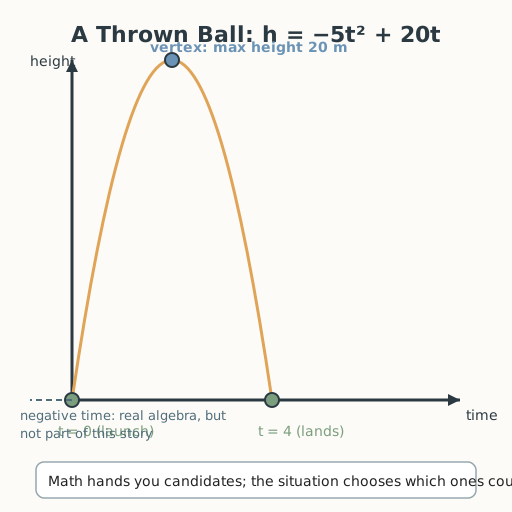
- Worked-example card · 1 per learner A ball's height h = −5t² + 20t, solved for when it lands, with the vertex found and both read in context
Low-tech / no-cost
- A shared board or large paper Sketch the parabola and mark the roots and vertex; learners copy by hand
- A tossed object (a stone or ball of paper) · 1 Throw it and watch the up-down arc that the quadratic models
Enriched / lab & device
- A graphing tool · 1 per learner Graph h = −5t² + 20t and read the landing time and maximum height off the curve
- A slow-motion video of a tossed object · 1 Watch the real arc and connect it to the parabola's shape
Works in different contexts
- large-group Solve the ball problem together, then pairs interpret the garden-area problem and share their reading
- multi-age Younger learners find when the ball lands (h = 0); older learners also find the maximum height and interpret negative-time roots
- self-directed A learner solves both situations, interprets each solution in a sentence, and self-checks by substitution
- level-grouped Learners ready to extend use the discriminant to predict how many real solutions a quadratic has before solving
- outdoor-only Toss a stone, time its flight, and model the height with a quadratic; discuss why the model is only approximate
Lesson 8 — Quadratic Solutions in Real Situations
Summary
Learners interpret quadratic solutions in real situations, reading the roots of a quadratic as the moments when something is zero (a ball lands, a rectangle has zero area), the vertex as a maximum or minimum, and learning that a mathematically real solution can still be meaningless in context — such as a negative time.
Objectives
- Solve quadratic equations using several methods and interpret what their solutions mean in real situations. (D05.S2.09.02)
Connection
Throw a ball straight up and watch it: it rises, slows, and falls. Its height is a quadratic function of time — an arch, not a line. Solve the equation “height = 0” and you get two answers: the moment it leaves your hand and the moment it lands. The highest point of the arch is the vertex. But not every answer the algebra gives you belongs to the story — a ball did not leave your hand at “negative five seconds.” Today you learn to read a quadratic’s answers back into real life and to know which answers matter.
Materials
- Interpretation sheet
- Worked-example card
Preparation
- Copy the interpretation sheet and worked-example card.
- Retrieval: from the last lesson, recall the three methods for solving a quadratic and the discriminant.
Facilitator note
This lesson is written to the learner (“you”). The skill to land: the roots of a quadratic are the input values where the output is zero (x-intercepts); the vertex is the maximum or minimum; and in context you must decide whether each solution is meaningful — a negative time, a negative length, or a length larger than the available space is real algebra but false in the story. Use a worked example first (S-011): a ball’s height h = −5t² + 20t (in meters, t in seconds). Set h = 0: −5t² + 20t = 0 → −5t(t − 4) = 0 → t = 0 (launch) or t = 4 (lands). The vertex is at t = 2, h = 20 m (maximum height). The critical-thinking lens: the context decides which solutions count — math gives candidates, the situation picks the winners. The ethics lens: reporting a “solution” that the situation rules out is the same over-claiming we met with precision — honesty means saying what the number can and cannot mean (philosophy §5). The environment lens: the same quadratic reasoning models a water jet or a rocket, and a model is always an approximation of a real, messy thing — name what the model leaves out (air resistance, wind). The egalitarian lens: reading a solution back into its story is a skill every learner can practice — it needs care, not special equipment. The global lens: a thrown ball, a water jet, and a garden plot arch the same parabola everywhere — the quadratic is one shape shared across every place that measures. The technology lens: a graphing tool draws the arch instantly, but the human must still decide which solutions the story accepts and which it rejects. Keep the tone: modeling is sense-making, not magic.
Procedure
- Recall (5 min). From the last lesson: how do you solve a quadratic by factoring? What does the discriminant tell you about how many real solutions there are?
- Study the worked example (12 min). A ball’s height (meters) after t seconds is h = −5t² + 20t. When does it land? Set h = 0: −5t(t − 4) = 0, so t = 0 or t = 4. It leaves at t = 0 and lands at t = 4 seconds. How high does it go? The vertex is halfway between the roots, at t = 2; h = −5(4) + 40 = 20 meters.
- Solve and interpret (15 min). On the interpretation sheet: (a) a garden plot has area A = x(10 − x), where x is the width in meters. For what widths is the area zero, and what do those roots mean (a plot with no area)? (b) What width gives the largest area, and what is that area?
- Meet the meaningless root (10 min). For the ball, solve h = −5t² + 20t when the ball is at height −5 m. You get real t values — but a negative height is impossible. State which solutions the story rules out and why.
- Peer-check (5 min). Swap. Did each solution get read back into the situation? Did you name any root that is real algebra but false in context?
- Close (5 min). Math hands you candidates; the situation chooses which ones count.
Differentiation
- Support: Provide the factored form already filled in and ask learners only to interpret the roots and vertex.
- Extension: Use the discriminant to predict, before solving, how many real solutions a new quadratic has, then verify by solving.
Assessment
- Formative (observation): Can the learner state what each root and the vertex mean in the ball-throwing situation, and name a root that the context rejects?
- Portfolio artifact: The completed interpretation sheet, kept in the portfolio.
Home connection
Toss a small object at home and time its flight. Write a rough quadratic model, solve for when it lands, and say what the model ignores (air resistance, your throw’s angle).
Resources
- On projectile motion as a quadratic model: OpenStax, College Physics / Algebra and Trigonometry (projectile motion and quadratics) — a standard, openly licensed reference (S-435).
- On explicit instruction and worked examples: Kirschner, Sweller & Clark (2006), https://doi.org/10.1207/s15326985ep4102_1 (S-011).