Lesson 07 — Quadratic Equations: Several Methods
Learners **solve quadratic equations by three connected methods** — factoring (with the zero-product property), square roots, and the quadratic formula — and learn when each is easiest. They meet the ancient origins of completing the square in Babylonian and al-Khwarizmi's geometric algebra, and see every solution checked by substitution.
Objectives
Objectives
- D05.S2.09.02 Solve quadratic equations using several methods and interpret what their solutions mean in real situations.
Essential question
How do I solve a quadratic equation by factoring, by square roots, and by the quadratic formula — and how are the methods connected?
Key vocabulary
Materials
Standard materials
- Methods sheet · 1 per learner A one-page map of three methods — factoring, square roots, quadratic formula — with when each is easiest
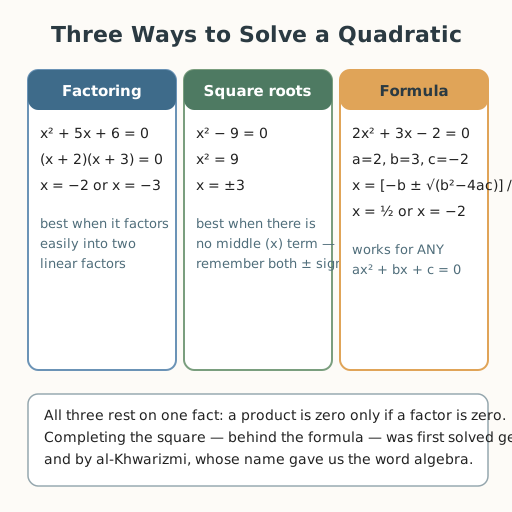
- Worked-example card · 1 per learner x² + 5x + 6 = 0 solved by factoring, x² − 9 = 0 by square roots, and 2x² + 3x − 2 = 0 by the quadratic formula, each fully shown
Low-tech / no-cost
- A shared board or large paper Model each method; learners copy the three worked examples by hand
- A square of paper or tiles Build a square-and-rectangle picture of completing the square to see it, not just memorize it
Enriched / lab & device
- A graphing tool or calculator · 1 per learner Graph each quadratic and see the solutions as where the parabola crosses the x-axis
- A short image of al-Khwarizmi's geometric completing the square · 1 A reproduction of the oldest known visual argument for completing the square
Works in different contexts
- large-group Model factoring and the formula once to the whole group, then pairs solve their own and choose the best method
- multi-age Younger learners solve x² = 16 by square roots; older learners complete the square and use the formula
- self-directed A learner studies the three worked examples, solves a mixed set, and self-checks by substituting each root back
- level-grouped Learners ready to extend derive the quadratic formula by completing the square on ax² + bx + c = 0
- outdoor-only Draw squares and rectangles in sand to build the completing-the-square picture, then solve a simple quadratic by it
Lesson 7 — Quadratic Equations: Several Methods
Summary
Learners solve quadratic equations by three connected methods — factoring (with the zero-product property), square roots, and the quadratic formula — and learn when each is easiest. They meet the ancient origins of completing the square in Babylonian and al-Khwarizmi’s geometric algebra, and see every solution checked by substitution.
Objectives
- Solve quadratic equations using several methods and interpret what their solutions mean in real situations. (D05.S2.09.02)
Connection
A quadratic equation asks: when does a square-shaped quantity plus a line-shaped quantity equal zero? That sounds abstract, but it appears the moment you throw a ball (height as a function of time) or design a rectangular plot (area as a function of side length). Different equations are easiest in different ways — some factor, some are ready for square roots, and some need a formula that works every time. Today you learn all three and how to choose.
Materials
- Methods sheet
- Worked-example card
Preparation
- Copy the methods sheet and worked-example card.
- Retrieval: from Grade 8, recall factoring and how squaring and square roots undo each other.
Facilitator note
This lesson is written to the learner (“you”). The skill to land: solve a quadratic by (1) factoring — set equal to zero, factor, and use the zero-product property (if a product is zero, at least one factor is zero); (2) square roots — isolate the squared term and take the square root of both sides, remembering both ± signs; (3) the quadratic formula — x = [−b ± √(b²−4ac)] / (2a), which works for any ax² + bx + c = 0. Use a worked example first, then guided practice (S-011). Model three: x² + 5x + 6 = 0 (factors to (x+2)(x+3) = 0, so x = −2 or −3); x² − 9 = 0 (square root: x = ±3); and 2x² + 3x − 2 = 0 (formula gives x = ½ or −2). The critical-thinking lens: the methods are one idea seen three ways — the square-root method and the formula both come from completing the square. The global lens: completing the square was solved geometrically by Babylonian scribes on clay tablets and by al-Khwarizmi, whose name for the move survives in our word algebra (S-429, S-431). The egalitarian lens: three methods mean three entry points — no learner is locked out because one path does not click; choose the tool that fits you. The ethics lens: checking every root by substitution is intellectual honesty — the method hands you candidates, and only the check makes them knowledge (philosophy §5). The technology lens: a calculator or spreadsheet can run the quadratic formula in an instant, but choosing the method and verifying the answer is the human’s judgment — the tool does the arithmetic, not the thinking. Check every root by substitution; that is what turns a formula into knowledge.
Procedure
- Recall (5 min). From Grade 8: what is factoring? What does √16 equal — and why are there two answers to x² = 16?
- Meet the three methods (10 min). Read the methods sheet. Factoring works when the quadratic factors nicely. Square roots works when there is no middle (x) term. The quadratic formula works always. All three rest on one fact: a product is zero only if a factor is zero.
- Study the worked examples (15 min). Trace each: Factoring — x² + 5x + 6 = 0 → (x+2)(x+3) = 0 → x = −2 or x = −3. Square roots — x² − 9 = 0 → x² = 9 → x = ±3. Formula — 2x² + 3x − 2 = 0, with a = 2, b = 3, c = −2 → x = [−3 ± √(9+16)] / 4 = [−3 ± 5] / 4 → x = ½ or x = −2. Check each answer by putting it back in.
- Guided practice (15 min). With a partner, solve x² − 16 = 0 (square roots), x² + 7x + 12 = 0 (factoring), and x² + 2x − 5 = 0 (formula). Choose the easiest method and justify your choice.
- Peer-check (5 min). Swap. Did each solution get checked by substitution? Did the square-root method keep both ± answers?
- Close (5 min). Three paths, one destination. Pick the tool that fits the equation — and the one that fits you.
Differentiation
- Support: Start with x² = 25 and x² = 49 (square roots only), then add factoring with a pre-factored pair.
- Extension: Derive the quadratic formula by completing the square on ax² + bx + c = 0.
Assessment
- Formative (observation): Can the learner solve one quadratic by each method and state which method fits which form?
- Portfolio artifact: The completed methods sheet with three checked solutions, kept in the portfolio.
Home connection
Solve x² = 144 in your head. Then write a quadratic that describes the area of a square room with a side of length x and area 100, and solve it two ways.
Resources
- On completing the square and the word algebra: Wikipedia, “Muhammad ibn Musa al-Khwarizmi,” https://en.wikipedia.org/wiki/Muhammad_ibn_Musa_al-Khwarizmi (S-431); Boyer & Merzbach, A History of Mathematics (S-429).
- On explicit instruction and worked examples: Kirschner, Sweller & Clark (2006), https://doi.org/10.1207/s15326985ep4102_1 (S-011).