Lesson 10 — Theorems: Lines, Angles, Triangles & Parallelograms
Learners **prove and apply theorems** about vertical angles, parallel lines cut by a transversal, the triangle-sum theorem, and parallelograms, building each proof in a clear two-column form. They connect these theorems to real structures and to the many traditions that proved them first.
Objectives
Objectives
- D05.S3.09.02 Prove and apply theorems about lines, angles, triangles, and parallelograms.
Essential question
How do I prove and apply theorems about vertical angles, parallel lines, triangles, and parallelograms?
Key vocabulary
Materials
Standard materials
- Theorems sheet · 1 per learner A one-page list of the theorems to prove and apply, with a blank two-column proof template
- Worked-example card · 1 per learner A proof that alternate interior angles are equal when a transversal crosses parallel lines, and the triangle-sum theorem
Low-tech / no-cost
- A shared board or large paper Draw the angle and triangle diagrams; learners copy and fill in the proof
- Sticks or straws · 3 per learner Form a triangle, tear its "corners," and see the three angles join to a straight line (180°)
Enriched / lab & device
- A dynamic geometry tool · 1 per learner Drag a triangle's vertices and watch the three angles always sum to 180°
- A short image of a truss bridge or roof · 1 A real structure built of triangles and parallelograms, to read through the theorems
Works in different contexts
- large-group Prove the angle theorems together on the board, then pairs prove a parallelogram property and share
- multi-age Younger learners tear a paper triangle to see 180°; older learners write the two-column proofs
- self-directed A learner works through the theorems, fills the proof template, and self-checks each step's reason
- level-grouped Learners ready to extend prove that opposite sides of a parallelogram are equal using alternate interior angles and a diagonal
- outdoor-only Find parallel lines and angles outdoors (fences, rooflines, bridges) and check the angle relationships by sight and rough measure
Lesson 10 — Theorems: Lines, Angles, Triangles & Parallelograms
Summary
Learners prove and apply theorems about vertical angles, parallel lines cut by a transversal, the triangle-sum theorem, and parallelograms, building each proof in a clear two-column form. They connect these theorems to real structures and to the many traditions that proved them first.
Objectives
- Prove and apply theorems about lines, angles, triangles, and parallelograms. (D05.S3.09.02)
Connection
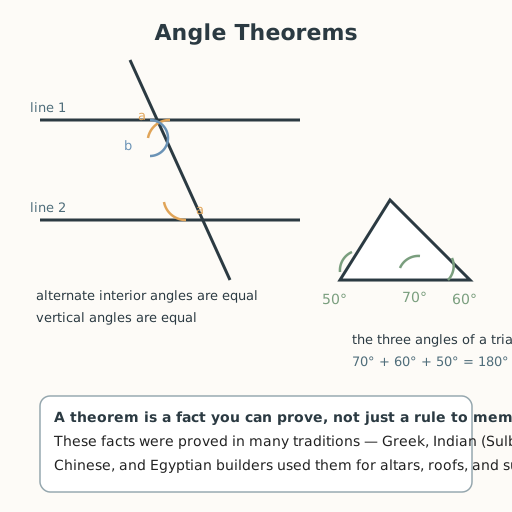
Look at a roof, a bridge, a fence, a ladder — they are made of lines, triangles, and parallelograms. Engineers trust those shapes because certain facts about them are always true: vertical angles are equal; when a line crosses two parallel lines, the angles match in predictable ways; the three angles of any triangle always add to 180°. A theorem is a fact that has been proved to be always true, from reasons you can check. Today you prove a few of the most useful ones yourself.
Materials
- Theorems sheet
- Worked-example card
Preparation
- Copy the theorems sheet and worked-example card.
- Retrieval: from Grade 8, recall angle relationships and the angle sum of a triangle.
Facilitator note
This lesson is written to the learner (“you”). The skill to land: prove and apply the key theorems — vertical angles are equal; when a transversal crosses parallel lines, alternate interior angles are equal; the three angles of a triangle sum to 180°; and (by a diagonal and congruent triangles) opposite sides of a parallelogram are equal. Use a worked example first, then guided practice (S-011): model a two-column proof that alternate interior angles are equal (using vertical angles and corresponding angles), then the triangle-sum theorem (using a line drawn parallel to one side). The critical-thinking lens: a theorem is not “what the book says” — it is a conclusion that follows from reasons, and anyone can check each step. The global lens: the angle-sum fact was known across traditions — Euclid’s Elements organized such proofs in the Greek world, while Indian Sulba Sutra texts, the Chinese Nine Chapters on the Mathematical Art, and Egyptian builders used the same geometry in altar-building and land surveying (S-429, S-434). The egalitarian lens: a proof is a shared, checkable argument that belongs to no one’s authority — “believe me” is replaced by “check this step.” The ethics lens: a theorem is true because it is proved, not because a person or a book says so — proof is how a claim earns our trust, and honesty means checking each step rather than accepting it (philosophy §5). The technology & environment lens: bridges, roofs, and towers are built on these proved facts — a truss or a frame holds because the theorems hold, and a structure that fails is a reminder of why proof matters for real lives and safe buildings. Emphasize the two-column format as scaffolding, not a cage; a proof can also be written as a clear paragraph.
Procedure
- Recall (5 min). From Grade 8: what are vertical angles? What do the three angles of a triangle add to?
- Meet a theorem (5 min). A theorem is a statement you can prove from reasons. A proof is a chain where every step has a reason. The two-column form puts statements on the left and reasons on the right.
- Study the worked example (15 min). Theorem: alternate interior angles are equal. Given two parallel lines and a transversal, mark a pair of alternate interior angles. Reason: corresponding angles are equal (from the parallel lines), and vertical angles are equal — so the alternate interior angles are equal. Theorem: triangle sum. Draw a line through one vertex parallel to the opposite side; the three angles of the triangle reassemble along that straight line, so they sum to 180°.
- Prove a parallelogram property (15 min). In a parallelogram, draw a diagonal. The diagonal makes two triangles. Using alternate interior angles (from the parallel sides) and the shared diagonal, show the two triangles are congruent, so opposite sides of a parallelogram are equal. Fill the two-column template.
- Apply the theorems (10 min). With a partner, use the theorems to find a missing angle in a drawn triangle and in a parallelogram, naming the theorem each time.
- Close (5 min). A theorem is a fact with a reason. Proof is what turns “it looks true” into “it must be true.”
Differentiation
- Support: Provide the diagram with the auxiliary line already drawn and the statement column pre-filled; learners supply the reasons.
- Extension: Prove the converse — if alternate interior angles are equal, the lines are parallel — and state it as a theorem.
Assessment
- Formative (observation): Can the learner complete a two-column proof that opposite sides of a parallelogram are equal, with a correct reason at each step?
- Portfolio artifact: One completed two-column proof, kept in the portfolio.
Home connection
Find a triangle or parallelogram in a structure near home (a roof truss, a gate, a bookshelf corner). Sketch it, label its angles, and use the theorems to find one missing angle.
Resources
- On the Sulba Sutras and early geometry: Wikipedia, “Shulba Sutras,” https://en.wikipedia.org/wiki/Shulba_Sutras (S-434).
- On the history of geometry and proof: Boyer & Merzbach, A History of Mathematics (S-429).
- On explicit instruction and worked examples: Kirschner, Sweller & Clark (2006), https://doi.org/10.1207/s15326985ep4102_1 (S-011).