Lesson 01 — Living Systems, Physical Systems & Our Origins: Where We've Been, Where We're Going
Learners retrieve the evidence-and-source discipline from Unit 1 and map it onto the three bodies of this unit — living systems, physical systems, and Earth, space, and origins. They preview the six objectives and commit to the rule that will govern the whole unit: evidence, then claim, with limits stated.
Objectives
Objectives
- D06.S1.09.01 Construct an evidence-based explanation that links data to a claim and states its limits and uncertainties.
- D06.S1.09.02 Critically evaluate a source of scientific information for reliability, bias, and conflicts of interest.
Essential question
How do we carry the evidence discipline from Unit 1 into the three great bodies of the natural world — living systems, physical systems, and our origins?
Key vocabulary
Materials
Standard materials
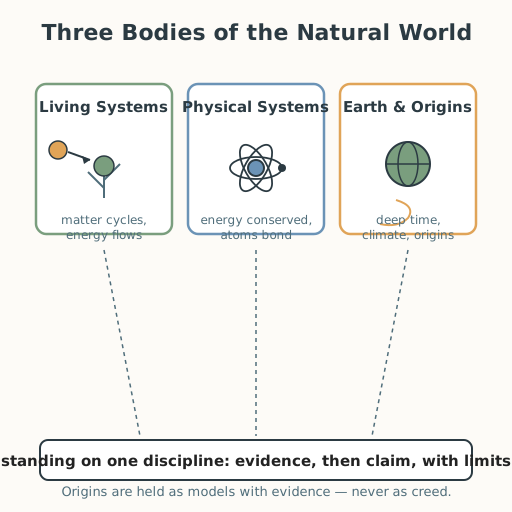
- Unit map sheet · 1 per learner A three-panel diagram (living / physical / Earth-and-origins) standing on a base labeled "the evidence discipline," to annotate
- Sticky notes or small cards · 6 per learner One for each of the unit's six objectives, to sort onto the map
Low-tech / no-cost
- A shared board or large paper Draw the three-panel map together and place the six ideas on it by discussion
- Voice and a partner Say each idea aloud and agree where it belongs before writing
Enriched / lab & device
- A digital mind-map or slide tool · 1 per group Build the unit map collaboratively and share it
- One or two real scientific sources from Unit 1 · 1 set Re-examine how they stated claims, limits, and who funded them
Works in different contexts
- large-group Draw the map once to the whole group, then small groups place the six ideas and report one each
- multi-age Younger learners place one idea with a partner; older learners explain how the evidence discipline applies to each
- self-directed A learner fills the map alone and writes one sentence for each idea naming the evidence it will need
- level-grouped Learners ready to extend draft one "claim → evidence → limit" sentence for an idea of their choice
- outdoor-only Build the map on the ground with sticks and stones, each pile a panel, and walk through the six ideas
Lesson 1 — Living Systems, Physical Systems & Our Origins: Where We’ve Been, Where We’re Going
Summary
Learners retrieve the evidence-and-source discipline from Unit 1 and map it onto the three bodies of this unit — living systems, physical systems, and Earth, space, and origins. They preview the six objectives and commit to the rule that will govern the whole unit: evidence, then claim, with limits stated.
Objectives
- Construct an evidence-based explanation that links data to a claim and states its limits and uncertainties. (D06.S1.09.01)
- Critically evaluate a source of scientific information for reliability, bias, and conflicts of interest. (D06.S1.09.02)
Connection
You already know how a good answer to a hard question is built. In Unit 1 you learned to look at the data, state what you can honestly claim from it, and say where the claim runs out — and to ask who is telling you, why, and who paid for it. That same discipline now has a bigger job. This unit asks three of the biggest questions science holds: how living things fit together, how matter and energy behave, and where we — and everything else — came from. The method does not change; the questions just get deeper.
Materials
- Unit map sheet
- Sticky notes or small cards
Preparation
- Copy the unit map sheet (or draw the three panels on a shared board).
- Retrieval: from Unit 1 (U.09.001), recall what made an explanation evidence-based (data → claim → limits) and what made a source trustworthy (reliability, bias, conflict of interest).
- From Grade 8, recall the systems you met: cells, genes, ecosystems, atoms, energy, stars, and plate tectonics.
Facilitator note
This lesson is written to the learner (“you”). Its job is retrieval and framing, not new content. The rule to land, in the learner’s own words: an evidence-based explanation links data to a claim and states its limits and uncertainties (S1.09.01), and a source is judged for reliability, bias, and conflicts of interest (S1.09.02). Use a worked example first (S-011): recall a claim from Unit 1 and ask what data backed it and what limit it admitted. The critical-thinking lens is the spine: the discipline is the same whether the object is a forest, an atom, or the age of the cosmos. The ethics lens: stating limits is honesty — pretending certainty where there is none is a small falsehood, and in science that falsehood has consequences. The egalitarian lens: asking “who funded this, and who benefits?” is how we keep knowledge from being captured by the powerful. The global lens: this discipline is not one nation’s invention — careful observation, measurement, and honest reporting belong to every people; astronomy, medicine, and natural history grew in many places at once. Keep origins explicitly open: we will meet accounts of beginnings as models with evidence, never creed (philosophy §11). Cite the source-evaluation practice from Unit 1; no new factual claim needs a new citation here.
Procedure
- Recall (8 min). From Unit 1: what two moves make an explanation evidence-based? (Name the data, state the claim, say the limit.) And what three questions do you ask of a source? (Reliable? Biased? Who pays for it?)
- Meet the map (10 min). Look at the unit map: three panels — living systems, physical systems, and Earth & origins — all standing on one base: the evidence discipline.
- Place the six ideas (15 min). Here are the six objectives of the unit, in plain words. Sort
each onto the panel where it belongs:
- “Matter cycles and energy flows through ecosystems; disruptions change carrying capacity.”
- “Biodiversity matters for resilient ecosystems and human well-being.”
- “Energy is conserved but transformed, with efficiency; atoms bond and reactions move energy.”
- “The structure of the atom explains bonding and chemical energy.”
- “Greenhouse gases regulate climate, and human activity is changing it.”
- “Evidence lets us measure the age of the Earth and the universe.”
- Commit to the rule (10 min). Write one sentence completing this frame: “In this unit, I will not accept a claim unless I can see ___, and I will always ask ___ about a source.”
- Close (7 min). These are big questions. The method is small and sturdy: evidence, then claim, with limits — and wonder kept open the whole way.
Differentiation
- Support: Provide the six ideas pre-written on cards and a labeled map; the learner matches them.
- Extension: Draft a full “claim → evidence → limit” sentence for one of the six ideas, using prior knowledge from Grade 8.
Assessment
- Formative (observation): Can the learner restate, in their own words, what makes an explanation evidence-based and what makes a source trustworthy?
- Self (portfolio): The completed “I will not accept a claim unless…” sentence, kept in the portfolio as the unit’s opening artifact.
Home connection
Ask an adult at home: “How do you decide whether to believe a claim you read?” Listen for the three source questions — and share the evidence discipline you will use all unit.
Resources
- On explicit instruction and worked examples: Kirschner, Sweller & Clark (2006), https://doi.org/10.1207/s15326985ep4102_1 (S-011).
- On the evidence discipline practiced in Unit 1: see U.09.001, Lessons 1–4 (D06.S1.09.01, D06.S1.09.02).