Lesson 02 — Matter Cycles and Energy Flows Through Ecosystems
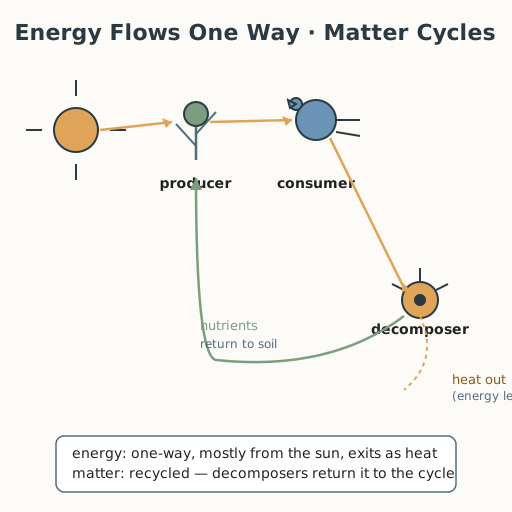
Learners explain the two great movements of an ecosystem: **matter cycles** — atoms are reused over and over — and **energy flows** — it enters from the sun and leaves as heat, one way. They trace one atom and one packet of energy through producers, consumers, and decomposers.
Objectives
Objectives
- D06.S2.09.01 Explain how matter cycles and energy flows through ecosystems, and how disruptions affect carrying capacity.
Essential question
How does matter cycle and energy flow through ecosystems, and what keeps them in balance?
Key vocabulary
Materials
Standard materials
- Matter-and-energy diagram sheet · 1 per learner A blank diagram (sun, producer, consumer, decomposer, soil) to draw the two arrows — one-way energy and looping matter — onto
- Arrow cards · 2 per group One "energy" arrow (one-way) and one "matter" arrow (loop) to place on a shared diagram
Low-tech / no-cost
- A shared board or large paper Draw the sun → producer → consumer → decomposer diagram together with two colors of chalk or pencil
- Voice and a partner Trace the path of one atom of carbon and one packet of energy aloud, step by step
Enriched / lab & device
- A simple ecosystem simulation or food-web app · 1 per group Watch energy move up levels and matter recycle, and see how much is lost as heat at each step
- A small sealed terrarium or compost jar · 1 Observe, over days, matter recycled by decomposers while energy passes through once
Works in different contexts
- large-group Build the diagram once to the whole group, then pairs trace one atom and one packet of energy and report
- multi-age Younger learners name the four roles; older learners explain why energy is one-way but matter loops
- self-directed A learner draws both arrows and writes two sentences — one for energy, one for matter
- level-grouped Learners ready to extend estimate why only about 10% of energy moves up each level and where the rest goes
- outdoor-only Find a patch of living things outdoors — a log, a pond edge, a field — and trace matter and energy through what you see
Lesson 2 — Matter Cycles and Energy Flows Through Ecosystems
Summary
Learners explain the two great movements of an ecosystem: matter cycles — atoms are reused over and over — and energy flows — it enters from the sun and leaves as heat, one way. They trace one atom and one packet of energy through producers, consumers, and decomposers.
Objectives
- Explain how matter cycles and energy flows through ecosystems, and how disruptions affect carrying capacity. (D06.S2.09.01)
Connection
Think of a loaf of bread. Its atoms — carbon, hydrogen, oxygen — once lived in a wheat plant, which grew them from air, water, and soil. When you eat it, those atoms become part of you, and later they return to the air and soil, where another plant will use them again. The atoms are recycled, like coins handed around a market forever. But the energy in that bread had a one-way ticket: it came from the sun, and after it does its work, it leaves as heat. Ecosystems run on this pair — matter in circles, energy in a one-way stream.
Materials
- Matter-and-energy diagram sheet
- Arrow cards
Preparation
- Copy the diagram sheet and arrow cards.
- Retrieval: from Grade 6, recall that energy flows and matter (carbon, water) cycles through an ecosystem; from Grade 8, recall producers, consumers, and decomposers and the food web.
Facilitator note
This lesson is written to the learner (“you”). The two ideas to land, and not to conflate: (1) energy flows one way — it enters mostly as sunlight, moves through producers, consumers, and decomposers, and leaves as heat, never returning; (2) matter cycles — the atoms of carbon, nitrogen, and water are reused, returned by decomposers and by respiration, and taken up again. Use a worked example first (S-011): trace a single carbon atom through air → plant (photosynthesis) → animal (eaten) → soil (decomposed) → air again, then trace one packet of energy through the same path and show it leaving as heat. The critical-thinking lens: “flow” and “cycle” are different ideas; confusing them is the most common ecosystem mistake, so insist on the two-arrow diagram. The environment lens: because energy is always lost as heat, every level up a food chain holds less energy — which is why there are more plants than plant-eaters, more prey than predators, and why most human food comes from low on the chain. The egalitarian lens: that same energy arithmetic is why feeding people with grain goes further than feeding grain to animals and then eating the animals — a question of how a shared Earth feeds everyone, not just some. The global lens: this one rule operates identically in a rice paddy, a savanna, a kelp forest, and a coral reef — every ecosystem on Earth moves energy and cycles matter the same way (S-244). Cite the ecosystem energy-flow source (S-244) and the carbon-cycle source (S-253); the ~10% transfer figure is the standard ecological rule of thumb, stated as approximate.
Procedure
- Recall (5 min). From Grade 6 and 8: what do producers, consumers, and decomposers each do? Which direction does energy move?
- Meet the two movements (10 min). Energy flows one way: sunlight in, heat out. Matter cycles: atoms are reused. Draw the two arrows on the diagram sheet — a straight-through arrow for energy, a loop for matter.
- Trace one atom (12 min). Worked example: a carbon atom moves from air into a plant by photosynthesis, into an animal that eats it, into the soil by decomposition, and back into the air by respiration. Draw this loop.
- Trace one packet of energy (12 min). The same path, but energy enters as sunlight, powers each step, and leaves as heat at every step. It does not loop back. Label where the heat leaves.
- Check the pairing (8 min). Swap diagrams with a partner. Does the energy arrow go one way only? Does the matter arrow form a closed loop?
- Close (8 min). Write one sentence each: “Matter ___. Energy ___.” Keep the pair straight — it is the key to every ecosystem you will ever meet.
Differentiation
- Support: Provide the diagram with the roles already placed; the learner draws only the two arrows (one-way energy, looping matter) and labels them.
- Extension: Explain, using the one-way loss of energy as heat, why each level of a food chain holds only about a tenth of the energy below it.
Assessment
- Formative (observation): Can the learner state that energy flows one way (and leaves as heat) while matter cycles, and draw both arrows correctly?
- Portfolio artifact: The completed matter-and-energy diagram, kept in the portfolio.
Home connection
At a meal, ask: which parts of this food were built from recycled atoms (all of them), and where did its energy come from (the sun, through plants)? Trace one atom’s path aloud.
Resources
- On energy and matter in ecosystems (food chains, webs, producers–consumers–decomposers): BBC Bitesize (KS3), “Ecosystems and habitats: food chains and webs,” https://www.bbc.co.uk/bitesize/topics/zxhhvcw/articles/zjh4r2p (S-244).
- On the carbon cycle: National Geographic Education, “The Carbon Cycle,” https://education.nationalgeographic.org/resource/carbon-cycle/ (S-253).
- On explicit instruction and worked examples: Kirschner, Sweller & Clark (2006), https://doi.org/10.1207/s15326985ep4102_1 (S-011).