Lesson 08 — The Age of the Earth and the Universe: How We Measure Deep Time
Learners explain the **evidence for the age of the Earth (~4.54 billion years) and the universe (~13.8 billion years)** and how scientists measure it: **radioactive decay** clocks the Earth and meteorites, while the **expansion of galaxies** and the **cosmic microwave background** clock the universe. They treat these as measurements with stated uncertainty — models, not dogma.
Objectives
Objectives
- D06.S4.09.02 Explain the evidence for the age of the Earth and the universe and how scientists measure it.
Essential question
What is the evidence for the age of the Earth and the universe, and how do scientists measure it?
Key vocabulary
Materials
Standard materials
- Deep-time timeline sheet · 1 per learner Two timelines — Earth (~4.54 billion years) and the universe (~13.8 billion years) — to mark key events on
- Measurement-method cards · 1 set per group Cards for radioactive decay, oldest rocks and meteorites, galaxy redshifts, and the cosmic microwave background, to sort onto the two timelines
Low-tech / no-cost
- A shared board or large paper Draw the two timelines to scale and place the events by discussion
- Voice and a partner Explain each measurement method in one plain sentence, then teach it back to your partner
Enriched / lab & device
- A deep-time scale model (a rolled strip of paper or a walking timeline) · 1 per group Unroll 13.8 meters (or paces) to feel how recently humans appear
- Images of the cosmic microwave background and of dated rocks or meteorites · 1 set Connect each measurement to the object that carries it
Works in different contexts
- large-group Model one timeline and one method to the whole group, then groups sort the remaining cards and report
- multi-age Younger learners place events in order; older learners explain how each measurement method works and its uncertainty
- self-directed A learner marks both timelines, sorts the methods, and writes one sentence on how each measurement is made and its limits
- level-grouped Learners ready to extend explain what "half-life" means and why a steady decay rate acts as a clock
- outdoor-only Lay a rope or paced line for deep time, placing events at their correct scaled positions, and walk from the Big Bang to today
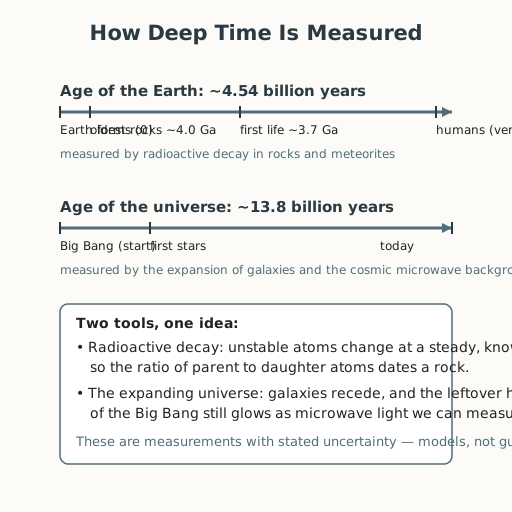
Lesson 8 — The Age of the Earth and the Universe: How We Measure Deep Time
Summary
Learners explain the evidence for the age of the Earth (~4.54 billion years) and the universe (~13.8 billion years) and how scientists measure it: radioactive decay clocks the Earth and meteorites, while the expansion of galaxies and the cosmic microwave background clock the universe. They treat these as measurements with stated uncertainty — models, not dogma.
Objectives
- Explain the evidence for the age of the Earth and the universe and how scientists measure it. (D06.S4.09.02)
Connection
How do you know how old a person is? You count the years since a date someone recorded. But the Earth and the universe were here long before any record, so we need a different kind of clock — one built into matter itself. Some atoms are unstable and change into other atoms at a steady, known rate; like an hourglass, the ratio of what has changed to what has not tells us how long it has been running. And the universe carries its own clock: the galaxies are still moving apart from a hot beginning, and the leftover glow of that beginning still reaches us. Two clocks, one story of deep time.
Materials
- Deep-time timeline sheet
- Measurement-method cards
Preparation
- Copy the timeline sheet and method cards.
- Retrieval: from Grade 8, recall the life cycle of stars and plate tectonics; from Grade 7, recall that fossils, rock layers, and ice cores tell deep time.
Facilitator note
This lesson is written to the learner (“you”). The ideas to land: the Earth is ~4.54 billion years old, dated by the radioactive decay of isotopes in the oldest Earth rocks and, most precisely, in meteorites (S-308); the universe is ~13.8 billion years old, measured from the expansion of galaxies and the cosmic microwave background — the leftover heat of the Big Bang (S-002). Use a worked example first (S-011): explain radioactive decay as a steady clock — a parent isotope changes into a daughter isotope at a fixed rate (its half-life), so measuring the ratio dates the rock. The critical-thinking lens is central: these are measurements with uncertainty, not revealed facts — the Earth’s age carries a stated uncertainty (about ±1%), and the numbers are revised when better data appear, which is exactly how science stays honest (S-308). The global lens: deep time is not one culture’s story — astronomers and geologists from many nations built these measurements, and many peoples have long held that the world is far older than human memory. The ethics lens: treating a measurement as a model with limits, and not overclaiming, is an act of intellectual honesty — the same honesty we ask of every claim. Hold origins explicitly open: the Big Bang and deep time are models with evidence, never creed (philosophy §11); they answer “how old,” not “why we are here” — that question belongs to the next lesson. Cite USGS (S-308) and NASA (S-002, S-361); keep all numbers hedged with “about.”
Procedure
- Recall (5 min). From Grade 7 and 8: what clues about deep time have you already met — fossils, rock layers, ice cores, stars?
- Meet the two ages (8 min). The Earth is about 4.54 billion years old; the universe is about 13.8 billion years old. Place both on the timeline sheet.
- Clock the Earth (12 min). Worked example: radioactive decay. An unstable parent atom changes into a stable daughter atom at a steady rate (its half-life). The ratio of parent to daughter in a rock — and in meteorites that date the solar system — tells the age. Mark oldest rocks (~4.0 billion years) and first life (~3.7 billion years).
- Clock the universe (12 min). Two lines of evidence: galaxies are receding, and the cosmic microwave background — faint microwave glow in every direction — is the cooled leftover heat of a hot beginning. Mark the Big Bang and the first stars on the timeline.
- Sort the methods (8 min). Place each method card on the correct timeline, and write one plain sentence for each: what is measured, and how.
- Close (10 min). These ages are not guesses and not creeds — they are measurements with stated uncertainty, open to revision, and they put human history in its humbling place.
Differentiation
- Support: Provide the timelines pre-drawn with events in order; the learner only matches each event to its age label.
- Extension: Explain what a half-life is using a coin-flip analogy, and why a steady decay rate makes a reliable clock.
Assessment
- Formative (observation): Can the learner state the approximate ages of the Earth and the universe and name one measurement method for each, with its uncertainty?
- Portfolio artifact: The two completed timelines with method cards placed, kept in the portfolio.
Home connection
Count how many generations back your family story reaches — a few hundred years, maybe. Compare that to 4.54 billion: ask what “deep time” does to your sense of a human lifetime.
Resources
- On the age of the Earth and radioactive dating: USGS, “Geologic Time: Age of the Earth,” https://pubs.usgs.gov/gip/geotime/age.html (S-308).
- On the Big Bang, the cosmic microwave background, and the age of the universe: NASA, “The Big Bang,” https://science.nasa.gov/universe/the-big-bang/ (S-002).
- On stars and the formation of elements: NASA, “Stars,” https://science.nasa.gov/universe/stars/ (S-361).
- On explicit instruction and worked examples: Kirschner, Sweller & Clark (2006), https://doi.org/10.1207/s15326985ep4102_1 (S-011).