Lesson 07 — Greenhouse Gases and a Changing Climate
Learners explain the **greenhouse effect** — how certain gases let sunlight in but trap some outgoing heat, keeping Earth livable — and how **human activity** (burning fossil fuels, clearing forests, agriculture) has strengthened it, changing the climate system. They separate the natural effect from the human addition.
Objectives
Objectives
- D06.S4.09.01 Explain how greenhouse gases regulate climate and how human activity is changing the climate system.
Essential question
How do greenhouse gases regulate climate, and how is human activity changing the climate system?
Key vocabulary
Materials
Standard materials
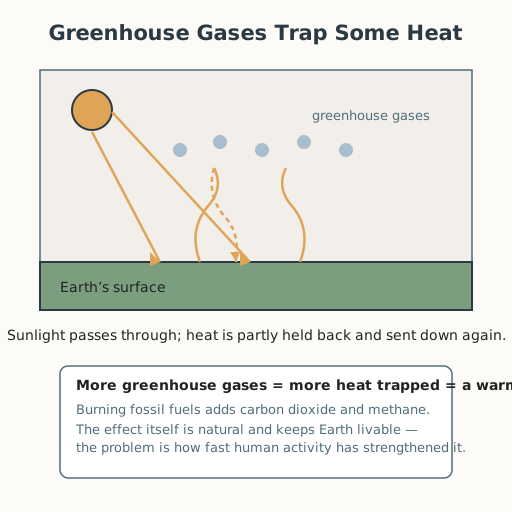
- Greenhouse-effect diagram sheet · 1 per learner A diagram of sunlight in, heat out, and the greenhouse-gas layer, to label the incoming and trapped arrows
- Human-activity card set · 1 set per group Cards for activities (burning coal and oil, clearing forest, rice and livestock, industry) to link each to the gas it adds
Low-tech / no-cost
- A shared board or large paper Draw the greenhouse-effect diagram together, marking the trapped heat with a different color
- Voice and a partner Explain the effect in your own words — what comes in, what goes out, what is held back
Enriched / lab & device
- A real greenhouse-gas dataset or interactive (a CO₂ curve or a climate dashboard) · 1 per group Read the rising carbon dioxide record and connect it to the mechanism
- A short, carefully chosen clip on the greenhouse effect and human emissions · 1 Trace the mechanism from mechanism to measurement
Works in different contexts
- large-group Model the mechanism once to the whole group, then groups link activities to gases and report
- multi-age Younger learners name the gases and where they come from; older learners explain the mechanism and the human signal in the record
- self-directed A learner labels the diagram, links activities to gases, and writes a paragraph distinguishing the natural effect from the human strengthening of it
- level-grouped Learners ready to extend explain why the recent rise is attributed to human activity rather than natural variation
- outdoor-only Notice how the ground and air warm in sun and cool at night, and model with your body how a blanket traps heat the way greenhouse gases do
Lesson 7 — Greenhouse Gases and a Changing Climate
Summary
Learners explain the greenhouse effect — how certain gases let sunlight in but trap some outgoing heat, keeping Earth livable — and how human activity (burning fossil fuels, clearing forests, agriculture) has strengthened it, changing the climate system. They separate the natural effect from the human addition.
Objectives
- Explain how greenhouse gases regulate climate and how human activity is changing the climate system. (D06.S4.09.01)
Connection
A blanket does not make heat; it holds in the heat your body already makes. Earth’s atmosphere wears a thin blanket of greenhouse gases — carbon dioxide, methane, water vapor — that lets sunlight in but holds some of the heat the ground gives back, keeping our planet warm enough for life. The blanket itself is good; without it, Earth would be a frozen rock. The problem is not the blanket but its thickness: by burning coal, oil, and gas and clearing forests, humans have been adding to it, faster than the Earth can keep its usual balance.
Materials
- Greenhouse-effect diagram sheet
- Human-activity card set
Preparation
- Copy the diagram sheet and card set.
- Retrieval: from Unit 1 (U.09.001), recall the climate data you examined; from Lesson 6, recall that burning carbon-based fuel releases energy and carbon dioxide.
Facilitator note
This lesson is written to the learner (“you”). The idea to land, precisely: the greenhouse effect is natural and essential — sunlight (shortwave) passes through the atmosphere and warms the surface; the surface re-radiates heat (infrared), and greenhouse gases absorb some of that outgoing heat and send part of it back, keeping Earth warmer than it would otherwise be. Human activity — chiefly burning fossil fuels, which adds carbon dioxide, and agriculture and waste, which add methane — has strengthened this effect, and the measured rise in greenhouse gases and warming is the observed result. Use a worked example first (S-011): trace the incoming and outgoing arrows on the diagram. The environment lens: this is the mechanism behind the climate change learners met in Unit 1, now understood physically (S-005, S-438). The ethics lens: knowing the cause carries responsibility — the question is no longer whether we are changing the climate but what we owe each other as it changes. The egalitarian lens: the people who have burned the least fossil fuel are often the most exposed to the harm, so the climate is a fairness problem, not only a physical one (S-005; also D10 environmental-justice lessons later this year). The global lens: the atmosphere is shared by every nation and has no border — emissions anywhere warm the whole planet, which is why it is a genuinely global question (S-005). Cite IPCC (S-005) and NASA Climate Kids (S-438); distinguish the mechanism (fact, well-evidenced) from what we ought to do about it (a values question, held open).
Procedure
- Recall (5 min). From Unit 1: what did the climate data show? From Lesson 6: what does burning fuel release, besides energy?
- Meet the mechanism (12 min). Sunlight comes in and warms the surface. The warm surface radiates heat back out. Greenhouse gases let sunlight through but absorb some outgoing heat and send part of it back down. Label the arrows on the sheet: incoming light, outgoing heat, trapped heat.
- Name the gases (8 min). Carbon dioxide (burning coal, oil, gas; clearing and burning forests), methane (livestock, rice fields, leaks), and water vapor (which rises with warming). List them on the sheet.
- Link activity to gas (12 min). Sort the card set: match each human activity to the gas it adds. Which single activity adds the most carbon dioxide?
- Separate natural from human (10 min). Write two sentences: “The greenhouse effect is natural because ___. It is being strengthened by human activity because ___.”
- Close (8 min). The blanket is not the enemy; the rate at which we have thickened it is the challenge — and it is one we have the tools to meet.
Differentiation
- Support: Provide the diagram with the arrows already drawn; the learner only labels which arrows are sunlight, heat out, and trapped heat.
- Extension: Explain, using the carbon cycle, why the recent rise in carbon dioxide cannot be explained by volcanoes or other natural sources alone.
Assessment
- Formative (observation): Can the learner explain the greenhouse mechanism and name one human activity that strengthens it, and one gas that activity adds?
- Portfolio artifact: The labeled diagram with the two “natural vs. human” sentences, kept in the portfolio.
Home connection
At home, find one thing that burns fuel or gas — a stove, a car, a heater — and one thing that pulls carbon dioxide back out of the air (a plant, a tree). Name both sides of the balance.
Resources
- On the greenhouse effect and human greenhouse-gas sources: NASA Climate Kids, “What Is the Greenhouse Effect?”, https://climatekids.nasa.gov/greenhouse-effect/ (S-438).
- On the climate system and human influence: Intergovernmental Panel on Climate Change, https://www.ipcc.ch/ (S-005).
- On explicit instruction and worked examples: Kirschner, Sweller & Clark (2006), https://doi.org/10.1207/s15326985ep4102_1 (S-011).