Lesson 01 — The Long Story, Told from Many Voices
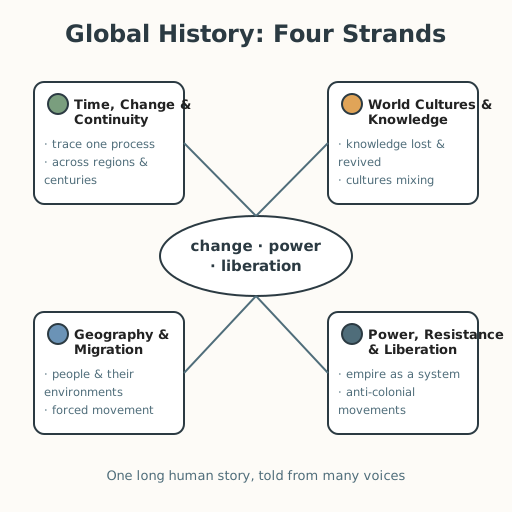
Learners recall four Grade-8 ideas — trade networks, colonization, slavery, and resistance — and preview this unit's four strands and seven goals. They meet the unit's organizing idea: global history traces **change and continuity** across regions and centuries, told from **many voices**, never as a single nation's triumph.
Objectives
Objectives
- D08.S1.09.01 Analyze continuity and change in one global process, such as long-distance trade or the growth of cities, across several regions and centuries.
Essential question
What does it mean to tell one long, global human story from many voices — and where are we going in this unit?
Key vocabulary
Materials
Standard materials
- Unit map sheet · 1 per learner A one-page map of the unit's four strands and seven goals, to mark and return to across the unit
- Recall cards · 1 set per group Cards recalling Grade-8 ideas — trade networks, colonization, slavery, and resistance
Low-tech / no-cost
- A shared board or large paper Draw the four strands and seven goals together; no printed map needed
- Voice and memory Recall the Grade-8 ideas aloud as a group instead of using cards
Enriched / lab & device
- A digital slideshow of the four strands · 1 One image or map per strand to preview each
- A wonder box (physical or shared document) · 1 A place to collect every learner's questions about the unit to revisit at the close
Works in different contexts
- large-group Do the recall round as a whole group with ideas recorded on the board, then small groups sort the recall cards
- multi-age Younger learners match each recall idea to a picture; older learners state each idea in one sentence and connect it to the new unit
- self-directed A learner reads the unit map, writes three sentences recalling the Grade-8 ideas, and lists one question per strand
- level-grouped Learners ready to extend add a fourth Grade-8 idea not on the cards and explain why it matters here
- outdoor-only Look at the place around you — a road, a field, a river — and ask what has changed there over generations and what has stayed
Lesson 1 — The Long Story, Told from Many Voices
Summary
Learners recall four Grade-8 ideas — long-distance trade networks, colonization, slavery, and resistance — and preview this unit’s four strands and seven goals. They meet the unit’s organizing idea: global history traces change and continuity across regions and centuries, and it is told from many voices — never as a single nation’s triumph.
Objectives
- Begin to name what a continuity-and-change analysis of one global process looks like — the unit’s first goal. (D08.S1.09.01)
Connection
Think of anything that has been around longer than you have — a road, a river, a language, a family custom, a market. Some things about it have changed, and some have stayed the same. History is the careful study of exactly that: what changes, what endures, and whose voices get to tell the story. Today we remember what we already know how to do and see where it is taking us.
Materials
- Unit map sheet
- Recall cards
Preparation
- Copy the unit map sheet and recall cards.
- Retrieval: from Grade 8, recall (a) long-distance trade networks, (b) colonization, (c) slavery, and (d) resistance. Today we link those to the new unit.
Facilitator note
This lesson is written to the learner (“you”). It is the unit’s opening and retrieval pass, so the goals are modest: (1) recall four Grade-8 ideas — trade networks (S-323), colonization (S-326), slavery and the transatlantic trade (S-322, S-274), and resistance; (2) preview the unit’s four strands — time/change/continuity, world cultures & knowledge traditions, geography & migration, power/resistance/liberation — and its seven goals; (3) plant the organizing idea: global history traces change and continuity and is told from many voices. Do not try to teach the seven goals today; just name and locate them. The global lens: the same human story looks different depending on whose records, songs, and memories we read — so we hold many side by side. The egalitarian lens: whose voices have been left out of the textbooks, and whose have been centered? The ethics lens: telling history honestly means naming harm and giving credit accurately, not glorifying one nation. The critical-thinking lens: “change and continuity” is the analytic habit we carry forward all unit. Keep questions open: history is offered as questions and competing accounts, not a single revealed story (philosophy §11). Spacing note (S-039): this recall pass is what makes the unit’s ideas stick later.
Procedure
- Recall (10 min). In a small group, look at four recall cards: trade networks, colonization, slavery, resistance. For each, say in one sentence what you remember from Grade 8.
- Connect the four (5 min). What do all four have in common? (Each is about how people, goods, ideas, and power move across the world — and about who gains and who is harmed.)
- Meet the map (10 min). Look at the unit map. Four strands: time, change & continuity; world cultures & knowledge traditions; geography & migration; power, resistance & liberation. Seven goals across them. Read each goal aloud once; don’t worry about understanding them yet.
- Plant the big idea (10 min). The unit’s idea in one breath: global history traces change and continuity — what shifts and what endures — across regions and centuries, and it is told from many voices, never as one nation’s triumph. Say it back in your own words.
- Wonder (10 min). Write one question about each strand in the wonder box. Which question do you most want answered by the end of the unit?
- Close (5 min). Today we remembered what we know and saw the road ahead. Next: we trace one global process — long-distance trade — across centuries.
Differentiation
- Support: Give sentence starters for the recall round (“A trade network is…”).
- Extension: Add a fourth Grade-8 idea of your own and say why it will matter in this unit.
Assessment
- Formative (observation): Can the learner recall each Grade-8 idea in one sentence and name the unit’s four strands?
- Artifact: The completed unit map (or the learner’s written recall), kept in the portfolio.
Home connection
Ask someone at home: what is one thing in our family or community that has changed over the generations, and one thing that has stayed the same? Bring both to the next lesson.
Resources
- On long-distance trade (Silk Roads and Indian Ocean): Encyclopaedia Britannica, https://www.britannica.com/topic/Silk-Road-trade-route (S-323).
- On Western colonialism: Encyclopaedia Britannica, https://www.britannica.com/topic/colonialism (S-326).
- On the transatlantic slave trade: Trans-Atlantic Slave Trade Database, https://www.slavevoyages.org/ (S-322); UNESCO Routes of Enslaved Peoples, https://www.unesco.org/en/routes-enslaved-peoples (S-274).
- On spaced retrieval: Dunlosky et al. (2013), https://doi.org/10.1177/1529100612453266 (S-039).