Lesson 02 — Continuity & Change: Long-Distance Trade
Learners analyze **continuity and change** in one global process — long-distance trade — across three networks and many centuries: the Silk Roads, the Indian Ocean, and the trans-Saharan routes. They learn the skill of a continuity-and-change analysis through a worked example and guided practice.
Objectives
Objectives
- D08.S1.09.01 Analyze continuity and change in one global process, such as long-distance trade or the growth of cities, across several regions and centuries.
Essential question
How did one global process — long-distance trade — change and stay the same across regions and centuries?
Key vocabulary
Materials
Standard materials
- Continuity-and-change sheet · 1 per learner A two-column sheet — "what stayed the same" on the left, "what changed" on the right
- Trade-network cards · 1 set per group Cards naming three networks — Silk Roads, Indian Ocean, trans-Saharan — and their goods and ideas
Low-tech / no-cost
- A shared board or large paper Draw three columns for the three networks and fill them together
- Voice and retelling Tell the three networks aloud and have learners retell what moved along each
Enriched / lab & device
- An atlas or digital world map · 1 To trace the three routes and locate the regions they linked
- A short documentary clip on one trade network · 1 Age-appropriate, to watch and then retell
Works in different contexts
- large-group Introduce the three networks to the whole group, then small groups sort the cards into continuity and change
- multi-age Younger learners match each good to its network; older learners state one continuity and one change with evidence
- self-directed A learner reads about the three networks, fills the sheet, and writes one sentence on what changed and one on what stayed the same
- level-grouped Learners ready to extend trace one good (silk, gold, or paper) across two networks and describe how its meaning shifted
- outdoor-only Trace a local trade route — a road, a river, a market path — and ask what has moved along it and how that has changed
Lesson 2 — Continuity & Change: Long-Distance Trade
Summary
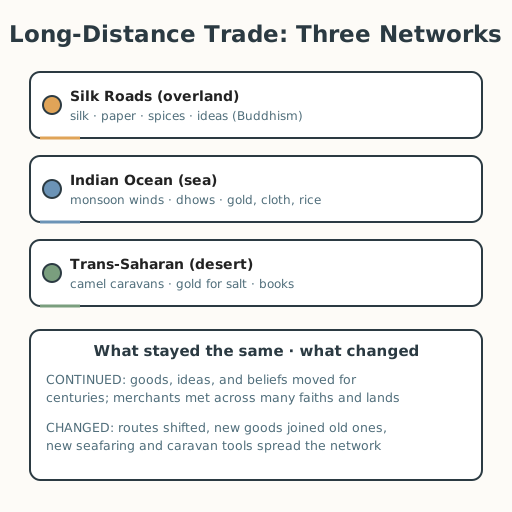
Learners analyze continuity and change in one global process — long-distance trade — across three networks and many centuries: the overland Silk Roads, the monsoon-driven Indian Ocean, and the trans-Saharan routes. They learn the skill of a continuity-and-change analysis through a worked example and guided practice.
Objectives
- Analyze continuity and change in long-distance trade across several regions and centuries, naming what stayed the same and what changed. (D08.S1.09.01)
Connection
Picture a market near you — or one you have seen in a story or film. Some things about it have not changed for a very long time: people still come to trade, and what one person has is what another needs. Other things have changed completely: the goods, the money, the speed. A market is a doorway into the oldest continuous human process on Earth: trade. Today we trace how that process has stayed the same and changed across regions and centuries.
Materials
- Continuity-and-change sheet
- Trade-network cards
Preparation
- Copy the sheet and the cards.
- Retrieval: from Lesson 1, recall the unit’s organizing idea (change and continuity, many voices). Today we apply it to trade.
Facilitator note
This lesson is written to the learner (“you”). The idea to land: a continuity-and-change analysis names two things at once — what stayed the same over time (the goods and ideas that kept moving; the fact that trade connected strangers across faiths and lands) and what changed (the routes shifted, new goods joined old ones, and new tools of travel spread the network). The three networks: (1) the Silk Roads — overland routes linking East Asia and the Mediterranean, carrying silk, spices, paper, and ideas such as Buddhism (S-323); (2) the Indian Ocean — monsoon-driven sailing in dhows linking East Africa, Arabia, India, and Southeast Asia, carrying gold, cloth, rice, and religions, and famously reached by Zheng He’s Ming fleets, 1405–1433 (S-323, S-265, S-207); (3) the trans-Saharan — camel caravans trading gold for salt across the desert, feeding cities like Timbuktu (S-470). This is a skill lesson, so use explicit instruction and a worked example first (Kirschner, Sweller & Clark 2006, S-011): model a two-column analysis on one network, then guided practice on the other two, then independent work. The global lens: trade is a shared human practice on every continent. The technology lens: the tools of travel — ships, saddles, compasses, caravanserai rest-stops — changed how far and fast trade could reach. The egalitarian lens: ask who profited and who did the dangerous carrying. Keep questions open (philosophy §11): the lesson offers evidence, not a single “winner” story.
Procedure
- Recall (5 min). From Lesson 1: what does “continuity and change” mean? Today we apply it to one process: trade.
- Worked example — the Silk Roads (10 min). Watch the model. Over centuries, the Silk Roads stayed the same in this way: they kept carrying silk, spices, and ideas such as Buddhism between East Asia and the Mediterranean. They changed in this way: paper — invented in China — joined the goods, and rest-stops called caravanserai grew up along the routes. Two columns: stayed the same, changed.
- Guided practice — the Indian Ocean (12 min). In a group, fill the sheet for the Indian Ocean. Clues: monsoon winds powered sailing for centuries (continuity); the arrival of Zheng He’s great fleets in the early 1400s and the spread of new ports marked change. What stayed? What changed?
- Independent work — the trans-Saharan (12 min). Now do it alone. Gold moved north and salt moved south for centuries by camel caravan (continuity); the rise of cities such as Timbuktu as centers of learning and books was a change. Fill both columns.
- Compare (8 min). Trade networks all shared one thing: they connected strangers. What was the deepest continuity across all three? What was the deepest change?
- Close (5 min). Trade changed the world without ever losing its oldest shape. Next: we trace a second global process — the growth of cities.
Differentiation
- Support: Provide the two columns pre-filled for one network and ask learners to match each fact to “stayed” or “changed.”
- Extension: Trace one good (silk, gold, or paper) across two networks and describe how its meaning or value shifted from one place to another.
Assessment
- Formative (observation): Can the learner name at least one continuity and one change for each network, with a fact to support each?
- Portfolio artifact: The completed continuity-and-change sheet, kept in the portfolio.
Home connection
Ask at home: what is one thing your family or community has traded or exchanged in the same way for a long time — and what has changed about how it is traded?
Resources
- On the Silk Roads and Indian Ocean trade: Encyclopaedia Britannica, https://www.britannica.com/topic/Silk-Road-trade-route (S-323).
- On Zheng He’s Indian Ocean voyages: UNESCO Silk Roads Programme, https://www.unesco.org/en/silk-road (S-265); UNESCO, “The Indian Ocean, a shared heritage” (S-207).
- On trans-Saharan gold–salt trade: The Metropolitan Museum of Art, “The Trans-Saharan Gold Trade (7th–14th Century)” (S-470).
- On explicit instruction and worked examples: Kirschner, Sweller & Clark (2006), https://doi.org/10.1207/s15326985ep4102_1 (S-011).