Lesson 08 — Colonialism & Empire as Systems of Power
Learners analyze colonialism and empire as **systems of power** built of three layers — individual actions, rules and laws, and structures and beliefs. They see that empire is a global phenomenon, and that undoing it took movements, not just speeches.
Objectives
Objectives
- D08.S4.09.01 Analyze colonialism and empire as systems of power and the anti-colonial movements that fought for liberation.
Essential question
How did colonialism and empire work as systems of power — not just as single events?
Key vocabulary
Materials
Standard materials
- Layer cards · 1 set per group Cards sorting colonial power into three layers — individual actions, rules and laws, structures and beliefs
- System sheet · 1 per learner A three-layer sheet for analyzing empire as a system
Low-tech / no-cost
- A shared board or large paper Draw the three layers and place each colonial practice in its layer together
- Voice and memory Tell the examples aloud and have learners retell each layer
Enriched / lab & device
- A map of colonized territories at a chosen date · 1 To see the reach of empire across continents
- A short, age-appropriate clip or excerpt on one colonial system · 1 Chosen with care and previewed
Works in different contexts
- large-group Present the three layers to the whole group, then small groups sort the cards into layers
- multi-age Younger learners match each practice to its layer; older learners explain how the three layers worked together
- self-directed A learner reads the layer cards, fills the sheet, and writes one sentence on why a system is more than one cruel act
- level-grouped Learners ready to extend trace one colonial system from a specific region through all three layers
- outdoor-only Discuss how a border, a fence, or a land-use rule near you is a system — not just one person's choice
Lesson 8 — Colonialism & Empire as Systems of Power
Summary
Learners analyze colonialism and empire as systems of power built of three layers — individual actions, rules and laws, and structures and beliefs. They see that empire is a global phenomenon (not only European), and that undoing it took movements, not just speeches.
Objectives
- Analyze colonialism and empire as systems of power. (D08.S4.09.01)
Connection
Think of any unfair rule you have seen — a line some people cannot cross, a rule that lands harder on some than others. A single unfair act is one thing; a system is many acts, rules, and beliefs working together so that the unfairness keeps happening even when no single person decides it each time. Empire worked that way. Today we take empire apart to see how its power was built — so we can understand how it was finally undone.
Materials
- Layer cards
- System sheet
Preparation
- Copy the layer cards and the system sheet.
- Retrieval: from Lesson 7, recall that forced migration was a system, not a series of accidents. Today we analyze the larger system of power behind it: empire.
Facilitator note
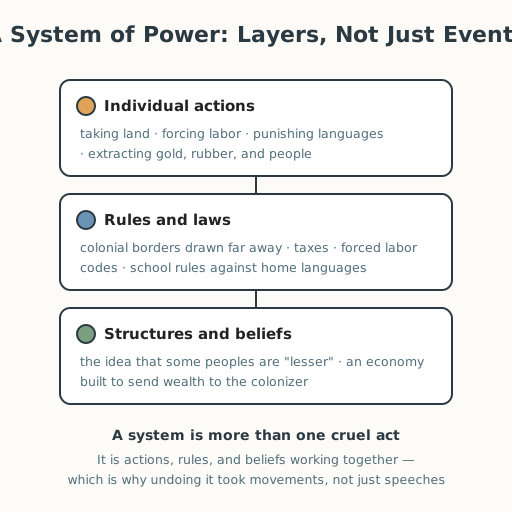
This lesson is written to the learner (“you”). The idea to land: colonialism and empire were systems of power, not just events — built of three layers working together: (1) individual actions — taking land, forcing labor, punishing languages, extracting gold, rubber, and people; (2) rules and laws — colonial borders drawn far away, taxes, forced-labor codes, school rules against home languages; (3) structures and beliefs — the idea that some peoples are “lesser,” and an economy built to send wealth to the colonizer. Teach empire as a global phenomenon so the framing is not Eurocentric: empires — the Ottoman, the Mughal, the Qing, the Inka, and many more — are found across continents and centuries; the lesson focuses on European overseas colonialism from the late 1400s because that is the one the unit’s essential questions and objectives center, while naming that empire itself is not a European invention (S-326). Specific documented examples: the 1884–85 Berlin Conference, where European powers drew Africa’s borders without Africans present (S-477); indirect rule and the warrant-chief system, against which the women of southeastern Nigeria rose in the Aba Women’s War of 1929 (S-209); and the suppression of languages, analyzed by the Kenyan writer Ngũgĩ wa Thiong’o (S-424). The egalitarian lens: who decided, and who was excluded from deciding? The ethics lens: naming a system’s cruelty is not the same as claiming its victims were helpless — they were not. The global lens: empire is everywhere in the human story. The technology lens: ships, weapons, and railroads were the tools that extended empire’s reach. Keep it analytical, not despairing — the next lesson is about the movements that undid it (philosophy §12).
Procedure
- Recall (5 min). From Lesson 7: why was forced migration a system, not a series of accidents? Today we analyze the larger system behind it: empire.
- Three layers (12 min). Read the layer cards. Sort each colonial practice into its
layer:
- Actions: taking land, forcing labor, punishing languages, extracting resources.
- Rules and laws: borders drawn far away, taxes, forced-labor codes, school rules against home languages.
- Structures and beliefs: the idea that some peoples are “lesser”; an economy built to send wealth to the colonizer.
- See the system (15 min). Fill the sheet with real examples. At the Berlin Conference of 1884–85, European powers drew Africa’s borders without Africans present. Under indirect rule, colonial governments appointed warrant chiefs and imposed taxes — against which the women of southeastern Nigeria rose in the Aba Women’s War of 1929. Schools punished children for speaking their home languages.
- Empire is global (8 min). Empire is not one region’s invention: the Ottoman, Mughal, Qing, and Inka empires all held power too. Why does it matter to name empire as a global human pattern, not one nation’s story?
- Why systems are hard to undo (10 min). Write one sentence: why is a system — actions, rules, and beliefs together — harder to change than a single cruel act?
- Close (5 min). Systems can be undone — by movements. Next: the movements that did.
Differentiation
- Support: Provide the three-layer sheet with the layer names filled in, and ask learners to add one example to each layer.
- Extension: Trace one colonial system from a specific region through all three layers, using a source.
Assessment
- Formative (observation): Can the learner place colonial practices into the three layers and explain how the layers worked together?
- Portfolio artifact: The completed three-layer system sheet, kept in the portfolio.
Home connection
Ask at home: what is one system — not just one person’s choice — that you can see shaping who gets what in your community? How is it built of actions, rules, and beliefs?
Resources
- On Western colonialism: Encyclopaedia Britannica, https://www.britannica.com/topic/colonialism (S-326).
- On the Berlin Conference and the partition of Africa: Encyclopaedia Britannica (S-477).
- On the Aba Women’s War (1929): Afigbo, The Warrant Chiefs (S-209).
- On the suppression of languages: Ngũgĩ wa Thiong’o, Decolonising the Mind (S-424).