Lesson 07 — The Transatlantic Slave Trade & Forced Migration
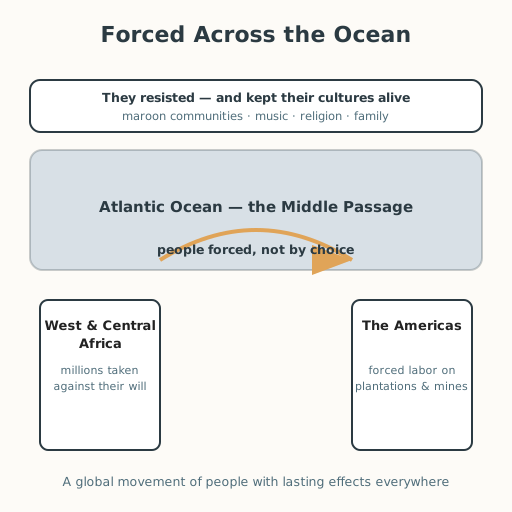
Learners analyze the transatlantic slave trade and other forced migrations as global movements of people with lasting effects. They face the scale of the trade with care, and they center the **resistance and humanity** of the people taken — maroon communities, music, religion, and family.
Objectives
Objectives
- D08.S3.09.02 Analyze the transatlantic slave trade and other forced migrations as global movements of people, and their lasting effects on societies, with care and respect.
Essential question
How did the transatlantic slave trade and other forced migrations move millions of people — and what lasting effects do they still have?
Key vocabulary
Materials
Standard materials
- Evidence cards · 1 set per group Cards with the scale of the trade, the Middle Passage, other forced migrations, and resistance (maroon communities)
- Effects sheet · 1 per learner A sheet for tracing the trade's lasting effects on people and places
Low-tech / no-cost
- A shared board or large paper Draw the Atlantic and the forced crossings, and list the lasting effects together
- Voice and memory Tell the story with care aloud, and have learners retell the resistance
Enriched / lab & device
- The SlaveVoyages database or an interactive map · 1 To see the scale and routes of the trade in data
- A short, age-appropriate documentary segment · 1 Chosen with care; preview first and offer a pause option
Works in different contexts
- large-group Present the evidence once to the whole group with care, then small groups work with the effects sheet
- multi-age Younger learners match each effect to a place; older learners explain one lasting effect with evidence and one form of resistance
- self-directed A learner reads the evidence, fills the effects sheet, and writes one sentence on resistance and one on lasting effects
- level-grouped Learners ready to extend compare the transatlantic trade with another forced migration and name what they share and how they differ
- outdoor-only Hold the discussion in a calm outdoor space; name feelings before facts and let learners step away
Lesson 7 — The Transatlantic Slave Trade & Forced Migration
Summary
Learners analyze the transatlantic slave trade and other forced migrations as global movements of people with lasting effects. They face the scale of the trade with care, and they center the resistance and humanity of the people taken — maroon communities, music, religion, and family.
Objectives
- Analyze the transatlantic slave trade and other forced migrations as global movements of people, and their lasting effects on societies, with care and respect. (D08.S3.09.02)
Connection
Every person has a story of how their family came to be where they are. Some journeys were chosen; some were not. There is a kind of movement that is not migration by choice at all, but forced migration — people taken against their will. The largest of these in modern history was the transatlantic slave trade. It is a hard thing to face, and facing it honestly is part of respecting the people it harmed. Today we do that, and we also honor what they refused to lose.
Materials
- Evidence cards
- Effects sheet
Preparation
- Copy the evidence cards and the effects sheet.
- Retrieval: from Lesson 6, recall that decline and change are multi-causal. Today we study a forced change — a movement of people, not a choice.
Facilitator note
This is a hard topic; hold it with care (facilitation.md). Name feelings before facts, offer a pause, and let learners step away. The idea to land: the transatlantic slave trade was a global system that forcibly moved an estimated 12.5 million African people across the Atlantic (of whom roughly 10.7 million survived the crossing), and it was part of a wider set of forced migrations — including the Saharan and Indian Ocean slave trades — whose effects last to this day (S-322, S-274). Crucially, teach agency alongside atrocity: enslaved people resisted — through revolt, sabotage, running away, and the building of free communities — the quilombos and maroon settlements such as Palmares in Brazil (S-476) — and they kept their cultures alive through music, religion, family, and language, which became lasting world contributions (S-274). Lasting effects: the demographic reshaping of the Americas, the African diaspora, and the cultural forms born of it — from musical traditions to religions to cuisines. Do not use graphic images or numbers as shock; state scale soberly and move to humanity. The ethics lens: the trade was a system built on the denial of human dignity. The egalitarian lens: whose labor built the wealth, and who was credited? The global lens: this was a movement that connected three continents and reshaped all of them. The critical-thinking lens: distinguish documented evidence from later myths. End on dignity and agency, never on despair (philosophy §12).
Procedure
- Recall (5 min). From Lesson 6: change is rarely one cause. Today we study a change people were forced into — a movement of people, not a choice.
- Name the scale (10 min). Read the evidence. The transatlantic slave trade forcibly moved an estimated 12.5 million African people across the Atlantic, over about four centuries. The ocean crossing — the Middle Passage — was brutal and deadly. The trade was part of a wider pattern of forced migrations, including the Saharan and Indian Ocean slave trades.
- Trace the effects (15 min). Fill the effects sheet. On people: the African diaspora — communities of African descent across the Americas and beyond. On places: the demographic reshaping of the Americas. On culture: music, religion, language, and cuisine born of the meeting of African, Indigenous, and European peoples.
- Center resistance (12 min). Read the card on resistance. Enslaved people resisted — through revolt, refusal, escape — and built free communities called quilombos or maroon settlements, such as Palmares in Brazil. Write one sentence on what they refused to lose, and how they kept it alive.
- Connect to now (8 min). Where do you see the lasting effects of this history today — in music, food, language, or in the ongoing work for repair?
- Close (5 min). The trade tried to deny people’s humanity; they kept it. Next: how empire worked as a system of power.
Differentiation
- Support: Provide the effects sheet with categories pre-filled and ask learners to add one example to each.
- Extension: Compare the transatlantic trade with another forced migration and name what they share and how they differ, using evidence.
Assessment
- Formative (observation): Can the learner state the scale of the trade soberly, name one lasting effect, and describe one form of resistance?
- Portfolio artifact: The completed effects sheet, kept in the portfolio.
Home connection
Ask an elder at home about a family or community story of migration — chosen or forced — and how it shaped your family. Listen and reflect in writing (no one is required to share anything private).
Resources
- On the scale of the trade: Trans-Atlantic Slave Trade Database, https://www.slavevoyages.org/ (S-322).
- On the trade and the resistance of enslaved peoples: UNESCO Routes of Enslaved Peoples, https://www.unesco.org/en/routes-enslaved-peoples (S-274).
- On quilombos and Palmares: Encyclopaedia Britannica (S-476).
- On the wider movement of plants, animals, and people: Crosby, The Columbian Exchange (1972) (S-273).