Lesson 01 — Technology, Media & Our Earth Home: The Road Ahead
Learners recall three Grade-8 ideas — framed or edited images, deepfakes, and ecosystem resilience — and preview this unit's two arcs and eight goals. They meet the unit's organizing idea: the tools and media we make, and the living systems we are part of, are read with **critical judgment — neither worship nor fear.**
Objectives
Objectives
- D10.S1.09.01 Explain how software and algorithms, such as recommendations and feeds, shape what people see and choose, and their effect.
Essential question
How do software and algorithms shape what people see and choose — and where is this unit taking us?
Key vocabulary
Materials
Standard materials
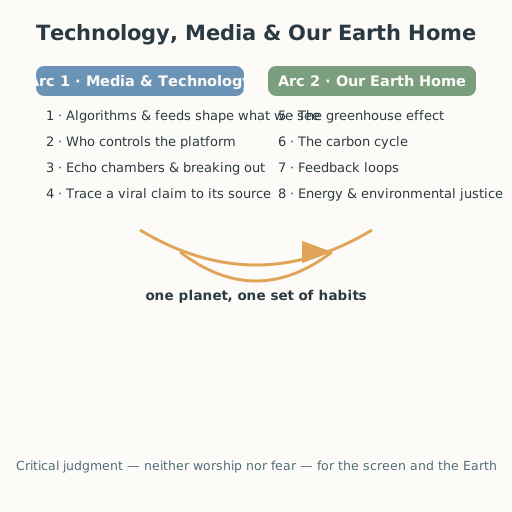
- Unit map sheet · 1 per learner A one-page map of the unit's two arcs and eight goals, to mark and return to across the unit
- Recall cards · 1 set per group Cards recalling Grade-8 ideas — framed or edited images, deepfakes, and ecosystem resilience
Low-tech / no-cost
- A shared board or large paper Draw the two arcs and eight goals together; no printed map needed
- Voice and memory Recall the Grade-8 ideas aloud as a group instead of using cards
Enriched / lab & device
- A digital slideshow of the two arcs · 1 One image or diagram per arc to preview each
- A wonder box (physical or shared document) · 1 A place to collect every learner's questions about the unit to revisit at the close
Works in different contexts
- large-group Do the recall round as a whole group with ideas recorded on the board, then small groups sort the recall cards
- multi-age Younger learners match each recall idea to a picture; older learners state each idea in one sentence and connect it to the new unit
- self-directed A learner reads the unit map, writes three sentences recalling the Grade-8 ideas, and lists one question per goal
- level-grouped Learners ready to extend add a fourth Grade-8 idea not on the cards and explain why it matters here
- outdoor-only Look at the place around you — a screen, a road, a field, a sky — and ask which arc of the unit it connects to and why
Lesson 1 — Technology, Media & Our Earth Home: The Road Ahead
Summary
Learners recall three Grade-8 ideas — framed or edited images, deepfakes, and ecosystem resilience — and preview this unit’s two arcs and eight goals. They meet the unit’s organizing idea: the tools and media we make, and the living systems we are part of, are read with critical judgment — neither worship nor fear.
Objectives
- Begin to name what it means that software and algorithms shape what people see and choose — the unit’s first goal. (D10.S1.09.01)
Connection
Think of two things in front of you right now: a screen, and the world outside a window. The screen shows you a small, chosen slice of everything there is — chosen partly by software. The world outside is the one system that holds everyone: its air, water, soil, and living things. This unit is about reading both with clear eyes: neither trusting a screen blindly nor fearing the world’s changes, but understanding each well enough to act.
Materials
- Unit map sheet
- Recall cards
Preparation
- Copy the unit map sheet and recall cards.
- Retrieval: from Grade 8, recall (a) framed or edited images, (b) deepfakes, and (c) ecosystem resilience. Today we link those to the new unit.
Facilitator note
This lesson is written to the learner (“you”). It is the unit’s opening and retrieval pass, so the goals are modest: (1) recall three Grade-8 ideas — framed/edited images (S-393), deepfakes (S-393), and ecosystem resilience; (2) preview the unit’s two arcs — media & technology (goals 1–4) and our Earth home (goals 5–8); (3) plant the organizing idea: read the screen and the Earth with critical judgment, neither worship nor fear. Do not try to teach the eight goals today; just name and locate them. The technology lens and the environment lens are the two halves of the unit, deliberately joined. The ethics lens: how we use tools and how we treat the Earth are questions about what is right and what the consequences are for others. The egalitarian lens: ask who is centered and who is left out — online and in environmental change. The critical-thinking lens: this unit is one long exercise in holding questions open and weighing evidence (philosophy §11). Spacing note (S-039): this recall pass is what makes the unit’s ideas stick later.
Procedure
- Recall (10 min). In a small group, look at three recall cards: framed or edited images, deepfakes, ecosystem resilience. For each, say in one sentence what you remember from Grade 8.
- Connect the three (5 min). What do all three have in common? (Each is about how what we see or what a system can absorb is shaped — and about learning to look closely.)
- Meet the map (10 min). Look at the unit map. Two arcs: media & technology (algorithms and feeds; who controls the platform; echo chambers and breaking out; tracing a viral claim) and our Earth home (the greenhouse effect; the carbon cycle; feedback loops; energy and environmental justice). Read each goal aloud once; don’t worry about understanding them yet.
- Plant the big idea (10 min). The unit’s idea in one breath: we read the tools and media humans make, and the living systems we are part of, with critical judgment — neither worship nor fear. Say it back in your own words.
- Wonder (10 min). Write one question about each arc in the wonder box. Which question do you most want answered by the end of the unit?
- Close (5 min). Today we remembered what we know and saw the road ahead. Next: how the feed on your screen is built.
Differentiation
- Support: Give sentence starters for the recall round (“A deepfake is…”).
- Extension: Add a fourth Grade-8 idea of your own and say why it will matter in this unit.
Assessment
- Formative (observation): Can the learner recall each Grade-8 idea in one sentence and name the unit’s two arcs?
- Artifact: The completed unit map (or the learner’s written recall), kept in the portfolio.
Home connection
Ask someone at home: what is one thing our family or community sees on screens that we should look at more closely, and one thing about our local environment that has changed over the years? Bring both to the next lesson.
Resources
- On deepfakes and synthetic media: WITNESS Media Lab, “Prepare, Don’t Panic: Synthetic Media and Deepfakes,” https://lab.witness.org/projects/synthetic-media-and-deep-fakes/ (S-393).
- On spaced retrieval: Dunlosky et al. (2013), https://doi.org/10.1177/1529100612453266 (S-039).