Lesson 02 — Algorithms & Feeds: How Software Shapes What We See and Choose
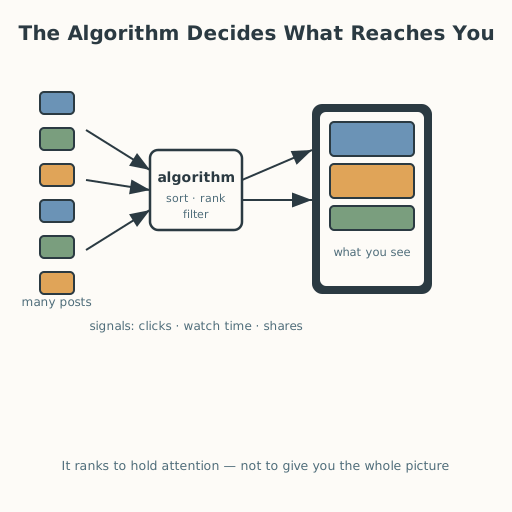
Learners explain how a recommendation algorithm and feed work: software ranks a flood of possible content using signals about a user — clicks, watch time, shares — and shows only a chosen slice. They name the effect: feeds hold attention, but they do not show the whole picture.
Objectives
Objectives
- D10.S1.09.01 Explain how software and algorithms, such as recommendations and feeds, shape what people see and choose, and their effect.
Essential question
How do recommendation algorithms and feeds shape what people see and choose — and what is the effect?
Key vocabulary
Materials
Standard materials
- Feed diagram sheet · 1 per learner A simplified feed diagram with signals (clicks, watch time, shares) and a ranked output
- Signal cards · 1 set per group Cards naming signals an algorithm might use to rank content
Low-tech / no-cost
- A shared board or large paper Draw the feed diagram together; no printed sheet needed
- Voice and memory Name the signals aloud and rank a pretend feed as a group
Enriched / lab & device
- A shared screen to open a real feed · 1 To notice how a feed is ordered and where "recommended" content appears
- A timer app · 1 To run a short, honest attention-tracking reflection on one's own scrolling
Works in different contexts
- large-group Build the feed diagram once on the board as a whole group, then small groups rank a pretend feed with the signal cards
- multi-age Younger learners match each signal to what it measures; older learners explain how ranking by engagement differs from ranking by truth or importance
- self-directed A learner fills the feed diagram, lists three signals their own feeds seem to use, and writes one paragraph on the effect
- level-grouped Learners ready to extend compare ranking by engagement with ranking by relevance or accuracy, and argue which they would choose and why
- outdoor-only Ask what "signals" a market, a town crier, or a notice board uses to decide what people hear first — and how that compares to a feed
Lesson 2 — Algorithms & Feeds: How Software Shapes What We See and Choose
Summary
Learners explain how a recommendation algorithm and feed work: software ranks a flood of possible content using signals about a user — clicks, watch time, shares — and shows only a chosen slice. They name the effect: feeds hold attention, but they do not show the whole picture.
Objectives
- Explain how software and algorithms, such as recommendations and feeds, shape what people see and choose, and their effect. (D10.S1.09.01)
Connection
Open the screen you use most. Is what you see in the order you chose, or did someone — something — arrange it for you? A feed is not a window onto everything; it is a list that software has already sorted for you. Understanding that sorting is the first step toward choosing for yourself instead of being chosen for.
Materials
- Feed diagram sheet
- Signal cards
Preparation
- Copy the feed diagram sheet and the signal cards.
- Retrieval: from Lesson 1, recall the unit’s two arcs and the idea “critical judgment — neither worship nor fear.” Today we meet the first goal: how a feed is built.
Facilitator note
This lesson is written to the learner (“you”). The idea to land: a recommendation algorithm ranks a flood of possible content using signals about the user — clicks, watch time, shares — and shows only a ranked slice; the effect is that feeds hold attention, but they do not show the whole picture. Keep the mechanism concrete and honest: an algorithm is just a set of steps a computer follows, and a feed is the ranked list those steps produce. The signals named (clicks, watch time, shares) are the ones platforms commonly describe (S-481). The technology lens is the heart here. The ethics lens: is it right that the content most likely to hold attention — not the most true or most important — rises to the top, and who decides? The egalitarian lens: feeds treat people as audiences to be kept engaged; ask who profits and who is served. The critical-thinking lens: “what I see” is not “all there is” — a claim to hold open, not a fact to accept. Model the ranking step once, then let learners practice (worked example → guided practice, S-011). Do not moralize about screen use; invite honest noticing (facilitation.md).
Procedure
- Recall (5 min). From Lesson 1: name the unit’s two arcs. Today we meet the first goal — how a feed is built.
- Meet the mechanism (12 min). Look at the feed diagram. Many posts exist; software sorts them. Follow the steps: (a) gather signals — what you click, how long you watch, what you share; (b) rank everything; (c) show you the top slice. The name for this is a recommendation algorithm; the ranked list it makes is a feed.
- Rank a pretend feed (15 min). In a small group, use the signal cards. Take ten pretend posts and rank them three ways: by engagement (what people click most), by truth (what is most accurate), and by importance (what matters most for a community). How different are the three lists?
- Name the effect (10 min). What does ranking by engagement tend to promote — and leave out? Write one sentence on each: what a feed gives you, and what it hides.
- Self-check (5 min). Ask yourself honestly: which signal does your favorite feed seem to reward? What would you ask it to change?
- Close (5 min). A feed is software’s answer to “what should I see next?” Next: who owns that answer — and what power does that give them?
Differentiation
- Support: Provide the three ranking lists pre-started and ask learners to finish sorting the posts.
- Extension: Compare ranking by engagement with ranking by accuracy, and write a short argument for which a public-information feed should use, naming your reasoning.
Assessment
- Formative (observation): Can the learner trace the algorithm’s steps (signals → rank → slice) and name one effect on what people see and choose?
- Portfolio artifact: The completed feed diagram and the “gives / hides” sentences, kept in the portfolio.
Home connection
Notice one feed you use at home this week. Write down one thing it chose to show you first and one thing you suspect it left out. Bring both to the next lesson.
Resources
- On social media, feeds, and recommendation systems: Encyclopaedia Britannica, “Social media,” https://www.britannica.com/topic/social-media (S-481).
- On media’s impact on adolescents and the habit of asking where information comes from: Common Sense Education, “News & Media Literacy,” https://www.commonsense.org/education/digital-citizenship/topic/news-and-media-literacy (S-063).
- On modeling then guided practice for a new skill: Kirschner, Sweller & Clark (2006), https://doi.org/10.1207/s15326985ep4102_1 (S-011).