Lesson 08 — Feedback Loops: When Warming Speeds Up Warming
Learners explain what a feedback loop is and trace one amplifying example — the ice-albedo loop: warming melts bright ice, dark water and land absorb more sunlight, and the extra absorption adds more warming. They name two other amplifying loops and see why small changes can grow.
Objectives
Objectives
- D10.S3.09.02 Explain what a feedback loop is and give one example of how warming can speed up more warming.
Essential question
What is a feedback loop, and how can warming speed up more warming?
Key vocabulary
Materials
Standard materials
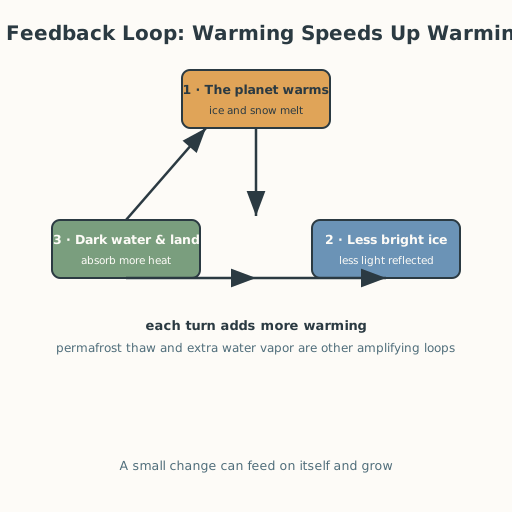
- Feedback loop diagram sheet · 1 per learner A circular loop of warming → melting ice → less reflection → more absorption → more warming
- Loop card set · 1 set per group Cards for three amplifying loops — ice-albedo, permafrost thaw, and water vapor — with each step named
Low-tech / no-cost
- A shared board or large paper Draw the loop together and trace it around and around
- Voice and body Act out the loop — each step spoken aloud and the circle walked around, getting "louder" each turn
Enriched / lab & device
- A short animation of an amplifying feedback · 1 To watch and then retell the loop in one's own words
- Two swatches (dark and light) in the sun · 1 set To feel how dark surfaces absorb more heat than light, reflective ones
Works in different contexts
- large-group Build the loop once on the board, then small groups arrange the loop cards into the right order
- multi-age Younger learners match each step to its picture; older learners explain why the loop *amplifies* and name a second loop
- self-directed A learner fills the loop diagram, writes the loop in their own words, and names one other amplifying loop
- level-grouped Learners ready to extend compare an amplifying (positive) feedback with a stabilizing (negative) feedback and explain why the sign matters
- outdoor-only Feel a dark rock and a light surface in the sun; connect which one warms faster to the ice-albedo loop
Lesson 8 — Feedback Loops: When Warming Speeds Up Warming
Summary
Learners explain what a feedback loop is and trace one amplifying example — the ice-albedo loop: warming melts bright ice, dark water and land absorb more sunlight, and the extra absorption adds more warming. They name two other amplifying loops and see why small changes can grow.
Objectives
- Explain what a feedback loop is and give one example of how warming can speed up more warming. (D10.S3.09.02)
Connection
Think of a snowball rolling downhill: as it rolls, it picks up more snow, which makes it bigger, which makes it pick up more. A small beginning grows on itself. Earth’s climate has loops like that — but instead of snow, they run on heat. Once one of these loops starts, each turn makes the next turn stronger.
Materials
- Feedback loop diagram sheet
- Loop card set
Preparation
- Copy the feedback loop diagram sheet and the loop cards.
- Retrieval: from Lessons 6–7, recall the greenhouse effect and the carbon cycle. Today we see how a warming already underway can feed on itself.
Facilitator note
This lesson is written to the learner (“you”). The idea to land: a feedback loop is a cycle in which an effect feeds back to change its own cause. In an amplifying (positive) loop, the change grows. The ice-albedo loop is the clearest example: warming melts bright ice and snow → the darker water and land reflect less sunlight (lower albedo) → more sunlight is absorbed → more warming → more melting. Two other amplifying loops: water vapor (warmer air holds more water vapor, itself a greenhouse gas) and permafrost thaw (warming thaws frozen ground, which releases stored carbon as CO₂ and methane). These are documented in the climate literature (S-005). Be precise with language: “positive” feedback does not mean “good” — it means the loop amplifies; say “amplifying” to avoid confusion. The environment lens is central. The technology lens: our energy choices set these loops turning faster. The ethics lens: loops mean delay is costly — the longer warming runs, the more it drives itself; that is a question of responsibility to others. The global lens: the ice is in the poles and mountains, but the loop’s effects are everywhere. The critical-thinking lens: trace the loop around the circle until learners can see it feed itself — that is the mark of understanding, not memorizing the phrase.
Procedure
- Recall (5 min). From Lessons 6–7: what is the greenhouse effect, and where does the extra carbon come from? Today: how a small warming can drive itself.
- Meet the loop (12 min). Look at the diagram. Follow it around: (a) the planet warms and bright ice melts; (b) dark water and land reflect less light — this reflectiveness is called albedo; (c) the darker surface absorbs more heat; (d) more heat means more warming — which melts more ice. Say the circle back once.
- Name what kind of loop this is (8 min). A feedback loop is a cycle in which an effect feeds back to change its own cause. In an amplifying loop the change grows each turn. Explain why the ice-albedo loop amplifies rather than settles down.
- Meet two more loops (12 min). Use the loop cards. Water vapor: warmer air holds more of it, and it is itself a greenhouse gas. Permafrost thaw: warming thaws frozen ground, which releases stored carbon as CO₂ and methane. For each, name the step that feeds back.
- Write it (10 min). Draw or write the ice-albedo loop in your own words, around the full circle, and write one sentence on why a loop that feeds itself makes delay costly.
- Close (5 min). A small change can feed on itself and grow. Next: the energy choices that set these loops turning — fossil fuels versus renewables.
Differentiation
- Support: Provide the loop as a scrambled four-step list and ask learners to arrange it in the correct order.
- Extension: Compare an amplifying (positive) feedback with a stabilizing (negative) feedback and explain why the sign of a loop determines whether a system settles or runs away.
Assessment
- Formative (observation): Can the learner trace the ice-albedo loop around the full circle and explain why it amplifies warming?
- Portfolio artifact: The drawn or written loop explanation, kept in the portfolio.
Home connection
Explain the ice-albedo loop to someone at home using a snowball or a dark-versus-light example. Ask them to name one place near you that is brighter or darker than its surroundings, and why that matters for heat.
Resources
- On feedbacks and the climate system: IPCC, https://www.ipcc.ch/ (S-005).
- On the climate system and the greenhouse effect these loops build on: NASA, “What Is the Greenhouse Effect?,” https://science.nasa.gov/kids/earth/what-is-the-greenhouse-effect/ (S-438).