Lesson 07 — The Carbon Cycle: Life, Ocean, Air, and Rock
Learners trace the carbon cycle across its four great reservoirs — atmosphere, plants and soil, oceans, and rock — and see that carbon is reused, not created new. They explain that burning fossil fuels moves ancient buried carbon back into the atmosphere fast, linking the cycle to the greenhouse effect.
Objectives
Objectives
- D10.S3.09.01 Explain the greenhouse effect and how the carbon cycle connects living things, oceans, atmosphere, and rock over time.
Essential question
How does the carbon cycle connect living things, oceans, atmosphere, and rock over time — and what happens when we burn fossil fuels?
Key vocabulary
Materials
Standard materials
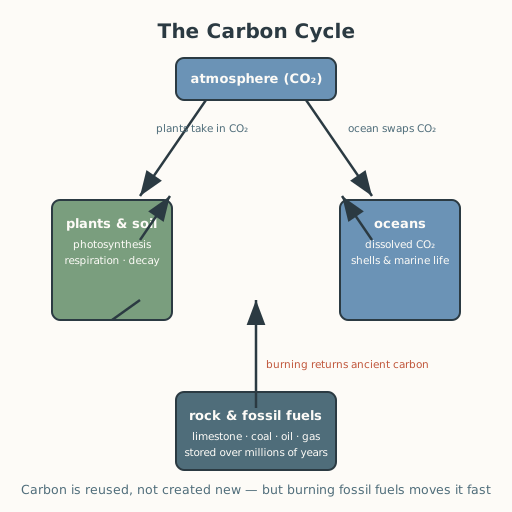
- Carbon cycle diagram sheet · 1 per learner A labeled cycle of carbon moving between atmosphere, plants and soil, oceans, and rock and fossil fuels
- Reservoir card set · 1 set per group Cards for the four reservoirs, with how carbon enters and leaves each
Low-tech / no-cost
- A shared board or large paper Draw the cycle together and move a "carbon" token around it
- Voice and body Act out the cycle — learners as atmosphere, plants, ocean, and rock, passing a carbon "coin" between them
Enriched / lab & device
- A short animation of the carbon cycle · 1 To watch and then retell the movements in one's own words
- A piece of limestone or coal (where available) · 1 set To hold a real sample of carbon locked in rock, millions of years old
Works in different contexts
- large-group Build the cycle once on the board, then small groups move a carbon token around the four reservoirs
- multi-age Younger learners match each reservoir to a picture and one carbon movement; older learners explain the fast and slow parts of the cycle and the effect of burning
- self-directed A learner fills the cycle diagram, traces one carbon atom through all four reservoirs, and writes the effect of burning fossil fuels
- level-grouped Learners ready to extend distinguish the fast biological loop from the slow geological loop and explain why the slow loop matters for climate
- outdoor-only Find a living plant, a body of water, the air, and a rock or soil nearby, and trace carbon's path among the four in the place around you
Lesson 7 — The Carbon Cycle: Life, Ocean, Air, and Rock
Summary
Learners trace the carbon cycle across its four great reservoirs — atmosphere, plants and soil, oceans, and rock — and see that carbon is reused, not created new. They explain that burning fossil fuels moves ancient buried carbon back into the atmosphere fast, linking the cycle to the greenhouse effect.
Objectives
- Explain how the carbon cycle connects living things, oceans, atmosphere, and rock over time. (D10.S3.09.01)
Connection
The carbon in your body today was once in the air, in a plant, in the ocean, maybe in a dinosaur or a fern a hundred million years ago. Carbon is not made new; it is moved around — breathed in by leaves, eaten, exhaled, dissolved, and locked into rock. Seeing that whole round-trip is seeing how one shared substance ties every living thing to the air, the sea, and the stone. Fire is one of carbon’s great movers — and for tens of thousands of years Aboriginal and Torres Strait Islander peoples have tended that mover with cool, careful cultural burns, reading this same cycle through a different knowledge.
Materials
- Carbon cycle diagram sheet
- Reservoir card set
Preparation
- Copy the carbon cycle diagram sheet and the reservoir cards.
- Retrieval: from Lesson 6, recall the four steps of the greenhouse effect. Today we see where the extra carbon comes from — the cycle itself.
Facilitator note
This lesson is written to the learner (“you”). The idea to land: carbon cycles among four great reservoirs — the atmosphere (as CO₂), living things and soil (through photosynthesis, eating, and decay), the oceans (dissolved CO₂ and marine life), and rock (limestone and, over millions of years, fossil fuels). Carbon is neither created nor destroyed; it moves. Burning fossil fuels is the fast return of carbon that was buried over millions of years — which is why it changes the atmosphere so quickly (S-253; S-438; S-005). Distinguish the fast loop (a leaf takes in CO₂ today; a breath returns it) from the slow loop (carbon locked in limestone and coal for millions of years). The environment lens is central. The technology lens: fossil-fuel combustion is the human technology that reroutes the slow loop into the fast one. The ethics lens: the cycle itself is neutral; our rate of moving carbon is the moral question. The global lens: the cycle is planetary — a fire in one country changes air everywhere. The critical-thinking lens: “carbon is reused, not created new” is a conservation idea learners can demonstrate, not merely recite. Encourage the “one carbon atom’s journey” telling as the assessment of real understanding.
Multiple knowledge traditions (philosophy §11). The four-reservoir account above is Western Earth science (S-253; S-438; S-005). Hold it side by side with Aboriginal and Torres Strait Islander cultural burning, a living, millennia-old ecological knowledge tradition that works the fire path of this same cycle: cool, low-intensity burns that move carbon slowly, promote plant growth, maintain habitats, and reduce the fuel that feeds runaway fires (S-320; S-321). Cultural burning is not a “primitive” precursor to the Western diagram; it is a parallel knowledge system — a practiced, place-based understanding of how fire and carbon move through Country, refined over thousands of years and still applied today. Science names the reservoirs and the fluxes; cultural burning names how to tend one of those fluxes responsibly. Present it as a living practice of specific First Nations, attributed precisely, never as a specimen (philosophy §4).
Procedure
- Recall (5 min). From Lesson 6: what are the four steps of the greenhouse effect? Today: where the extra carbon comes from.
- Meet the four reservoirs (12 min). Look at the diagram. Carbon lives in four great stores: the atmosphere, living things and soil, the oceans, and rock. For each, name one way carbon enters and one way it leaves.
- Trace one atom (15 min). Choose a starting point — a carbon dioxide molecule in the air. Move it, step by step: into a leaf by photosynthesis, into an animal by eating, back to the air by respiration, into the ocean, and finally locked into rock as limestone or, over millions of years, as fossil fuel. Tell the journey aloud to a partner.
- Burn the fuel (10 min). Now add the human step: burning fossil fuels takes carbon that was buried for millions of years and returns it to the air in a few centuries. Why does that rate matter for the greenhouse effect?
- Write it (8 min). Write the cycle in your own words: the four reservoirs, one movement into and out of each, and one sentence on why the speed of the fossil-fuel step matters.
- Close (5 min). Carbon is reused, not created new — we just move it fast. Next: how a small change can feed on itself — the feedback loop.
Differentiation
- Support: Provide a partly labeled cycle and ask learners to draw in the four movement arrows.
- Extension: Distinguish the fast biological loop from the slow geological loop and explain, with the greenhouse effect in mind, why the slow loop’s carbon matters so much.
Assessment
- Formative (observation): Can the learner trace carbon through all four reservoirs and explain what burning fossil fuels does to the cycle’s speed?
- Portfolio artifact: The written cycle explanation, kept in the portfolio.
Home connection
Find carbon in three places at home or nearby — a plant, the soil, the air you breathe out, a shell or a stone. Write down where you found it and which reservoir each belongs to.
Resources
- On the carbon cycle and its reservoirs: National Geographic Education, “The Carbon Cycle,” https://education.nationalgeographic.org/resource/carbon-cycle/ (S-253).
- On the greenhouse effect the cycle feeds into: NASA, “What Is the Greenhouse Effect?,” https://science.nasa.gov/kids/earth/what-is-the-greenhouse-effect/ (S-438).
- On the human signal in the climate system: IPCC, https://www.ipcc.ch/ (S-005).
- On Aboriginal and Torres Strait Islander cultural burning as a parallel knowledge system for the fire path of the carbon cycle: CSIRO, “Indigenous Cultural Burning,” https://www.csiro.au/en/education/Resource-Library/Indigenous-STEM-Education-Resources/Cultural-Burning-Resources (S-320); and Firesticks Alliance / Living Knowledge Network, https://www.firesticks.org.au/ (S-321).