Lesson 12 — Seeing It Through: Reflection and Celebration
Learners check in on their self-directed project, adjust rather than abandon, and assemble the unit portfolio across all six objectives. The lesson closes the unit as a celebration of growth — strengths named, "not yet" honored — and hands the work forward.
Objectives
Objectives
- D01.S3.11.02 Take authorship of a personal project or commitment and see it through with self-direction.
Essential question
How do I keep my own word to myself, and how do I celebrate growth — including "not yet"?
Key vocabulary
Materials
Standard materials
- Journal (the unit portfolio) · 1 per learner
- Project map (from Lesson 11) · 1 per learner
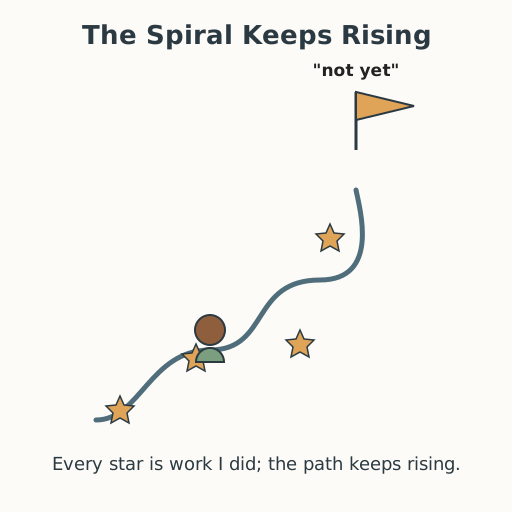
- Spiral-and-summit diagram (print or draw) · 1 per learner A rising spiral to a summit flagged "not yet"
Low-tech / no-cost
- The assembled portfolio itself Lay every artifact in a row and walk its length; no diagram required
- Voice and a circle Each learner shares one thing they are proud of, one thing still growing; no one is required to speak
Enriched / lab & device
- A simple slideshow or shared board of artifacts · 1 To gather the unit's work and present it as a whole
Works in different contexts
- large-group Celebrate in small circles, then gather for a brief whole-group honoring; keep it a celebration, never a ranking
- multi-age Younger learners share one proud thing; older learners complete the full check-in and portfolio cover
- self-directed A learner completes the check-in alone, writes the portfolio cover, and reads their own unit through start to finish
- level-grouped Pair learners across levels so each reads their cover aloud to a peer guide and receives one affirming question
- outdoor-only Gather in a circle outdoors; pass a natural object as the "speaking token" and close by looking at the sky
Lesson 12 — Seeing It Through: Reflection and Celebration
Summary
Learners check in on the project they authored, adjusting rather than abandoning when a milestone slips. They assemble the full unit portfolio — the climate readings, the emotional-development reflection, the values-and-purpose statement, the place-in-the-world reflection, the decision log, and the project map — and close the unit as a celebration of a self in the making: strengths named, “not yet” honored.
Objectives
- Take authorship of a personal project or commitment and see it through with self-direction. (D01.S3.11.02)
Connection
Every journey needs a moment to look back down the path. You have spent this unit reading the weather of groups, tracing your own growth, naming your values, widening your care, and practicing decisions under pressure — and you signed your name to a project. Looking back is not the end; it is how you see how far the spiral has risen, and where it points next. “Not yet” is not a failure. It is a summit flag: this is where I am, and the path keeps rising.
Materials
- Your journal (now the unit portfolio)
- Your project map from Lesson 11
- A spiral-and-summit diagram (see the asset)
Preparation
- Gather all unit artifacts in order.
- Retrieval (spaced, interleaved): this lesson recalls every strand of the unit — the collective emotions (S1), the values and purpose (S2), and the decisions and project (S3) — a spaced, interleaved pass that is itself the science-of-learning payoff (S-039).
Facilitator note
This lesson is written to the learner (“you”). The idea to land: follow-through is not perfection — it is the discipline of checking in, adjusting, and keeping one’s word to oneself; and a unit closes as a celebration of mastery-in-progress, never a ranking. Guide the check-in with a worked example (S-011), then release learners to assemble and celebrate.
The social-emotional lens: this is self-management and self-direction at their peak (CASEL, S-001), and mastery — not ranking — is the assessment stance (philosophy §8). The ethics lens: keeping one’s word to oneself is an ethical act, and so is owning a slipped milestone and adjusting honestly. The egalitarian lens: celebration must not become comparison — every learner’s path is their own, and a small kept promise is honored as fully as a large finished one. The global lens: the unit’s work connects outward — a learner’s small project is a knot in a global web, and their widening circle of care reaches past themselves. The technology & environment lens: invite one quiet reflection on how screens and the living world showed up in this unit’s work — as tools, as pressures, as things owed care.
Emotional safety above all. This is a celebration, not a test. No learner is ranked, and no project is judged by size. “Not yet” is spoken with pride. Any learner may pass on sharing. End on warmth and looking-forward, not on a verdict.
Procedure
- Check in on your project (15 min). Open your project map. For each milestone, write one of three honest marks: done, in progress, or not yet. Then answer: what helped me keep going? what got in the way? what is my next small step? If a milestone slipped, adjust the map rather than abandon it — remember, a slipped milestone is information, not a verdict. Write the adjustment in.
- Assemble the portfolio (20 min). Lay out your six artifacts in order: (1) the climate readings and hope/fear/grief reflections, (2) the emotional-development then/now/next map, (3) the values compass and purpose reflection, (4) the place-in-the-world reflection and widening-circles statement, (5) the decision log, (6) the signed project map. On the portfolio’s cover, write one sentence you now believe about who you are, what you value, and what you will do.
- Celebrate, not test (15 min). In a small circle, each person shares (if they wish) one thing I am proud of and one thing that is still growing — and the circle receives each with a nod, never a score. If you work alone, read your own portfolio from start to finish and notice the arc.
- Close the unit (5 min). Look at the spiral-and-summit diagram once more. The flag at the top says “not yet.” That is not a failure — it is the truth of every growing thing: you are a whole self in the making, never a label, and the path keeps rising. Keep your project going; your word to yourself is the point.
Differentiation
- Mode (expression): Writing is one way, not the only way — respond by speaking, pointing to a word card, arranging found objects, drawing, or gesturing; a response that uses neither writing nor speaking is still a full response.
- Support: Offer the three milestone marks and sentence starters; help pair a slipped milestone with a smaller next step.
- Extension: Write a one-paragraph “letter to my future self” naming what you will have seen through by the next check-in, and date it.
Assessment
- Formative (self + peer): Does the check-in honestly mark each milestone and produce an adjusted next step, rather than abandoning the project?
- Summative (portfolio, unit): The assembled six-artifact portfolio, reviewed for completeness across all six objectives and for the learner’s own cover statement.
Home connection
Show your portfolio cover to someone at home and read them your one sentence. Ask them to hold you to your project, as a witness rather than a judge.
Resources
- CASEL, Fundamentals of Social and Emotional Learning (self-management, self-direction): https://casel.org/fundamentals-of-sel/ (S-001).
- On retrieval practice and spacing: Dunlosky et al. (2013), https://doi.org/10.1177/1529100612453266 (S-039).
- On worked examples and guided practice: Kirschner, Sweller & Clark (2006), https://doi.org/10.1207/s15326985ep4102_1 (S-011).