Lesson 01 — The Body as Home: Dignity, Joy, and Noticing Your State
Learners open the unit by building the dignity-and-joy container that will hold three weeks of body work, meet the idea of "state," and take a first baseline body-scan so they can notice how practices change them over time.
Objectives
Objectives
- D03.S1.11.01 Use mind-body practices such as breathing, movement, and mindfulness deliberately to regulate their own state and explain why they work.
Essential question
How do I notice my own state, and why is noticing — without judgment — the first skill of mind-body practice?
Key vocabulary
Materials
Standard materials
- Practice log (journal or notebook) · 1 per learner A dedicated place to record practices, states, and "why it works" notes across the unit
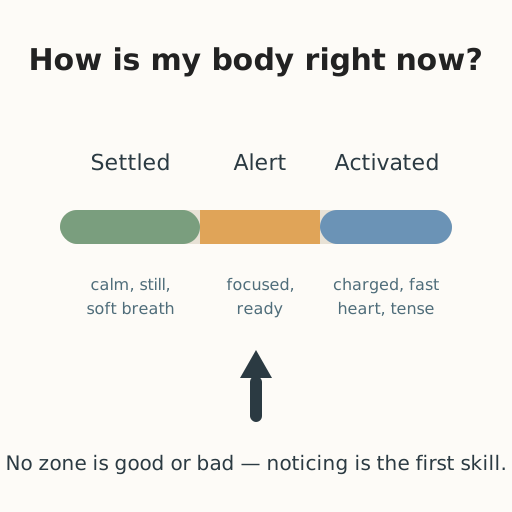
- State spectrum chart (printed or drawn) · 1 for the group A simple Settled–Alert–Activated scale for naming states without judgment
Low-tech / no-cost
- Voice and a drawn line in the ground or on paper Draw the state spectrum with chalk or a stick; no printed chart needed
- Found object as a marker A stone or seed each learner can slide along the spectrum to show their state
Enriched / lab & device
- Digital practice log · 1 per learner A shared or private document where learners track states and practices over time
- Projector or large display · 1 for the group To show the state spectrum to the whole room
Works in different contexts
- large-group Do the spectrum check as a quick whole-group show of hands or a line-up across the room; keep sharing brief so everyone is included
- multi-age Younger learners place a marker on a physical line; older learners add a one-word label for why they are there
- self-directed A learner draws their own spectrum, marks their baseline, and writes three words describing their state without a facilitator
- level-grouped Group learners new to mind-body work together for extra modeling of "noticing without judging"; a ready group drafts a "why noticing matters" note
- outdoor-only Do the body scan outdoors; anchor to real sensations (wind on skin, feet on earth, sounds of the place)
Lesson 1 — The Body as Home: Dignity, Joy, and Noticing Your State
Summary
Learners open the unit by agreeing on how they will talk about bodies — with dignity and joy, never shame — then meet the idea of “state” (how the body feels right now) and take a first baseline body-scan. They begin a practice log they will carry all unit, so that by the end they can see how deliberate practice changed them.
Objectives
- Begin to use mind-body practices deliberately to regulate your own state, starting with the foundational skill of noticing your state without judging it. (D03.S1.11.01)
Connection
Think of the last time you noticed your heart pounding before speaking, or your shoulders heavy after a hard day, or a warm lightness when someone made you laugh. Your body is always sending signals — a stomach that tightens, a breath that slows, a jaw that clenches. This unit is about reading those signals on purpose and learning what you can do with them. You live in your body every minute of every day; it is the one home you never leave.
Materials
- Practice log (journal or notebook)
- State spectrum chart (printed or drawn)
- A small marker (stone, seed, or finger)
Preparation
- Draw or print the state spectrum (Settled–Alert–Activated).
- Have practice logs ready to hand out or set up.
Facilitator note
This lesson is written to the learner (“you”). Your job is to build a container of dignity and joy that will hold three weeks of body work. Land these commitments now and return to them every day: (1) no shame about any body — no weight talk, no ranking bodies, no able-bodied default; (2) every body is a real body — disability, illness, and difference are ordinary, not “special cases”; (3) everyone owns their own story — learners may pass, be silent, or write privately at any time; and (4) practices are invitations, not tests.
Inclusion is non-negotiable. Model “noticing without judging” by naming your own state (“my shoulders are tense today”) rather than pointing at learners’. Never require a learner to name a diagnosis, disclose illness, or demonstrate a movement that is not safe for them. If a learner’s sharing suggests distress or need, follow your setting’s care procedure and connect them with a trusted adult or service.
The ethics lens: treating every body with dignity is the right way to begin. The egalitarian lens: these agreements protect everyone equally. The global lens: many cultures have their own practices for noticing the body; we honor them all. The social-emotional lens: naming a state is itself a regulation skill.
Procedure
- Gather and agree (10 min). Sit comfortably. Read the four commitments: no shame about any body; every body is a real body; everyone owns their own story; practices are invitations. Add one agreement of your own that would make this a safe place to notice your body.
- Meet “state” (5 min). Your state is how your body feels right now — heart, breath, muscles, energy. It is never “good” or “bad”; it is information. Look at the state spectrum: Settled, Alert, Activated. Where are you right now? Put a marker (or your finger) there.
- Body scan — your baseline (10 min). Close your eyes or lower your gaze. Slowly travel from your feet to your head. Where is there warmth, tightness, ease, restlessness? Notice three things without trying to change them. This is your baseline — the starting point you will return to all unit.
- Record it (5 min). In your practice log, write today’s date and three words for your baseline (for example: “tense shoulders, warm hands, steady breath”). If writing is hard, draw it or record your voice.
- Why notice? (10 min). With a partner or alone, answer: What could you do with this information? How might noticing a tight jaw early help you later? Share one idea aloud or in writing.
- Close (5 min). Say or write one word for how you want to feel in this unit. Remember: your body is your home; you are learning to read its signals with care.
Differentiation
- Support: Offer a short list of state words to choose from; allow drawing or pointing instead of writing.
- Extension: Ask learners to note a second body-scan later the same day and compare the two states.
Assessment
- Formative (self + observation): Can the learner place themselves on the state spectrum and name at least two body signals? Did they record a baseline?
- Artifact (portfolio): The first baseline entry in the practice log, kept private or shared by choice.
Home connection
This week, notice one body signal at home — before a meal, after waking, or in a moment of stress — and jot it in your log. No equipment, no one else involved. If you prefer, notice a signal in a plant or animal you care for instead; reading bodies is a skill that generalizes.
Resources
- CASEL — Fundamentals of Social and Emotional Learning (self-awareness and self-management as core competencies): https://casel.org/fundamentals-of-sel/ (S-001).
- UNESCO — International Charter of Physical Education, Physical Activity and Sport (the right of every person to participate, regardless of ability): https://www.unesco.org/en/sport-and-anti-doping/international-charter-sport (S-342).