Lesson 02 — Breath as a Lever: Why Slow Breathing Calms You
Learners practice a simple paced-breathing exercise and learn the nervous-system mechanism behind it: the sympathetic "fight-or-flight" branch speeds the body up, while the parasympathetic "rest-and-digest" branch — activated by a slow exhale — brings it back to calm.
Objectives
Objectives
- D03.S1.11.01 Use mind-body practices such as breathing, movement, and mindfulness deliberately to regulate their own state and explain why they work.
Essential question
Why does slow breathing — especially a longer exhale — help my body return to calm?
Key vocabulary
Materials
Standard materials
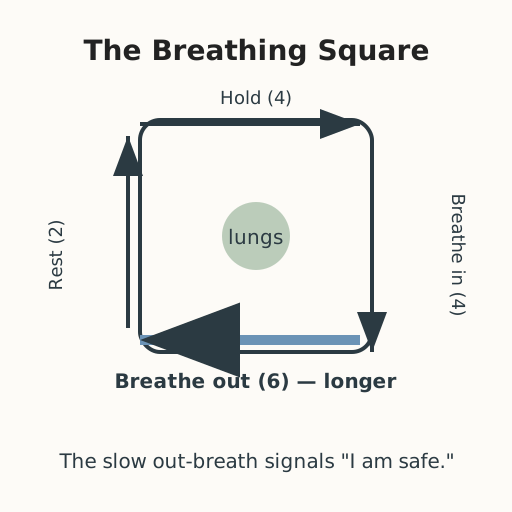
- Breathing square chart (printed or drawn) · 1 for the group A four-phase guide — breathe in (4), hold (4), breathe out (6), rest (2)
- Practice log · 1 per learner
Low-tech / no-cost
- Voice and counting Count the four phases aloud; no chart needed
- Hand on chest or belly Learners feel their own breath rise and fall instead of reading a diagram
Enriched / lab & device
- Short animation or video of paced breathing · 1 for the group A visual pacer for the four phases, if a device is available
- Heart-rate display (optional, with consent) · 1 per group To observe heart rate before and after slow breathing — always voluntary
Works in different contexts
- large-group Lead the breathing square aloud for the whole room; invite learners to close their eyes or soften their gaze
- multi-age Younger learners use a shorter count (in 2, out 4); older learners can try the full 4-4-6-2
- self-directed A learner follows the four phases alone with a slow count and records how they felt before and after
- level-grouped Pair learners to take turns counting for each other; a ready group writes the mechanism in their own words
- outdoor-only Practice the breath outdoors; anchor the exhale to a long, slow outward sound like wind through leaves
Lesson 2 — Breath as a Lever: Why Slow Breathing Calms You
Summary
Learners practice a paced-breathing exercise and learn why it works: the autonomic nervous system has two branches — one that speeds the body up (sympathetic, “fight-or-flight”) and one that settles it (parasympathetic, “rest-and-digest”). A slow, extended exhale nudges the body toward the calm branch. Understanding the mechanism lets learners use the tool deliberately, not just hope it works.
Objectives
- Use breathing deliberately to regulate your own state and explain why a slow, extended exhale calms the nervous system. (D03.S1.11.01)
Connection
You already use this lever without knowing it. Ever sighed after finishing something hard? A sigh is a long exhale. Ever noticed a person calm down as they slowly blow out through pursed lips? That is not magic — it is your nervous system responding to the shape of your breath. Whether you are in a city exam hall, a fishing boat in rough weather, or a crowded kitchen, the tool travels with you, because it is inside you.
Materials
- Breathing square chart
- Practice log
Preparation
- Draw or print the breathing square.
- Clear a moment of quiet in the schedule.
Facilitator note
This lesson teaches a skill, so use explicit instruction: model the four phases step-by-step, then do guided practice together, then let learners try it independently (Kirschner, Sweller & Clark, 2006; S-011). The mechanism matters as much as the feeling — the objective is to explain why it works, not just to feel calm.
Safety and inclusion. Never force anyone to hold their breath or breathe in any pattern. Learners with respiratory conditions, anxiety, or dizziness should use a gentle, natural rhythm instead — a comfortable in-breath and a slightly longer out-breath is enough. The “hold” step is optional and skippable. Some learners cannot safely do breath work at all — when breathing is painful, distressing, or medically unsupported — so offer a non-breath alternative that reaches the same idea through a different channel: rest a hand lightly on the chest or belly and feel its natural rise and fall, deliberately soften the jaw and drop the shoulders, or quietly watch a partner’s calm, steady rhythm. The learning target — explaining why a slow exhale calms the body — is open to everyone, whether or not they practice the breath. Frame slow breathing as one tool among many, not a cure, and note that it helps return the body to calm rather than eliminating stress altogether.
The ethics lens: a tool that works for many bodies, freely, without cost, is a fair tool. The egalitarian lens: breath requires no equipment and no money, so it is available to everyone. The global lens: breath practices exist across many cultures (prāṇāyāma in yoga, qigong in China, and others), and the science explains one mechanism common to them all. The technology lens: apps and devices now pace breathing, but the body’s lever works with or without them.
Procedure
- Recall (5 min). What was your baseline from last lesson? Without looking, write one body signal you remember. Then check your log — retrieval builds memory.
- Feel the two branches (5 min). Imagine something that startles you — a loud bang, a near-miss. What would happen in your body? (Faster heart, quicker breath, tense muscles.) That is the sympathetic branch, the “fight-or-flight” response. Now imagine sitting safely in warm light. That is the parasympathetic branch, “rest-and-digest.”
- The key idea (5 min). Your breath is one of the few levers you can move on purpose. A slow, extended exhale signals the parasympathetic branch and helps the body settle. This is not magic; it is physiology — the vagus nerve and the relaxation response (Harvard Health, S-340).
- Model the breathing square (10 min). Watch and follow: breathe in through your nose for 4, hold for 4 (or skip), breathe out slowly through your mouth for 6, rest for 2. Repeat four rounds together, counting aloud. If breath work is not safe or comfortable for you, use the non-breath version instead: rest a hand on your chest or belly, soften your jaw and shoulders, or watch a partner’s calm rhythm — and still notice how your state shifts.
- Guided practice (10 min). Pairs take turns counting for each other. Then do two quiet rounds on your own. Notice: does anything feel different?
- Explain it back (10 min). In your log, finish both sentences: “Slow breathing works because…” and “One situation where I could use this is…” Say it to a partner in your own words.
- Close (5 min). One deep, easy breath. Note your state on the spectrum. Did it shift?
Differentiation
- Support: Use a 2-4 count (in 2, out 4) with no hold; allow humming the exhale; offer the non-breath alternative (hand on chest, soft jaw, watching a partner) to any learner who needs it.
- Extension: Ask learners to read about the vagus nerve and add one accurate sentence to their “why it works” note.
Assessment
- Formative (self + peer): Can the learner perform (or adapt) the four phases and explain the mechanism — a slow exhale activating the parasympathetic “rest” branch — in their own words?
- Artifact (portfolio): The two-sentence “why it works” entry in the practice log.
Home connection
Before sleep tonight, try four slow breaths with a longer exhale. No counting aloud — just a gentle, slightly longer out-breath. If sleep is not a safe or quiet time in your home, practice it walking to school or waiting in line instead.
Resources
- Harvard Health — Relaxation techniques: breath control helps quell errant stress response: https://www.health.harvard.edu/mind-and-mood/relaxation-techniques-breath-control-helps-quell-errant-stress-response (S-340).
- Cleveland Clinic — What Happens During Fight-or-Flight Response? https://health.clevelandclinic.org/what-happens-to-your-body-during-the-fight-or-flight-response (S-339).
- Kirschner, Sweller & Clark (2006) — on explicit instruction for new skills https://doi.org/10.1207/s15326985ep4102_1 (S-011).