Lesson 10 — Designing Inclusive Movement
Learners design an inclusive movement activity from scratch, applying the seven principles of universal design and everything they have learned about diverse bodies and cross-cultural movement, so the activity welcomes the widest range of bodies and environments. This is the strand's summative portfolio artifact.
Objectives
Objectives
- D03.S2.11.02 Design inclusive movement activities that adapt to a wide range of bodies, abilities, and environments.
Essential question
How do I design a movement activity that adapts to a wide range of bodies, abilities, and environments — so that more people can join, not fewer?
Key vocabulary
Materials
Standard materials
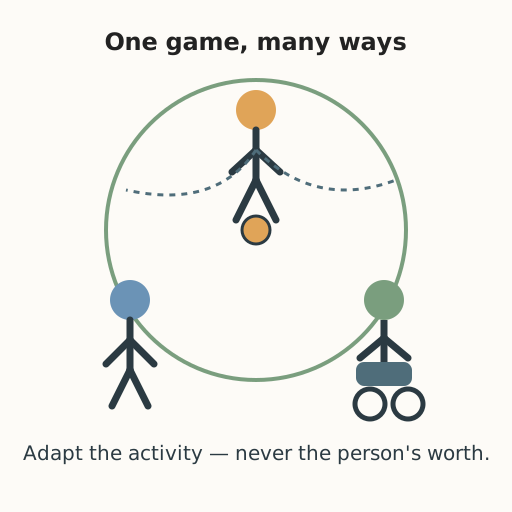
- Universal-design-game chart (printed or drawn) · 1 for the group A circle game shown playable standing, seated, and wheeling
- Practice log · 1 per learner
- Paper for a design sketch · per learner
Low-tech / no-cost
- Body, space, and found objects Design a game using only the room and simple objects (a rolled cloth ball, a soft container)
- Paper and pencil Sketch the activity and its adaptations
Enriched / lab & device
- Universal-design principles handout · 1 per pair The seven principles as a design checklist
- Adapted-sports video or examples (optional) · 1 for the group Wheelchair basketball, goalball, boccia, or other inclusive games, if available
Works in different contexts
- large-group Design one activity whole-class, collecting adaptations from many voices onto a shared board
- multi-age Younger learners suggest a playful adaptation; older learners check it against the universal-design principles
- self-directed A learner designs a complete inclusive activity and writes the rules and adaptations for a facilitator to run
- level-grouped Pair a "designer" with a "tester" who tries to find who is left out, then swap
- outdoor-only Design for an outdoor space with uneven ground, weather, and varied sound — name the environment's constraints and your adaptations
Lesson 10 — Designing Inclusive Movement
Summary
Learners design an inclusive movement activity — a game, dance, or routine — that adapts to many bodies (standing, seated, wheeling, low-energy) and environments (indoor, outdoor, small, loud, low-resource). They apply the seven principles of universal design and test their design with a partner, so the strand ends in a real, usable artifact.
Objectives
- Design inclusive movement activities that adapt to a wide range of bodies, abilities, and environments. (D03.S2.11.02)
Connection
Think of the last game you played where someone stood at the edge, watching. Maybe the rules assumed two working legs, quick hands, or full hearing. Now imagine the same game rebuilt so that the person at the edge plays fully — not as a “special” version, but as the way the game simply is. That is inclusive design: not an add-on for a few, but a design that never had a default to begin with.
Materials
- Universal-design-game chart
- Practice log
- Paper for a design sketch
Preparation
- Prepare the chart and the universal-design principles.
- Gather a few simple objects that could become game equipment (soft ball, cloth, container).
Facilitator note
This is the strand’s summative design task, and it should feel like real design work, not a worksheet. Walk learners through a worked example first: a simple circle pass game, then show how three adaptations widen it — play seated or standing; use a larger, softer, slower ball; allow an underarm roll instead of a throw; drop the “you’re out” rule in favor of “everyone keeps playing.” Then let learners design their own.
Anchor to the seven principles (Equitable Use, Flexibility in Use, Simple and Intuitive Use, Perceptible Information, Tolerance for Error, Low Physical Effort, Size and Space for Approach and Use; S-369). Ask designers to name which principle each adaptation serves. This turns “be nice to everyone” into a checkable design standard.
Test for who is left out. Require each design to name at least three distinct bodies/needs it welcomes (for example: a person who uses a wheelchair, a person with low energy or chronic pain, a Deaf or hard-of-hearing person, a person in a small or loud space) and at least one environment it works in. Avoid able-bodied default and avoid ranking bodies.
The ethics lens: inclusion is a design decision, not a favor. The egalitarian lens: who is in the circle, and who has been quietly designed out? The global lens: inclusive games and adapted sports exist worldwide (wheelchair basketball, goalball, boccia, and many traditional games with seated variants). The technology lens: consider whether equipment or an app widens access — or quietly depends on resources not everyone has.
Procedure
- Retrieve (5 min). Name the seven universal-design principles from memory (try for at least four), then check. What is the difference between a barrier and an adaptation?
- Study the worked example (10 min). Look at the chart: one circle game, three ways to play. List the adaptations and guess which universal-design principle each serves. Add one more adaptation of your own.
- Design (15 min). Choose a movement activity — a game, a simple dance, or a short routine. Write: the goal, the basic rules, and at least three adaptations that welcome different bodies or environments. Name the principle each adaptation serves. Sketch it if that helps.
- Test for gaps (10 min). Trade designs with a partner. Your job as tester: find one body or environment still left out, and suggest one way to widen the design. Revise your own design if the feedback fits.
- Write the final rules (10 min). Produce a clean, short set of rules a facilitator could run tomorrow — clear enough that anyone could lead it, in any setting.
- Close (5 min). One sentence to yourself: “A game is fair when…”
Differentiation
- Support: Provide a design template with fields (goal, rules, three adaptations, principle for each); design two adaptations instead of three.
- Extension: Ask learners to write a one-paragraph rationale for how their design reflects the social model of disability.
Assessment
- Summative (portfolio): A complete inclusive-movement design — goal, rules, three or more adaptations mapped to universal-design principles, and a tested revision that widens access.
- Peer: A tester’s check that no body or environment was left out without notice.
Home connection
Try your design with two or three people this week — family, friends, younger learners — in whatever space you have. Note what needed to change in the real world that you did not predict on paper. That is how good design is made.
Resources
- The Center for Universal Design (NC State) — The Principles of Universal Design: https://design.ncsu.edu/research/center-for-universal-design/ (S-369).
- UNESCO — International Charter of Physical Education, Physical Activity and Sport: https://www.unesco.org/en/sport-and-anti-doping/international-charter-sport (S-342).
- SHAPE America — fair play and inclusive physical education: https://www.shapeamerica.org/ (S-101).