Lesson 09 — Movement Traditions II: Dance, Sport, and Community
Learners complete the cross-cultural comparison with dance and sport, discovering that movement traditions do more than move bodies — they create belonging, transmit culture, and teach fair play. They synthesize a full comparison across all four categories: yoga, martial arts, dance, and sport.
Objectives
Objectives
- D03.S2.11.01 Compare movement traditions across cultures, such as yoga, martial arts, dance, and sport, and what each offers for health and community.
Essential question
What do dance and sport offer that movement alone does not — and what does each tradition offer for health and for belonging?
Key vocabulary
Materials
Standard materials
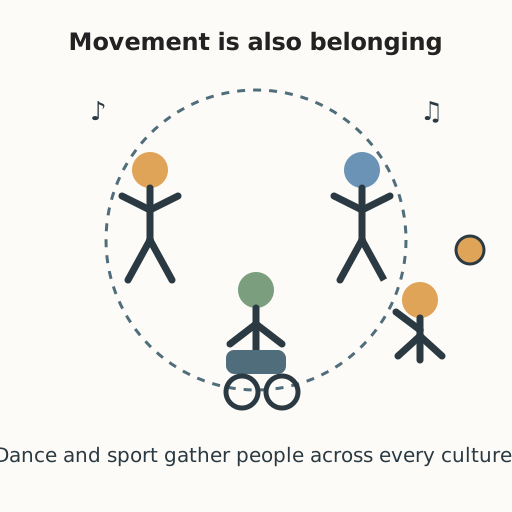
- Dance-sport-community chart (printed or drawn) · 1 for the group Figures dancing and playing sport together, including a wheelchair dancer
- Practice log · 1 per learner
Low-tech / no-cost
- Voice, body, and rhythm Clap or step a simple rhythm; no chart or music needed
- A shared game with adapted rules Any simple passing or circle game, played seated and standing
Enriched / lab & device
- Short clips of dance traditions (with respectful sourcing) · 1 for the group Real dancers demonstrating, if available and appropriate
- Library or web access · 1 per pair To research one dance or sport tradition with sources
Works in different contexts
- large-group Run a whole-room circle game with adapted rules; then debrief who could and could not easily join
- multi-age Younger learners learn a simple rhythm; older learners analyze fair play and inclusion in the game
- self-directed A learner researches one dance or sport tradition and writes a short comparison entry with sources
- level-grouped Group learners by interest (dance vs. sport) to research, then recombine to compare findings
- outdoor-only Play an adapted game outdoors and note how the setting (space, surface, sound) shapes who can join
Lesson 9 — Movement Traditions II: Dance, Sport, and Community
Summary
Learners extend their cross-cultural comparison to dance and sport, and discover the deeper offer of movement traditions: belonging. They play a simple, adapted game to feel inclusion and exclusion, then synthesize a four-way comparison — yoga, martial arts, dance, sport — as the strand’s portfolio artifact.
Objectives
- Compare movement traditions across cultures, including dance and sport, and what each offers for health and community. (D03.S2.11.01)
Connection
Think of a celebration you know — a wedding, a festival, a victory, a farewell. Almost always, people move: they dance, they play, they compete, they cheer. Movement is how communities mark joy and grief, welcome and goodbye. A dance is not just steps; a game is not just points. Each is a way a people says: we are here, together.
Materials
- Dance-sport-community chart
- Practice log
Preparation
- Prepare the chart and a simple passing or circle game with clear, adaptable rules.
Facilitator note
This lesson completes the strand’s comparison and adds its emotional heart: belonging. Teach the game as data, not just fun: run a circle or passing game once with rules that quietly exclude some bodies (for example, “stand to pass”), then run it again with rules that include everyone (seated and standing, larger/slower ball, no “out”). Debrief honestly about who could and could not join, and why. This makes the abstract idea of inclusion physical and memorable.
Dance traditions. Name a few respectfully as living heritage: tinikling (a Philippine folk dance stepping between bamboo poles; S-116), Bharatanatyam (South India), capoeira (an Afro-Brazilian art of movement, song, and resistance born among enslaved Africans; S-325, and UNESCO-inscribed in 2014 per S-056), haka (Māori), and countless regional dances. Sport traditions. Name traditional games as living heritage — kabaddi and kho-kho (South Asia), sepak takraw (Southeast Asia), and others (UNESCO TSG; S-287) — alongside globally played sports. In every case, emphasize: these are living traditions practiced by real communities, not museum pieces.
Fair play. UNESCO’s International Charter holds that sport and physical activity are a fundamental right and that opportunities must be inclusive of every person regardless of ability (S-342). Tie this to the game: fair play means everyone can play.
The ethics lens: a game that excludes some bodies is not fair, however exciting. The egalitarian lens: who gets to dance, to play, to belong — and who is left on the edge? The global lens: dance and sport are human universals expressed in a thousand local forms. The technology lens: broadcast sport and viral dance videos spread traditions globally — sometimes amplifying, sometimes flattening their meaning.
Procedure
- Retrieve (5 min). Without your log, name the three traditions from last lesson and one health offer each. Then check.
- Meet dance and sport (10 min). Study the chart. What is different about dance and sport compared to yoga or martial arts? (Rhythm, performance, competition, spectators, celebration.) Add your own community’s dance or sport if you wish.
- Play, then notice (15 min). Play the circle/passing game twice: first with a rule that only lets standing players pass, then with rules that welcome seated and standing players alike. After each round, write: who could join? who could not? how did it feel?
- Complete the comparison (10 min). Finish your four-row table — yoga, martial arts, dance, sport — with origin, health offer, and community offer. Use hedged, respectful language.
- Synthesize (5 min). One sentence: “Movement traditions matter for health because… and for community because…”
- Close (5 min). Reflect: what is one tradition from your own culture or family that deserves the same respect you gave the others today?
Differentiation
- Support: Provide a completed-row example and sentence frames; allow drawing the comparison.
- Extension: Ask learners to add a fifth row for a tradition they researched themselves, with a source.
Assessment
- Summative (portfolio): The four-way comparison table (yoga, martial arts, dance, sport) with origin, health offer, and community offer, written with respect and appropriate hedging.
- Self + peer: A reflection on how the two versions of the game felt differently.
Home connection
This week, watch or join a movement gathering in your community — a game, a dance, a sport, a festival — and note what it offers beyond exercise. Write one sentence about what you saw people share.
Resources
- UNESCO — Traditional Sports and Games: https://www.unesco.org/en/sport-and-anti-doping/traditional-sports-and-games (S-287).
- UNESCO — International Charter of Physical Education, Physical Activity and Sport: https://www.unesco.org/en/sport-and-anti-doping/international-charter-sport (S-342).
- Encyclopaedia Britannica — Capoeira (an Afro-Brazilian art of movement and song): https://www.britannica.com/sports/capoeira (S-325).
- NCCA Philippines — tinikling (Philippine folk dance): https://ncca.gov.ph/ (S-116).