Lesson 01 — Deep Listening: To Understand, Not to Win
Learners meet deep listening as a concrete, teachable skill: hearing fully, pausing before answering, reflecting back in their own words, and checking "did I get you?" They practice the loop in pairs on a low-stakes disagreement and name what makes it different from listening to win.
Objectives
Objectives
- D02.S1.11.01 Practice deep listening across disagreement, staying open to being changed by what others say.
Essential question
How do I listen to understand someone, even when I disagree, instead of listening only to win?
Key vocabulary
Materials
Standard materials
- Journal · 1 per learner
- Deep-listening loop diagram (print or draw) · 1 per learner Four steps — hear, pause, reflect back, check
Low-tech / no-cost
- Voice (or sign, writing, or gesture) and a partner Practice the loop with no chart; the steps live in the body, the breath, and any mode of attending — spoken, signed, written, or acted
Enriched / lab & device
- A short recorded dialogue or interview · 1 Listen to a real disagreement and practice reflecting each side back before choosing
Works in different contexts
- large-group Model the loop whole-class once, then practice in pairs; gather only brief shares at the end
- multi-age Younger learners practice the two middle steps (pause, reflect back); older learners analyze where the loop broke in a real dispute
- self-directed A learner works the loop alone by reflecting back a recorded or remembered disagreement in writing
- level-grouped A ready group tackles harder material: reflecting back a position they strongly oppose, without caricature
- outdoor-only Practice the loop in a walking pair — each step matched to a few paces, hearing before replying
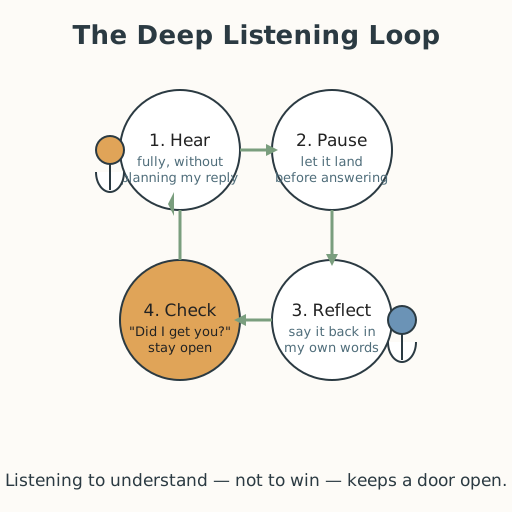
Lesson 1 — Deep Listening: To Understand, Not to Win
Summary
Learners meet deep listening as a skill they can practice, not a talent some people have. They learn a four-step loop — hear fully, pause, reflect back, check “did I get you?” — and practice it in pairs on a small, safe disagreement. They write a first reflection on what listening to understand feels like compared with listening to win.
Objectives
- Practice deep listening across disagreement, staying open to being changed by what others say. (D02.S1.11.01)
Connection
Think of the last argument where, while the other person was talking, you were silently rehearsing your next sentence. Most of us do this — it is ordinary, not a flaw. When you listen that way, you are not hearing the person; you are loading your own weapon. Deep listening is the opposite: you set your reply down for a moment and let the other person’s words actually reach you. This lesson gives you the tool for it — not a trick to win arguments, but a way to stay human with someone you disagree with.
Materials
- Your journal
- A deep-listening loop diagram (see the asset)
Preparation
- Print or draw the deep-listening loop diagram.
- Retrieval (spaced): recall from earlier grades (e.g., Grade 6 “acknowledge before you disagree,” Grade 10 de-escalation) one thing you already know about listening in conflict. Today we deepen it into a full, teachable loop.
Facilitator note
This lesson is written to the learner (“you”). The idea to land: deep listening is a concrete, practiced skill — hear fully, pause, reflect back, check — and its point is understanding, not winning. Teach the loop with a worked example, then let learners practice on a low-stakes disagreement (no forced disclosure of real conflicts).
The ethics lens: how we treat someone who disagrees with us is a moral choice, and listening well is one way we honor another person’s dignity. The egalitarian lens: deep listening levels the field — it gives the quieter or less powerful voice the same hearing as the loud one, and it refuses to let a disagreement turn one person into the loser and the other into the victor. The global lens: careful, reflective listening is practiced across cultures and traditions — from talking circles to council-style decision-making — and is a skill, not the property of any one region. The social-emotional lens: pausing before answering is self-regulation in action, and “reflect back” is perspective-taking made audible.
Emotional safety. Learners may have painful real conflicts. Use only invented, low-stakes practice disagreements (what to eat, which game, who should go first). No one is asked to disclose a real rift; “I’d rather not share” is always honored. Do not stage a debate with a “winner.”
Access. “Deep listening” names attention, not the ear. Non-hearing learners run the same loop by reading fully or watching a signed account; non-speaking learners reflect back by writing, sign, or gesture. The loop is about presence, and it is open to every mode of attending — this principle carries through the whole unit.
Procedure
- Recall (5 min). What is one thing you already know about listening well in a disagreement? Say or write it. Today we turn that into a loop you can run on purpose.
- Meet the loop (10 min). Worked example, together. Here is a small disagreement:
two housemates disagree about who should wash the dishes tonight. Watch the loop run:
- Hear fully — listen without planning your reply.
- Pause — let the words land before you answer.
- Reflect back — “So you’re saying you’re exhausted from work and the pile feels unfair to you. Is that right?”
- Check — “Did I get you?” and stay open to correction. Notice what is missing: the reply, the defense, the winning move. It comes later, and it is better for having waited.
- Practice in pairs (20 min). Choose a small, safe disagreement from the list (or invent one): the last slice of fruit, which music to play, whose turn it is to sweep. Partner A states a view. Partner B runs the loop — hear, pause, reflect back, check — before answering. Then switch. If your partner corrects your reflection, accept it and try again. That correction is the skill working.
- Reflect (15 min). In your journal, write: What did listening to understand feel like, compared with listening to win? Where was it hardest — the pause, the reflect, or the check? Be honest; difficulty here is information, not failure.
- Close (5 min). Put the loop diagram and your reflection in your portfolio. Say or write: I can listen to understand, not to win.
Differentiation
- Mode (expression): Writing is one way, not the only way — respond by speaking, drawing the loop, or acting it out; a response that uses neither writing nor speaking is still a full response.
- Access (deaf, hard-of-hearing, non-speaking): Run the loop non-aurally — read a partner’s written statement fully, or watch a signed account, before planning a reply; reflect back in writing, sign, drawing, or gesture; and check “did I get you?” on paper or a card. A non-speaking learner reflects back by writing, typing (AAC), signing, or pointing to a prepared card. Text, sign, and gesture are full listening and full speaking here.
- Support: Offer a sentence stem for the reflect-back step (“So what I hear you saying is …”) and a word bank.
- Extension: Run the loop on a disagreement you actually hold, in writing, and note whether reflecting the other side changes anything in you.
Assessment
- Formative (self + peer): In the pair practice, did the listener complete all four steps — hear fully, pause, reflect back in their own words, and check “did I get you?” — before answering?
- Portfolio: The loop diagram and the reflection, gathered toward D02.S1.11.01.
Home connection
With someone at home, try the loop once this week: let them finish, pause, then say back what you heard and ask “did I get you?” Notice what changes.
Resources
- CASEL — relationship skills and social awareness (listening as a core relationship skill): https://casel.org/fundamentals-of-sel/ (S-001).
- International Listening Association — listening skills: https://www.listen.org/ (S-174).
- On worked examples and guided practice for a new skill: Kirschner, Sweller & Clark (2006), https://doi.org/10.1207/s15326985ep4102_1 (S-011).