Lesson 02 — Staying Open to Being Changed
Learners practice the hardest part of deep listening: staying genuinely open to being changed. They learn the "steelman" — restating the strongest version of the view they oppose — and run a structured exchange in which each person must name one true thing in the other side. They reflect on "listening is not losing."
Objectives
Objectives
- D02.S1.11.01 Practice deep listening across disagreement, staying open to being changed by what others say.
Essential question
What would it take for me to genuinely change my mind — and can I welcome that instead of fearing it?
Key vocabulary
Materials
Standard materials
- Journal · 1 per learner
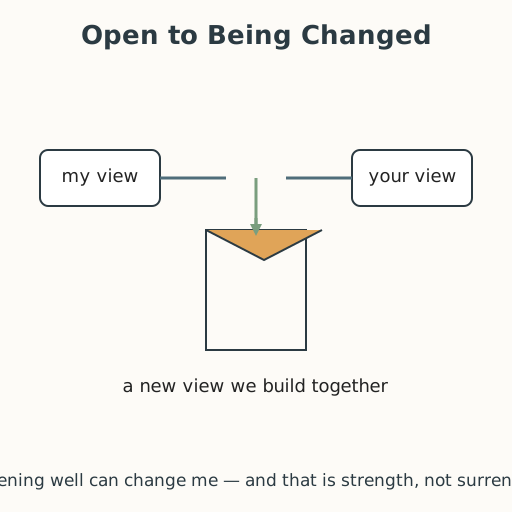
- Open-to-change diagram (print or draw) · 1 per learner Two views meeting at an open door to "a new view we build together"
Low-tech / no-cost
- Voice and a partner State your real view, hear theirs, and name one true thing in it — no chart needed
Enriched / lab & device
- A short text with two well-argued sides of one issue · 1 Use it to practice finding the strongest version of the view you oppose
Works in different contexts
- large-group Model the "steelman" once whole-class, then run the exchange in pairs; collect only one sentence each
- multi-age Younger learners name one thing they changed their mind about; older learners run the full steelman exchange
- self-directed A learner writes a steelman of a view they oppose, then names what in it gives them pause
- level-grouped A ready group debates a genuinely contested issue, required to restate the other side before replying
- outdoor-only Walk a loop: at each turn, state one thing you now see differently about a topic
Lesson 2 — Staying Open to Being Changed
Summary
Learners take deep listening one step further: not just hearing the other, but staying open to being changed by them. They learn the steelman — stating the strongest version of the view they oppose, instead of the weakest — and run a structured exchange where each person must name one true thing in the other side. They reflect on why “listening is not losing.”
Objectives
- Practice deep listening across disagreement, staying open to being changed by what others say. (D02.S1.11.01)
Connection
It is easy to listen politely while quietly staying exactly where you were. Being changed is harder — it can feel like losing. But consider: every belief you hold that is worth anything, you once did not hold. Someone, a book, an experience, a friend — something changed your mind to get you here. Being open to being changed is not weakness; it is how you got to be thoughtful at all. This lesson asks what it would take for you to change your mind again, on purpose, with dignity.
Materials
- Your journal
- An open-to-change diagram (see the asset)
Preparation
- Print or draw the open-to-change diagram.
- Retrieval (spaced): from Lesson 1, recall the four steps of the deep-listening loop. Today we ask the harder question that loop makes possible: am I willing to be changed?
Facilitator note
This lesson is written to the learner (“you”). The idea to land: deep listening culminates in real openness to being changed, and the “steelman” — restating the strongest version of the opposing view — is the concrete skill that makes it possible. Teach the steelman with a worked example; structure the exchange so no one is pushed to abandon a conviction, only to see it clearly.
The ethics lens: treating a disagreement as a shared search rather than a contest is an ethical stance — it treats the other person as a source of truth, not an obstacle. The egalitarian lens: a steelman gives the weaker or less popular side its best possible hearing, which is what fairness to ideas requires, not just fairness to people. The global lens: many traditions of decision-making — from deliberative councils to community assemblies — are built on the premise that the group is wiser when everyone can change the others and be changed in turn. The critical-thinking lens: steelmanning is the heart of reasoning well — you cannot refute a view you have not first understood at its strongest.
Emotional safety. Changing one’s mind can feel like a threat to identity. Frame it as curiosity and growth, never as defeat. No learner is graded on whether they change their mind — only on whether they can state the other side fairly. Offer opt-outs; a learner may choose a low-stakes topic or reflect privately. “Listening is not losing” is the constant refrain (Hess, S-349).
Procedure
- Recall (5 min). From Lesson 1, what are the four steps of the deep-listening loop? Now add the question the loop opens: would I let this change me?
- Meet the steelman (10 min). Worked example, together. A strawman is the weak, distorted version of an opposing view — easy to knock down. A steelman is the strongest, most honest version — hard to dismiss. Example: two people disagree about whether their village should build a road through a forest. The strawman of “no road” is “they don’t care about anyone’s job.” The steelman is “they fear losing a water source and a place the whole community depends on, and they want a slower, more careful plan.” That version is harder to dismiss — and truer.
- The exchange (20 min). In pairs, choose a topic you genuinely disagree on (small or large — a rule, a habit, a policy). Person A states their view in one or two sentences. Person B must steelman it back — “So your strongest point is…” — and then name one true thing in it. Switch. The rule: you may not answer until you have named one true thing in the other side.
- Reflect (15 min). In your journal: Did stating the other side’s best version change anything in how I see it? Was there a moment I felt myself soften? Be honest — no softening is also a real answer.
- Close (5 min). Put the diagram and reflection in your portfolio. Say or write: I can stay open to being changed — that is strength, not surrender.
Differentiation
- Mode (expression): Respond by speaking, writing, or drawing the two views meeting at an open door; expression is flexible.
- Access (deaf, hard-of-hearing, non-speaking): Run the exchange in writing, sign, or text instead of speech: each person writes or signs their view, then the other writes or signs the strongest version and one true thing. Reading or watching with full attention is the listening; writing, signing, typing (AAC), or drawing is the speaking.
- Support: Provide a steelman sentence frame (“Their strongest point is that …, and the true part is …”) and a list of low-stakes topics.
- Extension: Write a one-page steelman of a view you currently reject, then write the strongest reply you can — and name what, if anything, shifted.
Assessment
- Formative (self + peer): Did each person state the strongest version of the other’s view (not a strawman) and name one true thing in it before replying?
- Portfolio: The steelman exchange and the reflection, gathered toward D02.S1.11.01.
Home connection
Ask someone at home about a view you two differ on, and try stating their strongest point back to them before you answer. Ask: “Did I get you right?”
Resources
- Hess (2009), Controversy in the Classroom — structured deliberation across real disagreement, with “listening is not losing” held as a value (S-349).
- CASEL — relationship skills and social awareness: https://casel.org/fundamentals-of-sel/ (S-001).
- On worked examples and guided practice for a new skill: Kirschner, Sweller & Clark (2006), https://doi.org/10.1207/s15326985ep4102_1 (S-011).