Lesson 10 — Planning My Contribution to Belonging
Learners turn analysis into agency: they envision and plan one real contribution that strengthens belonging in a community they care about. They test the idea for who benefits and who is left out, then draft a concrete, doable plan with steps, a timeline, and a first move.
Objectives
Objectives
- D02.S3.11.02 Envision and plan a contribution that strengthens belonging in a community they care about.
Essential question
What is one real contribution I can plan that strengthens belonging in a community I care about — and how do I make it concrete enough to do?
Key vocabulary
Materials
Standard materials
- Journal · 1 per learner
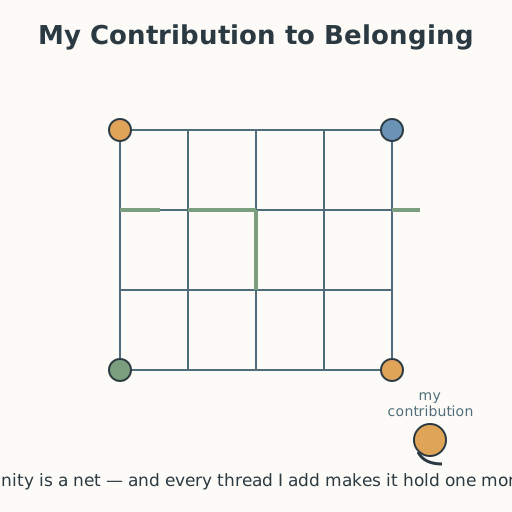
- Contribution-to-belonging diagram (print or draw) · 1 per learner A net of threads with one new thread being added — "my contribution"
Low-tech / no-cost
- Voice and a partner Talk through your idea and have a partner ask "what would make it real?"
Enriched / lab & device
- A list or map of local groups, needs, and opportunities · 1 Real places a contribution could land, gathered locally
Works in different contexts
- large-group Share ideas in small groups and give each one "one thing that would make it real" feedback
- multi-age Younger learners plan a small, immediate contribution; older learners plan a sustained one with steps
- self-directed A learner writes a full contribution plan alone, then tests it against one question: who benefits and who is left out
- level-grouped A ready group stress-tests each plan against feasibility, inclusion, and the lenses
- outdoor-only Choose a contribution to a shared outdoor space — a path, a garden, a clean-up — and sketch it on the ground
Lesson 10 — Planning My Contribution to Belonging
Summary
Learners stop analyzing and start contributing. They envision one real contribution that strengthens belonging in a community they care about, test it against the question “who benefits and who is left out?”, and draft a concrete plan — what, who, steps, timeline, and a first move small enough to actually take.
Objectives
- Envision and plan a contribution that strengthens belonging in a community they care about. (D02.S3.11.02)
Connection
A community is like a net: it holds people, but only where the threads are tied. A gap in the net is a person falling through — the newcomer no one greeted, the neighbor no one checks on, the quiet voice never asked. You do not have to weave the whole net. You only have to add one thread, in one gap, in a place you actually care about. That is a contribution. This lesson helps you plan yours so it is real enough to do, not just wish.
Materials
- Your journal
- A contribution-to-belonging diagram (see the asset)
Preparation
- Print or draw the contribution-to-belonging diagram.
- Retrieval (spaced): from Lesson 9, recall the three questions — who has a seat, who has no chair, who holds the gate. A contribution is aimed at a specific gap: a chairless person, a locked gate, a missing thread. Today we plan the thread.
Facilitator note
This lesson is written to the learner (“you”). The idea to land: a contribution to belonging is a concrete, planned action aimed at a real gap — and it must be tested for who benefits and who is left out. Teach the plan structure with a worked example; keep plans small enough to be feasible in the learner’s real circumstances (no resource-heavy requirements).
The ethics lens: contributing to belonging is a moral act — it treats another person’s being included as worth my effort. The egalitarian lens: test every plan against who benefits and who is left out — a contribution that helps the already-seated while ignoring the chairless is not yet a contribution to belonging (it may even widen the gap). The global lens: contributions to belonging take endlessly varied forms across cultures — hosting, sharing food, teaching a language, tending a shared space, welcoming a newcomer — and none is ranked above another; the common thread is the closing of a gap. The social-emotional lens: choosing where to care and acting on it builds purpose and agency — the feeling of mattering.
Emotional safety. Plans should be chosen freely and may stay private. No learner is required to commit publicly or to act outside their safety or capacity. A contribution to a small community (a family, a study group, a friendship) is as valid as one to a neighborhood or city; no scale is graded as better.
Procedure
- Recall (5 min). What are the three questions from Lesson 9? Which “gap” matters most to you in a community you actually know? Hold it.
- Meet the plan (10 min). Worked example, together. A learner notices that new
students eat alone. Their contribution plan:
- What: a weekly “welcome table” where new students are invited to sit.
- Who: the learner + two friends; the new students; the lunch monitor’s okay.
- Steps: ask the monitor → make a sign → invite one person the first week.
- First move this week: ask the monitor for permission.
- Test: who benefits (new students), who is left out (students who eat elsewhere — could the table rotate?), and is that acceptable?
- Draft your plan (20 min). In your journal, complete each part for your contribution: What? Who? Steps? First move this week? Then run the test: who benefits, who is left out, and can I adjust to include more?
- Peer check (10 min). In pairs, share plans (only what you choose). Your partner asks two questions: “What would make it real?” and “Who is still left out?” Adjust your plan.
- Close (5 min). Put the diagram and the plan in your portfolio. Say or write: I can add one thread to the net — and I have a plan to do it.
Differentiation
- Mode (expression): Plan by writing, drawing a map or net, or speaking it aloud; expression is flexible.
- Support: Offer a template with sentence starters and a menu of small contribution ideas.
- Extension: Draft the plan at two scales — one small and immediate, one larger and sustained — and compare feasibility and reach.
Assessment
- Formative (self + peer): Does the plan name a concrete contribution with a “what, who, steps, and first move,” and does it state who benefits and who is left out?
- Portfolio: The contribution plan, gathered toward D02.S3.11.02.
Home connection
Try the first move of your plan with your family’s encouragement — or name a small gap at home (a chore no one notices) and offer to be the thread that fills it.
Resources
- CASEL — responsible decision-making and social awareness (planning a prosocial act): https://casel.org/fundamentals-of-sel/ (S-001).
- On worked examples and guided practice for planning: Kirschner, Sweller & Clark (2006), https://doi.org/10.1207/s15326985ep4102_1 (S-011).