Lesson 09 — What Makes Communities Inclusive and Just
Learners analyze what makes communities inclusive and just — not only warm on the inside, but open at the edges and fair in how power, resources, and seats are shared. They learn to ask "who has a seat, who has no chair, and who holds the gate," and they audit one community they know.
Objectives
Objectives
- D02.S3.11.01 Analyze what makes communities resilient, inclusive, and just, using historical and contemporary examples.
Essential question
What makes a community inclusive and just — and who is being left out, even when the community feels warm to those inside it?
Key vocabulary
Materials
Standard materials
- Journal · 1 per learner
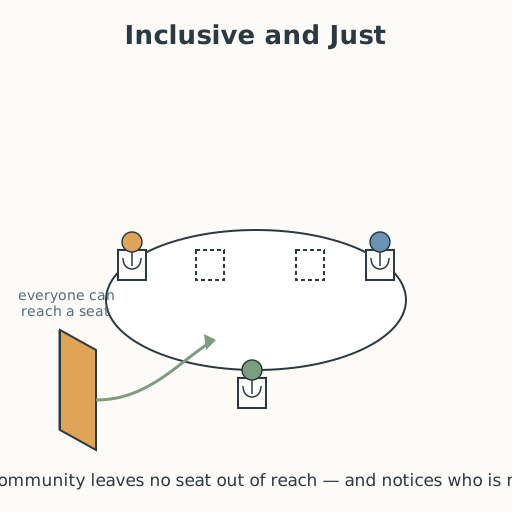
- Inclusive-just diagram (print or draw) · 1 per learner A table with varied figures seated, empty chairs, and an open gate "everyone can reach a seat"
Low-tech / no-cost
- Voice and a partner Discuss one group and ask: who has a seat, who has no chair, and who opens the gate
Enriched / lab & device
- A short text or case study of inclusion and exclusion in one community · 1 Historical or contemporary, from any world region, chosen with care
Works in different contexts
- large-group Arrange chairs for a "who has a seat" exercise — literally move chairs and name who is missing
- multi-age Younger learners name who is left out of a game or group; older learners analyze power, access, and the gate
- self-directed A learner audits one community they know for who is included and who is missing, and why
- level-grouped A ready group compares two communities' rules of membership and traces what each excludes
- outdoor-only Form a circle, then have one learner try to enter it; discuss who opens the circle and what the cost of entry is
Lesson 9 — What Makes Communities Inclusive and Just
Summary
Learners move from resilience to the harder questions of inclusion and justice. A community can be strong and still leave people out. Learners learn to ask three questions — who has a seat, who has no chair, and who holds the gate — and use historical and contemporary examples to see how belonging is given and withheld. They audit one community they know.
Objectives
- Analyze what makes communities resilient, inclusive, and just, using historical and contemporary examples. (D02.S3.11.01)
Connection
A group can feel wonderfully close to the people already inside it — and still have a locked door. The warmest table in the world is not just if some people were never invited, or were invited only to stand behind the chairs. Inclusion is not the same as being nice; it is about who can actually reach a seat, and justice is about who decides. This lesson gives you the three questions to ask any group, including your own.
Materials
- Your journal
- An inclusive-just diagram (see the asset)
Preparation
- Print or draw the inclusive-just diagram.
- Retrieval (spaced): from Lesson 8, recall the three roots of resilience. A community can have all three and still exclude people — resilience and justice are different things. Today we ask the justice question.
Facilitator note
This lesson is written to the learner (“you”). The idea to land: inclusion and justice are not feelings of warmth but structures — who has a seat, who has no chair, who holds the gate — and can be analyzed with historical and contemporary examples. Teach the three questions with a worked example; keep examples global and non-hierarchical.
The ethics lens: who a community leaves out, and whether that is just, is a moral question about the worth of persons — all persons, not only the ones already inside. The egalitarian lens: the lens is the core — look at how power and resources are shared, and at whose needs are treated as optional; note that exclusion is often structural and inherited, not chosen by the excluded (UNDP inequality data, S-283). The global lens: every society draws membership lines — by birth, language, ability, belief, gender, wealth, or migration status — and none has eliminated exclusion; the question is how the lines are drawn and whether they can be crossed. The critical-thinking lens: “who holds the gate” trains learners to look past a community’s self-description to its actual rules and power.
Emotional safety. Learners may recognize themselves as excluded, or as inside a group that excludes. Keep analysis structural, not personal-shaming; no one is asked to confess their own exclusion or exclusion of others. “I am still thinking about this” is a full answer. Emphasize that noticing is the first step to changing, never a verdict.
Procedure
- Recall (5 min). What were the three roots of resilience? Now a harder question: a community can be resilient and unfair. What is the difference?
- Meet the three questions (10 min). Worked example, together. Take a real pattern:
a thriving neighborhood association that “welcomes everyone” — but its meetings are
held at a time working people cannot attend, in a language not everyone speaks, and its
decisions are made by a few long-time members. Ask:
- Who has a seat? (the long-time members)
- Who has no chair? (newcomers, workers, non-speakers of the meeting language)
- Who holds the gate? (whoever sets the time, language, and agenda) Warmth is not the same as a chair.
- Study two examples (20 min). From the provided case study (or your own knowledge), choose two communities — one historical, one contemporary, from different regions. For each, answer the three questions: who has a seat, who has no chair, who holds the gate? Then ask the justice question: is the gate fair, and could it be opened?
- Audit a community you know (15 min). In your journal, choose one community you know. Run the three questions honestly: Who has a seat here? Who has no chair — and why? Who holds the gate? Then write one concrete change that would open it.
- Close (5 min). Put the diagram and the audit in your portfolio. Say or write: a just community notices who is missing — and opens the gate.
Differentiation
- Mode (expression): Audit by writing, drawing the table and chairs, or speaking; expression is flexible.
- Support: Provide a pre-filled example of the three questions and sentence frames for the audit.
- Extension: Compare two communities’ membership rules in depth and argue which is more just, and by what standard (see SEP distributive justice, S-388).
Assessment
- Formative (self): Does the audit answer all three questions (seat, no chair, gate) for one real community and propose one concrete change that would open it?
- Portfolio: The case comparison and the audit, gathered toward D02.S3.11.01.
Home connection
Ask someone at home: “Who is missing from the groups we belong to — and what would it take to invite them in?” Listen for the gate.
Resources
- UNDP — Human Development Reports (structural drivers of inequality and exclusion): https://hdr.undp.org/data-center (S-283).
- Stanford Encyclopedia of Philosophy, Distributive Justice: https://plato.stanford.edu/entries/justice-distributive/ (S-388).
- Tajfel (1970), minimal-group paradigm — in-group/out-group dynamics (S-232).
- On worked examples and guided practice: Kirschner, Sweller & Clark (2006), https://doi.org/10.1207/s15326985ep4102_1 (S-011).