Lesson 12 — Designing a Mutual-Aid or Cooperative Effort
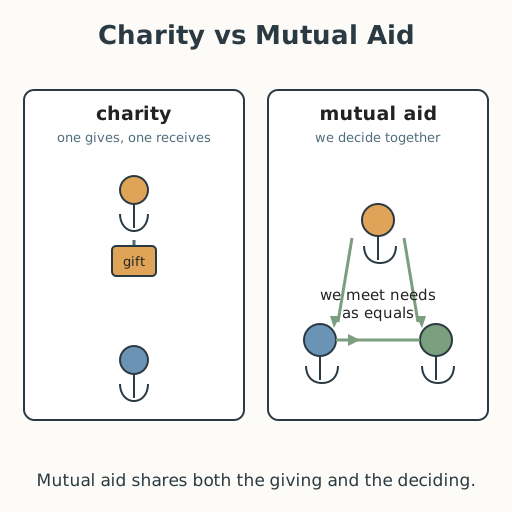
Learners design a mutual-aid or cooperative effort that meets a real need — and learn the difference between charity (one-way giving) and mutual aid (sharing both the giving and the deciding). They draft the effort's purpose, members, tasks, and decision-making so the people helped are co-authors, not recipients.
Objectives
Objectives
- D02.S4.11.02 Plan and begin a sustained mutual-aid or cooperative effort with accountability.
Essential question
How do I design a mutual-aid or cooperative effort that meets a real need — sharing both the giving and the deciding?
Key vocabulary
Materials
Standard materials
- Journal · 1 per learner
- Charity-vs-mutual-aid diagram (print or draw) · 1 per learner One-way giving versus a circle of equals deciding together
Low-tech / no-cost
- Voice and a partner Design the effort aloud (or in writing, sign, or gesture) with a partner playing the person you want to help — as an equal
Enriched / lab & device
- A short profile of a real cooperative or mutual-aid network · 1 e.g., a credit union, a worker co-op, a community kitchen — from any region
Works in different contexts
- large-group Design in small teams, then present each design in one minute for peer feedback on who decides
- multi-age Younger learners design a simple "help circle"; older learners design a cooperative with roles and shared decision-making
- self-directed A learner designs the full effort alone, then names where the power sits in each part
- level-grouped A ready group compares a charity model and a mutual-aid model for the same need and argues the trade-offs
- outdoor-only Design an effort around a shared outdoor need — a repair, a harvest, a shared space — with everyone holding a task
Lesson 12 — Designing a Mutual-Aid or Cooperative Effort
Summary
Learners design a real mutual-aid or cooperative effort that meets a need in a community they care about. They learn the key distinction — charity is one-way giving that keeps the power with the giver, while mutual aid and cooperatives share both the giving and the deciding — and they draft the effort so the people helped are co-authors, not recipients.
Objectives
- Plan and begin a sustained mutual-aid or cooperative effort with accountability. (D02.S4.11.02)
Connection
Imagine two ways to help a struggling neighbor. In one, you hand them food and decide what they need. In the other, you sit down together, ask what is needed, and build a way to meet it that they help run. The first is charity; the second is mutual aid. Both feed someone — but only the second treats the neighbor as an equal with a say. A cooperative — a shop, a farm, a credit circle owned and decided by its members — is that same idea made durable. This lesson helps you design the second kind, the kind that lasts and dignifies.
Materials
- Your journal
- A charity-vs-mutual-aid diagram (see the asset)
Preparation
- Print or draw the charity-vs-mutual-aid diagram.
- Retrieval (spaced): from Lesson 10, recall your contribution plan. A mutual-aid effort is a contribution grown into something shared and sustained — with others holding it, not just you. Today we design it.
Facilitator note
This lesson is written to the learner (“you”). The idea to land: a mutual-aid or cooperative effort differs from charity because it shares the deciding as well as the giving — and a good design names who is helped, who helps, what is done, and how decisions are made. Teach the charity/mutual-aid distinction with a worked example (Spade, S-345); hold “sharing power is better” as a value, distinct from the descriptive distinction.
The ethics lens: the difference between helping at someone and helping with someone is a moral difference about dignity and agency. The egalitarian lens: the core — where does the power sit? A design that lets the giver decide is charity; one that lets everyone decide is mutual aid. The global lens: mutual aid and cooperatives are widespread, documented forms across the world — communal-work traditions (harambee, gotong royong, mink’a/minga, S-164), worker cooperatives and credit unions (ICA, S-486; Mondragón, S-487) — not the invention of any one region. The technology lens: technology can carry a mutual-aid effort across distance (shared documents, group messages, digital collection) or concentrate decisions in a few hands — the design chooses which.
Emotional safety. Designing a real effort can feel like a big commitment. Reassure learners: this is a plan and a first beginning, not a lifetime pledge, and it may be small. No one is required to act beyond their capacity or safety. All forms of effort — a study-help circle, a shared garden, a mutual-fund pool, a co-op of any size — are equally valid; no scale is graded as better.
Procedure
- Recall (5 min). What was the contribution you planned in Lesson 10? Now imagine it is not your project but our project. What changes?
- Meet the distinction (10 min). Worked example, together. A need: several families
cannot afford school supplies.
- Charity: a donor buys supplies and distributes them. The donor decides; the families receive.
- Mutual aid: the families and neighbors pool small amounts, buy in bulk together, and together decide who needs what first. Everyone gives something; everyone decides. The goods may look similar; the power is different. A cooperative is this idea made permanent — members own and run it, one member one vote (ICA, S-486).
- Design the effort (25 min). In your journal (or with a partner), design a
mutual-aid or cooperative effort for a real need you can see. Answer:
- Need: what real need does it meet?
- Members: who is helped — and are they also helpers and deciders?
- Tasks: what does it do, and who does what?
- Deciding: how are decisions made, and how does every member have a voice?
- First move: what is the smallest first step this week?
- Peer check (10 min). Share designs in pairs (only what you choose). Your partner asks: “Where does the power sit?” and “Do the people helped have a voice?” Adjust.
- Close (5 min). Put the diagram and the design in your portfolio. Say or write: I can design help that shares the giving and the deciding.
Differentiation
- Mode (expression): Design by writing, drawing the circle of members, or speaking; expression is flexible.
- Support: Offer a template and a menu of small, feasible efforts; pair learners who want to design together.
- Extension: Draft the same effort twice — as charity and as mutual aid — and write which you would choose and why, naming the trade-off.
Assessment
- Formative (self + peer): Does the design name the need, the members (as helpers and deciders, not only recipients), the tasks, a decision-making method that gives every member a voice, and a concrete first move?
- Portfolio: The effort design, gathered toward D02.S4.11.02.
Home connection
Ask at home: “Is there something our household or street could do together that no one could do alone?” Notice where the deciding would sit.
Resources
- Spade (2020), Mutual Aid — charity vs. mutual aid and where the power sits (S-345).
- International Cooperative Alliance — cooperative identity and scale: https://www.ica.coop/ (S-486); Mondragón Corporation — worker cooperatives: https://www.mondragon-corporation.com/ (S-487).
- Communal-work traditions (harambee, gotong royong, mink’a/minga, barn-raising) (S-164).
- On worked examples and guided practice for design: Kirschner, Sweller & Clark (2006), https://doi.org/10.1207/s15326985ep4102_1 (S-011).