Lesson 13 — Beginning with Accountability
Learners take the final step: beginning. They convert their mutual-aid or cooperative design into a first commitment and a working accountability loop — agree, do, check and report, adjust. They set roles, a check-in rhythm, and a way to keep faith with each other, and they make their first move.
Objectives
Objectives
- D02.S4.11.02 Plan and begin a sustained mutual-aid or cooperative effort with accountability.
Essential question
How do I begin my mutual-aid or cooperative effort — and hold it (and myself) accountable as it grows?
Key vocabulary
Materials
Standard materials
- Journal · 1 per learner
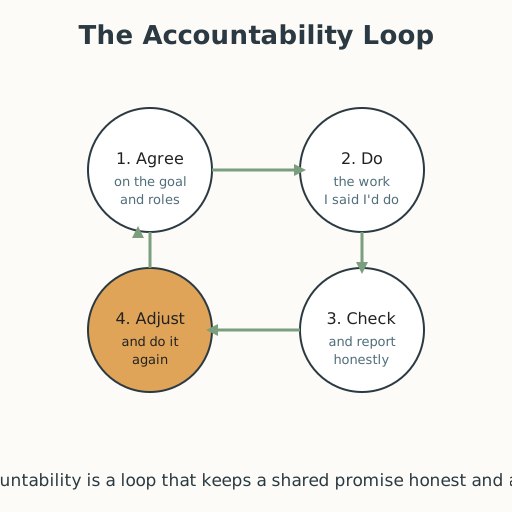
- Accountability-loop diagram (print or draw) · 1 per learner Agree, do, check and report, adjust — a loop that keeps a shared promise alive
Low-tech / no-cost
- Voice and a partner State your commitment aloud (or in writing, sign, or gesture) to a partner and set one check-in moment together
Enriched / lab & device
- A simple shared tracker (paper chart, shared document, or app) · 1 To record commitments, progress, and honest reporting
Works in different contexts
- large-group Learners state their first commitment aloud in small groups and choose a check-in partner
- multi-age Younger learners make one small promise with a buddy; older learners build the full accountability loop
- self-directed A learner writes a personal accountability plan and sets a calendar reminder to check in with themselves
- level-grouped A ready group designs the accountability *system* — how the whole group will report, adjust, and keep faith
- outdoor-only Make the loop physical: four marked spots you walk — agree, do, check, adjust — and plant a marker at "agree"
Lesson 13 — Beginning with Accountability
Summary
A plan is only paper until it begins — and it only lasts if it is held accountable. Learners convert their mutual-aid or cooperative design into a first commitment and a working accountability loop: agree on the goal and roles, do the work, check and report honestly, adjust and do it again. They set roles, a check-in rhythm, and a way to keep faith with one another — then take their first real step.
Objectives
- Plan and begin a sustained mutual-aid or cooperative effort with accountability. (D02.S4.11.02)
Connection
Most good intentions die quietly — not from lack of heart, but from lack of a loop. You decide to help, then the week fills up, and no one asks, and it fades. Accountability is not punishment or surveillance; it is the gentle structure that keeps a promise alive: you say what you will do, you do it, you tell the truth about what happened, and you adjust. Every lasting cooperative effort on Earth runs on some version of this loop. This lesson is where yours starts turning.
Materials
- Your journal
- An accountability-loop diagram (see the asset)
Preparation
- Print or draw the accountability-loop diagram.
- Retrieval (spaced): from Lesson 12, recall your effort’s design — need, members, tasks, deciding. Today we attach the loop that will keep it alive.
Facilitator note
This lesson is written to the learner (“you”). The idea to land: beginning means converting a plan into a first commitment wrapped in an accountability loop — agree, do, check and report honestly, adjust — so the effort sustains. Teach the loop with a worked example; keep commitments small, voluntary, and within the learner’s real capacity.
The ethics lens: keeping a promise to others — and telling the truth when I fall short — is the ethical core of accountability; it is what turns good feeling into trustworthy action. The egalitarian lens: accountability is mutual — it binds the powerful and the new equally, and “check and report” must be safe to do truthfully or it becomes theater. The global lens: sustained cooperation across cultures runs on shared expectations and honest reporting — from cooperative bylaws to communal-work rotas — all versions of the same loop. The social-emotional lens: naming a small commitment and following through builds self-trust and agency; honest self-reporting is emotional honesty practiced in public, kindly.
Emotional safety. Beginning can be intimidating. Keep first commitments small and real, never burdensome or unsafe. “Not yet ready to begin” is honored — a learner may refine the plan instead. Check-ins must be blame-free: reporting “I couldn’t do it” is information for adjusting, never a reason for shame.
Procedure
- Recall (5 min). From Lesson 12, what is your effort’s design? What is its smallest first step — the one you could actually take this week?
- Meet the loop (10 min). Worked example, together. A study-help circle’s first
week:
- Agree — the goal (two sessions this week) and roles (who hosts, who reminds).
- Do — each person does their part.
- Check and report — “I did mine; I couldn’t do mine” — honestly, without excuse and without shame.
- Adjust — change the time, swap roles, or shrink the goal — and do it again. The loop, not a single heroic effort, is what makes it sustained.
- Build your accountability plan (15 min). In your journal, complete:
- My first commitment: one concrete, small thing I will do this week.
- Who checks with me: a partner or the group — and when (a day, a moment).
- How we report honestly: a word, a mark, a short message.
- How we adjust: what we change if someone falls short, without blame.
- Begin (15 min). Do the first real move now if you can — send the message, make the sign, ask the question, plant the marker. If not now, write the exact day and time you will, and tell your check-in partner.
- Close (5 min). Put the diagram and the plan in your portfolio. Say or write: I have begun — and I have a loop to keep it true.
Differentiation
- Mode (expression): Plan by writing, speaking, or drawing the loop; expression is flexible.
- Access (deaf, hard-of-hearing, non-speaking): State the commitment in writing, sign, or a shared written chart instead of aloud; a written, typed, or signed check-in works as well as a spoken one. Honest reporting in any medium keeps the loop true.
- Support: Offer a template and pair each learner with a check-in partner who will also be checked on.
- Extension: Design the full group accountability system — cadence, format, and how the group will celebrate honest reporting as much as completion.
Assessment
- Formative (self + peer): Does the plan name a concrete first commitment, a check-in partner and time, an honest-reporting method, and a blame-free way to adjust? Has the learner taken (or scheduled) the first move?
- Performance: The begun effort, observed as an actual first step or a dated commitment with a named check-in.
- Portfolio: The accountability plan and first-move record, gathered toward D02.S4.11.02.
Home connection
Tell someone at home your first commitment and ask them to check with you on one specific day. Notice what changes when someone is watching kindly.
Resources
- Slavin (1995), Cooperative Learning — structures with individual accountability (S-147); Johnson & Johnson (1981), cooperative goal structures (S-233).
- International Cooperative Alliance — cooperative governance and accountability: https://www.ica.coop/ (S-486).
- On worked examples and guided practice: Kirschner, Sweller & Clark (2006), https://doi.org/10.1207/s15326985ep4102_1 (S-011).