Lesson 01 — Listening Across Accents and Dialects
Learners practice listening across accents, dialects, and viewpoints, separating the message from the voice that carries it, and name the reflex that treats one way of speaking as "correct." They build a listening record and begin the unit's cross-accent listening log.
Objectives
Objectives
- D04.S1.11.01 Listen across differences, including accents, dialects, and viewpoints, and identify assumptions in what is said.
Essential question
How do I listen across accents, dialects, and viewpoints with attention — and how do I catch the reflex that treats one way of speaking as "correct"?
Key vocabulary
Materials
Standard materials
- Listening record sheet · 1 per learner A table with columns for speaker, way of speaking, main idea, and one thing I almost misjudged
- Reading/learning journal · 1 per learner
Low-tech / no-cost
- Paper sheet folded into four columns, or lines drawn in the ground Same four columns — speaker, way of speaking, main idea, what I almost misjudged
- Voice and body (or sign, writing, or gesture) Take turns telling the same small story in different accents, dialects, or speeds — spoken or signed — and have listeners catch the main idea; where hearing is not the channel, use two different written or signed renditions and catch the idea from the page or the hands
Enriched / lab & device
- Short audio clips of speakers with different accents or dialects · 3 per class Speakers of the same language in different regions, or multilingual speakers — to practice listening for meaning, not for "correctness"
- Shared device · 1 per group To find one real recorded speaker with an accent different from the learner's own and note their main idea
Works in different contexts
- large-group Model one listening worked example whole-class, then learners practice in small circles of three to four, each retelling the previous speaker's main idea before adding their own
- multi-age Younger learners retell one main idea in a sentence; older learners add the "what I almost misjudged" column and compare two speakers
- self-directed A learner listens to three voices (family, media, community) with different ways of speaking and fills the record sheet alone
- level-grouped Learners ready to extend connect accent/dialect to register and preview Lesson 2's question about assumptions carried in tone
- outdoor-only Use the voices present — a market, a gathering, a neighbor — and fill the record sheet from live listening
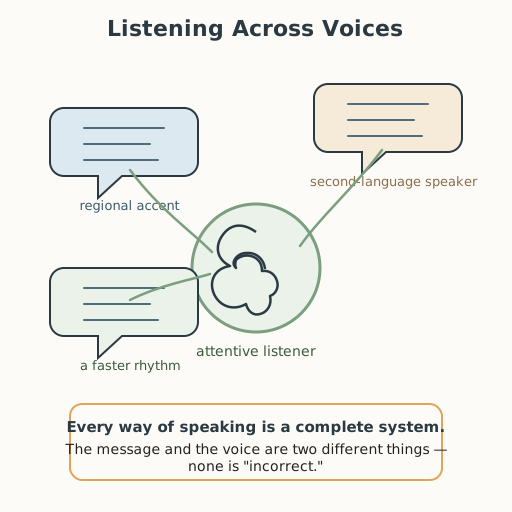
Lesson 1 — Listening Across Accents and Dialects
Summary
Learners meet the unit’s first skill: listening across differences of accent, dialect, and viewpoint — hearing the main idea a speaker is carrying rather than grading the voice that carries it. They learn that accents and dialects are complete, rule-governed systems, not “broken” versions of anything (S-167), name the reflex of linguistic prejudice, and begin the unit’s cross-accent listening log.
Objectives
- Listen across differences — including accents, dialects, and viewpoints — and identify assumptions in what is said, beginning here with hearing the message through an unfamiliar voice. (D04.S1.11.01)
Connection
Think of a time you understood someone perfectly even though they spoke differently from you — a relative from another region, a shopkeeper with another accent, a friend switching to a second language, a voice on a crackly call. You did the work of listening through the difference to reach the meaning. Now think of a time you or someone else stopped listening the moment the accent sounded “wrong” — and how much was missed. Every way of speaking is a complete system with its own rules and music (S-167); the listener’s real skill is to reach for the idea being shared, not to rank the voice. That skill is the doorway to this whole unit.
Materials
- Listening record sheet (speaker / way of speaking / main idea / what I almost misjudged)
- Learning journal
Preparation
- Copy or draw the four-column listening record sheet.
- Retrieval: from Grade 9–10, recall that a speaker’s word choice, tone, and delivery shape meaning (D04.S1.08.01) and that dialect and accent are natural variation, not error (D04.S4.07.02). Today we practice listening across that variation.
- Prepare one worked example: a short, familiar message said in two different ways of speaking.
Facilitator note
This lesson is written to the learner (“you”). The idea to land: accent and dialect are natural, complete, rule-governed variation — no way of speaking is “incorrect” — and the skilled listener reaches for the main idea instead of grading the voice (S-167). Every language and dialect is a full system of sounds and grammar; the varieties linguists call “non-standard” are no less systematic than the “standard” ones — the standard is just the variety that happened to be written down and given prestige. Linguistic prejudice (judging a speaker’s intelligence or worth by their accent) is a real, documented form of exclusion, not a neutral preference. Hold this as evidence about language and value about fairness in the same breath, but keep them distinct (philosophy §5).
Model the listening skill once, then let learners practice (worked example → guided practice → independent work; S-011). The global lens: there are roughly 7,000 living languages and countless dialects (S-426) — plus signed languages, which are complete languages with their own grammars, not “gestured” versions of speech — so “one accent for everyone” is not how the world is. The egalitarian lens: whose accent is called “clear” and whose is called “thick” is a question of power and history, not of clarity itself — the same sounds are praised in one mouth and mocked in another. The ethics lens: to listen fairly is to treat the speaker as a full person, not a specimen of a voice. The social-emotional lens: noticing the reflex to tune out or mock — in yourself — is self-awareness; invite, never force, sharing about a time you felt judged for how you speak.
Access. “Listening” names attention, not the ear. Non-hearing learners run the same skill through the eyes — reading two written renditions of one message, or watching two signers with different signing styles, and catching the main idea from the page or the hands. Provide any audio clip with a transcript or captions, and offer record sheets in large print and high contrast. This principle — every skill open to every mode of attending — carries through the whole unit, from listening across voices to bridging between speakers.
Preview: Lesson 2 turns to the next layer — assumptions carried inside what is said.
Procedure
- Recall (5 min). Think back: how does a speaker’s tone and delivery shape what you hear (D04.S1.08.01)? Today you train the listening side — hearing the idea through a voice that is not like yours.
- Meet the skill (10 min). Look at the listening record sheet. The four columns: speaker, way of speaking, main idea, what I almost misjudged. Watch a worked example: one message (“the water must be carried before noon”) said twice — once in a familiar way, once in an unfamiliar accent or dialect. Notice: the idea is identical; only the voice changed. Name the reflex to call one “clear” and the other “thick.”
- Learn the linguistics (10 min). Every accent and dialect is a complete system with its own rules — not “broken” and not “incorrect” (S-167). So are signed languages and creoles: a sign language is a full language with its own grammar (not “gestured speech”), and a creole is a complete language, not a “broken” form of another. There is no “correct accent,” only a variety that gained social prestige. Write in your journal: one way of speaking from your own life that people sometimes judge, and why the judgment is about status, not about the voice itself.
- Practice in a circle (15 min). In groups of three or four, take turns telling a short, true story — and try it in a different accent, dialect, speed, or language you partly know. Each listener, before adding their own story, must restate the previous speaker’s main idea in one sentence. Fill your record sheet as you go.
- Catch the reflex (10 min). In the “what I almost misjudged” column, write one honest moment where you almost tuned out or graded a voice. Then write the main idea you would have lost.
- Close (5 min). Remember: the message and the voice are two different things. Today you began the unit’s cross-accent listening log — keep it growing all unit long. Next time: the assumptions hiding inside the words.
Differentiation
- Access (deaf, hard-of-hearing, low-vision, non-speaking): Catch the main idea from any channel — a transcript, a caption, a written rendering, or a signed account — and restate it in writing, sign, typing (AAC), or by pointing. Two written or signed renditions of one message carry the same skill as two spoken accents.
- Support: Provide a short list of three messages read aloud two ways; ask only “what is the main idea?” and “which voice felt easier, and why might that be?”
- Extension: Find a recording of a speaker whose accent differs from yours, note their main idea, and identify one feature of their way of speaking (a sound, a rhythm, a word) that you can describe without judging it.
Assessment
- Formative (self): Can the learner restate a speaker’s main idea across an unfamiliar accent or dialect, and name one reflex of linguistic prejudice they caught in themselves?
- Portfolio artifact (unit): The first page of the cross-accent listening record, added to the unit portfolio as the opener of the “listening across differences” log.
Home connection
Ask an adult you trust: have you ever been judged for the way you speak — and how did it feel? Listen without interrupting, then tell them one main idea you heard in their story.
Resources
- On dialects and accents as complete, rule-governed systems (not “broken” varieties): Everett, Language: The Cultural Tool (2012) (S-167).
- On the number of living languages (roughly 7,000) and endangerment: Ethnologue — Languages of the World, https://www.ethnologue.com/ (S-426).
- On modeling + guided practice before independent work: Kirschner, Sweller & Clark (2006), https://doi.org/10.1207/s15326985ep4102_1 (S-011).