Lesson 02 — Identifying Assumptions in What Is Said
Learners learn to identify assumptions — the unstated beliefs a spoken claim stands on — using a three-part probe across accents, dialects, and viewpoints. They apply it to real claims from their week and begin to see that most of an argument lives beneath the surface.
Objectives
Objectives
- D04.S1.11.01 Listen across differences, including accents, dialects, and viewpoints, and identify assumptions in what is said.
Essential question
How do I hear the assumptions hiding inside what a speaker says — the unstated beliefs the words stand on?
Key vocabulary
Materials
Standard materials
- Assumption probe sheet · 1 per learner Three prompts — "what is said aloud," "what must already be true for this to make sense," "what would someone who disagrees question" — with room to write
- Learning journal · 1 per learner
Low-tech / no-cost
- Paper folded into three rows, or lines drawn in the ground The same three prompts written by hand
- Voice and body (or sign, writing, or gesture) Say — or write or sign — a statement and have a partner name what it assumes; then reverse roles
Enriched / lab & device
- Short video or audio of a real speech or debate (optional) · 1 per class To hunt for assumptions in a live argument, pausing to name each one
- Shared device · 1 per group To find one real claim from the news or a post and list its assumptions
Works in different contexts
- large-group Model the probe whole-class on one claim, then pairs apply it to a second claim and share one assumption each
- multi-age Younger learners name one assumption in a single simple sentence; older learners separate assumption from evidence and weigh whether the assumption is fair
- self-directed A learner runs the probe on three real claims they heard this week and writes each assumption out
- level-grouped Learners ready to extend connect assumptions to Lesson 3's argument structure — the warrant that a claim stands on
- outdoor-only Use a remembered claim from the community (a rule, a proverb, a dispute) and probe it aloud in a circle
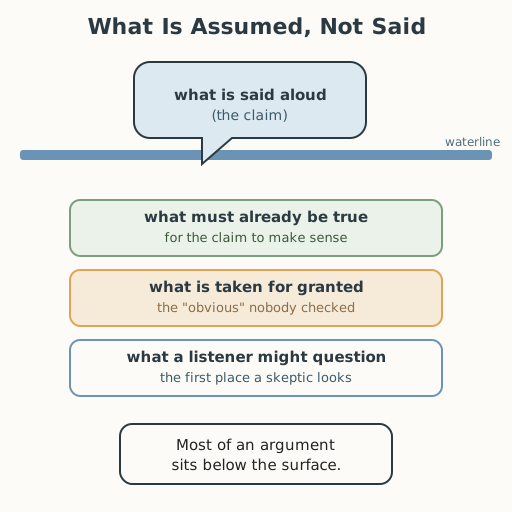
Lesson 2 — Identifying Assumptions in What Is Said
Summary
Learners move from hearing through a voice to hearing beneath the words: they learn to identify assumptions — the unstated beliefs a spoken claim stands on — using a three-part probe. They apply the probe to real claims from their week, across different viewpoints, and add an assumption log to the unit portfolio.
Objectives
- Listen across differences and identify assumptions in what is said — by naming the unstated beliefs a claim rests on, whatever the voice that speaks it. (D04.S1.11.01)
Connection
When someone says “you’re old enough to know better,” a whole shelf of beliefs is already assumed: that age brings duty, that you did know, that knowing is enough to change behavior. None of it is spoken — it is carried silently under the words. Every claim you hear, from a parent’s rule to a leader’s promise to an ad’s slogan, stands on assumptions like a house stands on its foundation. Learning to see the foundation — before you agree or disagree — is what keeps you from being moved by words whose support you never checked.
Materials
- Assumption probe sheet (what is said / what must be true / what a skeptic questions)
- Learning journal
Preparation
- Copy or draw the three-part probe sheet.
- Retrieval: from Lesson 1, recall that the message and the voice are different things. Today we look beneath the message for the beliefs it stands on.
- Prepare one worked example: a familiar claim with an obvious unstated assumption.
Facilitator note
This lesson is written to the learner (“you”). The idea to land: a spoken claim carries unstated assumptions — premises the speaker takes for granted — and the critical listener names them before agreeing or disagreeing. Assumptions are not automatically wrong; they are simply unstated. Some are fair and shared; some are dubious and, once named, collapse. The skill is to surface them so they can be judged on their merits (critical-thinking lens). This is the listening half of the standard: identifying assumptions across accents, dialects, and viewpoints — not just in the voices that sound like ours.
Model the probe once, then let learners practice (worked example → guided practice → independent work; S-011). The critical-thinking lens is the spine: every claim has a “what must already be true?” layer. The egalitarian lens: assumptions often encode who is assumed to be normal, capable, or included — “everyone has a phone,” “everyone celebrates this holiday,” “a family means a mother and father.” Naming those assumptions is how exclusion becomes visible. The ethics lens: fair disagreement requires naming the assumption you reject, not attacking the person who holds it. The global lens: what is “obviously true” in one culture or language is a visible assumption in another — probe across viewpoints, not only within your own. The social-emotional lens: catching assumptions in yourself can feel exposing; keep the tone gentle and treat “I didn’t realize I assumed that” as a discovery, not a fault. Preview: Lesson 3 builds the argument you will speak — and naming your own assumptions is the first step to defending them.
Procedure
- Recall (5 min). From Lesson 1: the message and the voice are different. Today you dig under the message itself — to the beliefs it never says out loud.
- Meet the probe (10 min). Look at the assumption probe sheet. Three questions: what is said aloud? what must already be true for this to make sense? what would a listener who disagrees question first? Watch a worked example: “You’re old enough to know better” — what must be true? (Age brings duty; you knew; knowing is enough.) Name each assumption.
- Probe real claims (15 min). Write three claims you actually heard this week — from family, a post, a speech, a song, an ad. For each, run the three questions. Underline the assumption that carries the most weight.
- Sort assumptions (10 min). Mark each assumption as fair and shared (most people would accept it), debatable (reasonable people differ), or hidden exclusion (it quietly assumes one kind of person is “normal”). Write one of each kind.
- Probe across viewpoints (10 min). Take one claim and imagine it spoken by two very different people — a grandparent and a younger sibling, a city neighbor and a rural neighbor. Does the same claim carry different assumptions in different mouths? Write what changes.
- Close (5 min). Remember: most of an argument lives under the surface, and you can see it. Add this page to your assumption log. Next time: you build the speech — and you will state your assumptions on purpose, not leave them hidden.
Differentiation
- Access (deaf, hard-of-hearing, non-speaking): The probe runs entirely on written claims — a sentence on paper carries its assumptions just as fully as one spoken aloud; read it, or have it read back, and name the assumption in writing, sign, or typing (AAC).
- Support: Provide three prepared claims with the assumption already half-named (“This claim assumes that ____.”) and ask learners to fill the blank.
- Extension: Take one public claim and write out the full chain of assumptions it depends on, then mark the weakest link and explain what would happen if it were removed.
Assessment
- Formative (self): Can the learner name at least one unstated assumption behind a real claim, and say whether it is fair, debatable, or exclusionary?
- Portfolio artifact (unit): The assumption probe sheet for one real claim, added to the portfolio as the “identifying assumptions” entry of the listening log.
Home connection
Listen to one claim an adult makes this week — a rule, a plan, a worry — and gently ask together: what are we assuming when we say that? See what naming it changes.
Resources
- On critical listening and evaluating reasoning (surfacing unstated support): UNESCO Media and Information Literacy framework (S-217).
- On the argument model behind claims, support, and warrants: Toulmin, The Uses of Argument (1958) (S-236).
- On modeling + guided practice before independent work: Kirschner, Sweller & Clark (2006), https://doi.org/10.1207/s15326985ep4102_1 (S-011).