Lesson 16 — The Live Bridge: Interpreting in a Real Setting
Learners complete the unit by performing a live bridge — interpreting between two speakers of different languages in a real setting — and recording what the bridge made possible. They reflect on the whole unit and gather their portfolio artifacts, closing the spiral of multilingual practice as wealth.
Objectives
Objectives
- D04.S4.11.02 Bridge between speakers of different languages in a real setting, interpreting main ideas with accuracy and care.
Essential question
How do I bridge between speakers of different languages in a real setting — interpreting main ideas with accuracy and care, and reflecting on what the bridge made possible?
Key vocabulary
Materials
Standard materials
- Live-bridge record · 1 per learner A record page — the setting, the speakers and their languages, the main ideas carried across, one checking-back moment, and one thing the bridge made possible
- Learning journal · 1 per learner
Low-tech / no-cost
- Paper record drawn by hand, or marks in the ground The same record on any surface
- Voice and body (or sign, writing, or gesture) Conduct the live exchange in a real three-way conversation — spoken, signed, or written — with the record filled afterward
Enriched / lab & device
- Recording device (optional, with consent) · 1 per pair To record the live bridge for the portfolio, where all participants agree
- Shared device to write or share the reflection (optional) · 1 per group To prepare the interpreting record for the portfolio
Works in different contexts
- large-group Run several simultaneous bridges in trios, then gather to share one moment each where checking back protected the meaning
- multi-age Younger learners bridge a short, simple exchange; older learners bridge a fuller one and write the reflection
- self-directed A learner arranges a real exchange with two willing speakers and fills the live-bridge record alone, then reflects in writing
- level-grouped Learners ready to extend note how they drew on more than one language (plurilingual competence) and what they would do differently
- outdoor-only Hold the bridge in a real outdoor setting — a market, a garden, a gathering — where two speakers genuinely need to understand each other
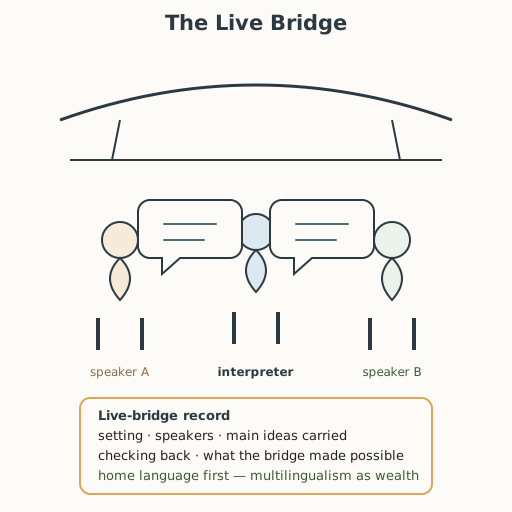
Lesson 16 — The Live Bridge: Interpreting in a Real Setting
Summary
Learners complete the unit with a live bridge: interpreting between two speakers of different languages in a real setting, and recording what the bridge made possible. They reflect on the whole unit and gather their portfolio artifacts — closing the spiral that began with listening across a voice and ends with carrying meaning across two.
Objectives
- Bridge between speakers of different languages in a real setting, interpreting main ideas with accuracy and care — and reflect on what the bridge made possible. (D04.S4.11.02)
Connection
All unit long you have crossed borders with your ears, your eyes, and your pen: you listened through an unfamiliar voice, read a text against its missing voice, carried your own words into a second language, and weighed the policies that decide whose language counts. Today you do the thing itself: two people who could not reach each other, and you — the bridge. Not because you are fluent in everything, but because you know to listen for the main idea, render it faithfully, check back, and admit when you are unsure. That is enough to let two humans meet.
Materials
- Live-bridge record (setting / speakers and languages / main ideas carried / one checking-back moment / what the bridge made possible)
- Learning journal
Preparation
- Copy the live-bridge record.
- Retrieval: from Lesson 15, recall the four moves — listen for the main idea, render it faithfully, check back, admit when unsure. Today you perform them live.
- Arrange a real setting and two willing speakers where possible, or use two speakers in the room with different languages or registers.
Facilitator note
This lesson is written to the learner (“you”). This is the unit’s capstone performance: a live bridge between two speakers of different languages in a real setting, with a written reflection on what the bridge made possible. The standard is accuracy and care, not fluency (S-237): a learner who checks back and admits uncertainty has met it fully. Where two real languages are not available, two registers or ways of speaking serve as a faithful low-threshold setting (egalitarian lens). The live bridge is also the unit’s closing retrieval and spacing payoff — every earlier skill returns here: listening across difference (Lessons 1–2), carrying meaning (5–6), reading position (7–8), writing across languages (11–12), weighing policy (13–14), bridging (15) (S-039).
Run the bridges in trios, then reflect (performance → reflection; S-011). The ethics lens: the bridge must serve both speakers equally — never “winning” for one side, never adding or dropping meaning. The egalitarian lens: every language in the room is a full language, and the bridge honors both, ranking neither. The global lens: this is a worldwide, ancient human act — in markets, clinics, courts, and families everywhere, people carry meaning across. The social-emotional lens: celebrate what the bridge made possible — connection — and name the care it took. The community lens: the bridge is an act of mutual aid; reflect on how it strengthens the group, not just the interpreter. Close by gathering the portfolio and honoring multilingualism as wealth, home language first.
Procedure
- Recall (5 min). From Lesson 15: the four moves — listen for the main idea, render it faithfully, check back, admit when unsure. Today you perform them live.
- Set the scene (8 min). Form a trio (or a real setting with two speakers who need each other). Agree on the exchange: one speaker has something to say or ask; the other needs to understand and reply. You are the bridge.
- Perform the live bridge (20 min). Interpret the exchange. Use all four moves. Carry the main ideas, not every word. When unsure, say so and check back. Let the exchange reach a real understanding — or honestly name where it could not.
- Record it (10 min). Fill the live-bridge record: the setting, the speakers and their languages, the main ideas you carried, one checking-back moment, and what the bridge made possible.
- Reflect on the unit (8 min). In your journal, write two or three sentences: what changed in how you listen, read, write, or bridge, from Lesson 1 to today? Which skill will you carry forward?
- Close (5 min). Gather your portfolio artifacts — the listening log, the speech scaffold and delivery, the translation comparison, the author-position analysis, the extended work, the adaptations, the policy evaluations, and this live-bridge record. Remember: home language first, multilingualism as wealth — and you, the bridge.
Differentiation
- Access (deaf, hard-of-hearing, non-speaking): The live bridge may be signed, written (passing notes), or spoken; fidelity and checking back are the standard in every channel. A non-speaking learner bridges by writing, typing (AAC), or signing; a deaf learner bridges between a signer and a speaker, or between two signed languages.
- Support: Bridge a short, simple exchange (one question and one answer) and record one checking-back moment.
- Extension: Bridge a fuller exchange with a moment of real ambiguity, and write what you would do differently next time — including drawing on more than one of your own languages (S-237).
Assessment
- Performance + self/peer: Can the learner bridge a real exchange, carrying main ideas with fidelity, checking back, and admitting uncertainty — and reflect on what the bridge made possible?
- Portfolio artifact (unit): The live-bridge record, added to the portfolio as the “live interpreting record” — the unit’s closing multilingual artifact.
Home connection
Offer to be the bridge one more time this week — in a shop, a message, a family call — even for one sentence. Then tell someone what it felt like to let two people meet.
Resources
- On plurilingual competence and mediation between languages: Council of Europe, CEFR Companion Volume (S-237).
- On spaced retrieval across a unit’s arc: Dunlosky et al. (2013), https://doi.org/10.1177/1529100612453266 (S-039).
- On modeling + guided practice before independent work: Kirschner, Sweller & Clark (2006), https://doi.org/10.1207/s15326985ep4102_1 (S-011).