Lesson 15 — Bridging Between Speakers: Interpreting with Care
Learners practice interpreting between two speakers of different languages using a four-move protocol — listen for the main idea, render it faithfully, check back, and admit when unsure. They learn interpretation is carried meaning, not word-for-word exchange, and prepare for a live bridge in Lesson 16.
Objectives
Objectives
- D04.S4.11.02 Bridge between speakers of different languages in a real setting, interpreting main ideas with accuracy and care.
Essential question
How do I interpret between two speakers of different languages — carrying the main ideas across with accuracy and care, without adding or dropping meaning?
Key vocabulary
Materials
Standard materials
- Interpreting protocol card · 1 per learner The four moves — listen for the main idea, render it faithfully, check back with the speaker, admit when unsure — printed or hand-copied
- Learning journal · 1 per learner
Low-tech / no-cost
- Paper protocol card written by hand, or marks in the ground The same four moves on any surface
- Voice and body (or sign, writing, or gesture) A three-way practice — one speaker, one listener who does not share the language, one interpreter — using gesture, sign, or writing as well as speech, with patience
Enriched / lab & device
- A short recorded or live dialogue between two languages (optional) · 1 per pair To practice rendering main ideas across a real language pair
- Shared device · 1 per group To hear a real interpreting moment and note how the interpreter checks back
Works in different contexts
- large-group Model one interpreting exchange whole-class, then trios practice the four moves with rotating roles, sharing one checking-back moment
- multi-age Younger learners render one main idea; older learners handle a full exchange and manage a moment of uncertainty aloud
- self-directed A learner practices the protocol with two willing speakers (or a recording) and writes where they checked back or admitted uncertainty
- level-grouped Learners ready to extend connect interpreting to plurilingual competence — drawing on all one's languages to mediate (S-237)
- outdoor-only Practice in a real three-way circle where two people genuinely do not share a language, using the four moves with care
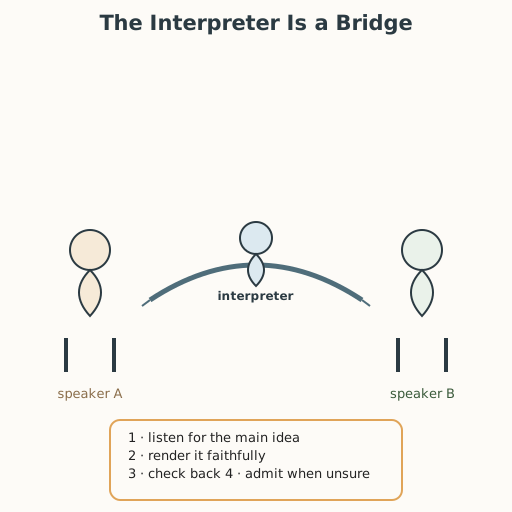
Lesson 15 — Bridging Between Speakers: Interpreting with Care
Summary
Learners practice interpreting between two speakers of different languages using a four-move protocol — listen for the main idea, render it faithfully, check back, and admit when unsure. They learn that interpretation is carried meaning, not word-for-word exchange, and they prepare for a live bridge in Lesson 16.
Objectives
- Bridge between speakers of different languages in a real setting, interpreting main ideas with accuracy and care — beginning with the protocol of faithful rendering. (D04.S4.11.02)
Connection
Two people who do not share a language can still need each other badly: a patient and a nurse, a buyer and a seller, a neighbor and a neighbor, a child and a grandparent whose languages drifted apart. The person in the middle is not a dictionary — a dictionary has no loyalty to meaning. The interpreter’s job is to carry what the speaker means across, faithfully, and to say honestly when the meaning will not cross. Done well, it is one of the most quietly powerful things a human being can do for another.
Materials
- Interpreting protocol card (listen for the main idea / render it faithfully / check back / admit when unsure)
- Learning journal
Preparation
- Copy or draw the four-move protocol card.
- Retrieval: from Lessons 5–6, recall that translation gains, loses, and changes, and that the human — not the tool — carries meaning with judgment. Today we interpret live, between people.
- Prepare a worked example: one short exchange, interpreted with a checking-back move.
Facilitator note
This lesson is written to the learner (“you”). The idea to land: interpretation is carrying meaning, not words — the interpreter listens for the main idea, renders it faithfully, checks back with the speaker, and admits when unsure; accuracy and care, not fluency, are the standard. Interpretation is a real skill of plurilingual competence — drawing on more than one language to mediate between people (S-237). A learner who is not fluent in two languages can still practice the protocol by interpreting between two registers or ways of speaking (child ↔ adult, formal ↔ informal), which is genuine bridging; the standard says “bridge between speakers of different languages,” and register-bridging is a faithful, low-threshold version of it (egalitarian lens — never gate the skill behind fluency).
Model the four moves once, then let trios practice (worked example → guided practice → independent work; S-011). The ethics lens is the spine: the interpreter’s first duty is to the meaning and the speaker — never to add, drop, or “improve” what was said; admitting uncertainty is honesty, not failure. The egalitarian lens: a good bridge treats both speakers as full persons, never as the “fluent” one and the “other” one. The global lens: interpretation is ancient and worldwide — trade, diplomacy, families, and courts have always needed people who carry meaning across. The social-emotional lens: being interpreted can feel vulnerable; the interpreter holds both speakers with care and patience. The critical-thinking lens: the interpreter decides what is the main idea — that is a judgment call, and “check back” is how it stays honest. Preview: Lesson 16 is the live bridge — a real setting, a real exchange, recorded for the portfolio.
Procedure
- Recall (5 min). From Lessons 5–6: translation carries meaning with judgment, and the human is the carrier. Today you interpret live, between two people.
- Meet the four moves (10 min). Look at the interpreting protocol card. The moves: listen for the main idea (not every word), render it faithfully (say what they meant), check back (“did I carry that right?”), admit when unsure (“I am not certain of this word — may I ask?”). Watch a worked example.
- Learn what interpretation is not (8 min). It is not word-for-word swapping — that produces nonsense. It is carried meaning (S-237). Write in your journal the difference in your own words, with one example.
- Practice in trios (20 min). In groups of three: a speaker (one language or register), a listener (who does not share it), and an interpreter (who bridges). Rotate roles. The interpreter must use all four moves at least once.
- Notice the hard moment (8 min). Write one moment where you had to check back or admit you were unsure — and what happened when you did. That moment is the skill, not a mistake.
- Close (5 min). Remember: the interpreter carries meaning, not words — with accuracy and care, not fluency. Add this page to your interpreting record. Next time: the live bridge, in a real setting.
Differentiation
- Access (deaf, hard-of-hearing, non-speaking): Interpreting is not only spoken. A learner may interpret between two written texts, between a signer and a speaker, or between two registers in writing. “Listen for the main idea” means attend — watch the signer’s hands and face, or read the line — and carry the meaning across in the channel the listener uses.
- Support: Interpret a single short sentence between two registers, using “check back” once.
- Extension: Interpret a longer exchange and manage one moment of real uncertainty aloud, then reflect on what “checking back” protected.
Assessment
- Formative (peer + self): Can the learner render a speaker’s main idea across a language or register, check back, and admit uncertainty when it arises?
- Portfolio artifact (unit): The protocol card with a note of one practiced exchange, added to the portfolio as the “interpreting record” opener.
Home connection
Find a moment at home where two people are not quite understanding each other — and quietly carry the main idea across once, then ask both if you got it right.
Resources
- On interpretation and plurilingual competence (mediation between languages): Council of Europe, CEFR Companion Volume (S-237).
- On the written-translation vs. spoken-interpretation distinction: Council of Europe, CEFR Companion Volume (S-237); Everett, Language: The Cultural Tool (S-167).
- On modeling + guided practice before independent work: Kirschner, Sweller & Clark (2006), https://doi.org/10.1207/s15326985ep4102_1 (S-011).