Lesson 01 — Designing and Defending an Investigation
Learners design a defensible investigation: they name a question and a hypothesis, identify the independent, dependent, and controlled variables, include a control group and replicate trials, and plan what to record. They then defend the design as fair, carrying Grade 10's evidence-and-source discipline into a full test design.
Objectives
Objectives
- D06.S1.11.01 Design and defend an investigation that controls variables, includes controls and replicates, and reports uncertainty.
Essential question
How do I design an investigation that controls variables, includes controls and replicates, and that I can defend as fair?
Key vocabulary
Materials
Standard materials
- Investigation design sheet · 1 per learner A template: question, hypothesis, independent/dependent/controlled variables, control group, number of replicates, and what to record
- Science journal · 1 per learner
Low-tech / no-cost
- Paper and pencil Design an investigation with no equipment — e.g., does a folded paper glider fly farther with more folds, all other things equal
- Found counters (seeds, pebbles) To mark trials and count replicates by hand
Enriched / lab & device
- Simple measurement tools (ruler, timer, thermometer) · 1 set per group To carry out one of the designs with real measurements
- Spreadsheet · 1 per group To lay out the variables and trials in a table
Works in different contexts
- large-group Build one worked design whole-class on the board, then learners work in pairs to design their own and present it in two sentences
- multi-age Younger learners identify the one thing that changes and the one thing they measure; older learners write the full variables/control/replicate plan and defend it
- self-directed A learner completes the design sheet alone, then writes a one-paragraph defense of why the test is fair
- level-grouped Group by comfort with variables; a ready group adds a second control and a plan for blinded measurement
- outdoor-only Design around a real outdoor question — plant growth in two spots, falling seeds timed, a puddle drying — naming the variables on the spot
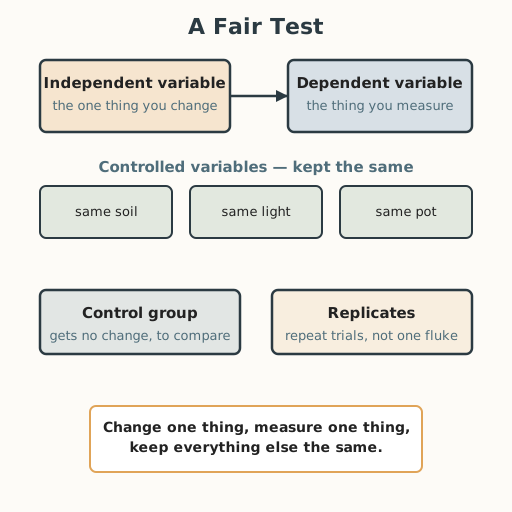
Lesson 1 — Designing and Defending an Investigation
Summary
Learners design an investigation they can defend as fair. They start from a question and a hypothesis, then name the independent variable (the one thing changed), the dependent variable (the thing measured), and the controlled variables (everything kept the same). They include a control group (no change) and replicate trials, and plan exactly what to record. The test they design is their first portfolio artifact for the unit.
Objectives
- Design an investigation that controls variables and includes controls and replicates, and defend the design as fair. (D06.S1.11.01)
Connection
Suppose you want to know whether watering a plant more makes it grow faster. If you water one plant a lot and move it to a sunnier windowsill and use better soil, you will never know which of the three did the work. A fair test changes one thing at a time and keeps everything else the same — whether you are testing a plant, a recipe, a medicine, or a phone’s battery. Naming the one thing you change and the one thing you measure is the first move in every honest investigation.
Materials
- Investigation design sheet
- Science journal
Preparation
- Copy or draw the investigation design sheet.
- Retrieval: from Grade 10, the idea that evidence, not opinion, settles a claim, and that sources are checked for bias (D06.S1.10.01, D06.S1.10.02). Today we build the test that generates trustworthy evidence.
- Prepare a worked example design to model the full loop before learners write their own.
Facilitator note
This lesson is written to the learner (“you”). The ideas to land: a fair test changes only the independent variable, measures the dependent variable, holds every controlled variable constant, includes a control group that receives no treatment, and runs replicate trials so a single fluke cannot masquerade as a result. Teach the question → hypothesis → variables → control → replicates → record loop explicitly, with a worked example and guided practice (S-011). Controls, randomization, and replication are the standard guardrails against bias and chance (S-250, S-242).
The intellectual lens: the design decides what the data can later claim — no analysis can rescue a confounded test. The critical-thinking lens: learners ask of every design “what was changed, what was measured, and what was kept the same?” The egalitarianism lens: a fair test includes everyone and every trial on the same footing, so no single case dominates the answer. The ethics lens: a test designed to confirm what you already believe is a small dishonesty that corrupts the whole result. Preview: Lesson 2 turns this design into a carried-out test and reports its uncertainty.
Procedure
- Recall (5 min). From Grade 10, what is the difference between evidence and opinion? Today we design the test that produces the evidence.
- Question and hypothesis (8 min). A test begins with a question (“Does more water make a plant grow faster?”) and a hypothesis — a guess you can check (“If I water it more, then it will grow taller, because water is needed for growth”). Write yours in one “If … then …” sentence.
- Variables (15 min). The independent variable is the one thing you change (amount of water). The dependent variable is the thing you measure (height of the plant). The controlled variables are everything you keep the same (same plant type, same soil, same pot, same light, same temperature). A fair test changes only the independent variable.
- Control and replicates (12 min). A control group gets no treatment (a plant watered normally) so you can compare. Replicates are repeated trials of the same treatment, so one odd result cannot fool you. Plan both: how many plants, how many trials, and what you will record each time.
- Defend the design (10 min). In pairs, present your design in two sentences and let a partner try to find a hole: “Did you change more than one thing? What did you keep the same? Where is your control?” Fix what they find.
- Close (5 min). In your journal, write one sentence saying why your test is fair, naming the independent and dependent variable and your control.
Differentiation
- Support: Start from a single worked example and change only one feature of it (a different question) rather than designing from blank.
- Extension: Add a second control group, plan blinded measurement (the person measuring does not know which group is which), and specify how many replicates make the result trustworthy.
Assessment
- Formative (peer + self): Can the learner name the independent, dependent, and controlled variables, state a control group and replicate count, and defend the design when a peer probes it?
- Portfolio artifact (unit): The completed investigation design sheet, saved as the first entry in the science portfolio.
Home connection
Think of one everyday “test” at home — trying a new ingredient, a new route, a new study habit. Write down the one thing that changes, the one thing you would measure, and everything you would keep the same.
Resources
- On worked examples and guided practice: Kirschner, Sweller & Clark (2006), https://doi.org/10.1207/s15326985ep4102_1 (S-011).
- On controls, randomization, and replication as guardrails against bias: Understanding Science (UC Berkeley), “What is science?” (S-250); BBC Bitesize, “Bias in science” (S-242).