Lesson 02 — Carrying It Out: Replicates and Uncertainty
Learners carry out repeated measurements and learn to report uncertainty honestly. They meet random and systematic error, precision and accuracy, and the mean and range as ways to summarize a spread of trials. They write a one-sentence uncertainty statement for their own measurements, turning the Lesson 1 design into a real, reported result.
Objectives
Objectives
- D06.S1.11.01 Design and defend an investigation that controls variables, includes controls and replicates, and reports uncertainty.
Essential question
How do I report the uncertainty in my measurements, and why do replicates and controls matter for trusting a result?
Key vocabulary
Materials
Standard materials
- Results and uncertainty sheet · 1 per learner A table for recording trials, the mean, the range, and a written statement of uncertainty
- Science journal · 1 per learner
Low-tech / no-cost
- Paper strips or string Measure the same thing several times with a rough tool to *feel* measurement spread
- Found object to measure (leaf, pebble, stick) One object measured many times by many hands shows variation between trials
Enriched / lab & device
- Rulers, timers, or thermometers · 1 set per group To carry out repeated measurements with a real instrument and read its scale
- Calculator or spreadsheet · 1 per group To compute a mean and range quickly
Works in different contexts
- large-group Measure one shared object as a whole class, collect every measurement on the board, and find the mean and spread together
- multi-age Younger learners measure and compare several trials by hand; older learners compute a mean, a range, and a written uncertainty statement
- self-directed A learner measures one thing five times, records the spread, and writes a sentence stating their uncertainty
- level-grouped Group by comfort with averages; a ready group distinguishes random error from a systematic bias (a scale always reading high)
- outdoor-only Measure a real outdoor quantity — the length of a shadow, the time a leaf falls — several times, and record the spread of the trials
Lesson 2 — Carrying It Out: Replicates and Uncertainty
Summary
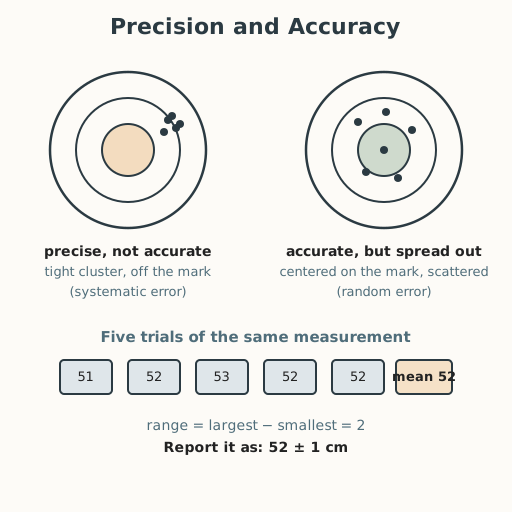
Learners carry out the measurement side of an investigation and learn to report its uncertainty. They measure the same thing several times and see that no measurement is perfectly exact: the mean centers the trials and the range shows their spread. They meet random error (scatter) and systematic error (a consistent bias), and the pair precision and accuracy. Each learner writes a one-sentence uncertainty statement for their own data.
Objectives
- Carry out repeated measurements and report uncertainty, explaining why replicates and controls matter for trusting a result. (D06.S1.11.01)
Connection
Measure the length of one table with a ruler and you get a number. Measure it five times — or let five people measure it — and you usually get five slightly different numbers. The truth is not the first number; it is somewhere in that spread. Honest measurement does not pretend to be exact; it says how sure it is. “About 52 cm, give or take half a centimeter” is a more truthful answer than “52 cm” — whether you are measuring a table, a dose of medicine, or a jump in a long-jump pit.
Materials
- Results and uncertainty sheet
- Science journal
Preparation
- Copy or draw the results and uncertainty sheet.
- Retrieval: from Lesson 1, the independent/dependent/controlled variables and the control group. Today we add the numbers — repeated trials and their spread.
- Prepare a shared object for the whole class to measure, and a worked example of a mean and range.
Facilitator note
This lesson is written to the learner (“you”). The ideas to land: every measurement carries uncertainty; replicates let you see the spread; the mean centers a set of trials and the range shows how much they scatter; random error is scatter around a true value, systematic error is a consistent push away from it; precision is how close repeats are to each other, accuracy is how close they are to the true value. Teach each pair of terms with a worked example and guided practice (S-011), and model writing an uncertainty statement as “value ± spread, with units” (S-249).
The intellectual lens: uncertainty is not a flaw to hide but a fact to report — knowledge states its limits. The critical-thinking lens: learners ask “how spread out were the trials, and could the tool itself be biased?” before trusting any single number. The ethics lens: reporting a measurement as more exact than it is is a quiet dishonesty; stating uncertainty is honesty. The egalitarianism lens: everyone’s careful measurement counts — pooling many hands’ trials is a cooperative way to locate a truer value than any one hand can. Preview: Lesson 3 steps back from numbers to ask how different ways of knowing — scientific, indigenous, artistic — each generate and test knowledge.
Procedure
- Recall (5 min). From Lesson 1, what made your test fair? Today we measure the result — and say how sure we are.
- Measure and spread (15 min). Measure the same object five times (or let five people measure it). Record all five numbers. Notice they are not all identical. Replicates exist to reveal this spread — one trial cannot show it.
- Mean and range (10 min). The mean is the sum of trials divided by how many there are. The range is the largest minus the smallest. Worked example: trials 51, 52, 53, 52, 52 cm → mean 52, range 2 cm. These two numbers summarize your measurement and its uncertainty.
- Random vs systematic, precision vs accuracy (12 min). Random error scatters trials around a true value (you read the ruler slightly differently each time). Systematic error pushes them all the same way (a ruler whose zero is worn off). Precision is how close repeats are to each other; accuracy is how close they are to the truth. You can be precise without being accurate, and accurate on average while scattered.
- Write the uncertainty statement (8 min). State your result as “value ± spread, with units” — for example, “52 ± 1 cm.” Then write one sentence saying what you are not claiming.
- Close (5 min). In your journal, finish this sentence: “My measurement is uncertain because…”
Differentiation
- Support: Measure only, skip the mean, and report “between 51 and 53 cm” as the honest range.
- Extension: Estimate the uncertainty from the instrument’s smallest division (half the smallest mark), and combine it with the spread of the trials into one statement.
Assessment
- Formative (peer + self) + performance: Can the learner produce several trials, state a mean and range, and write a one-sentence uncertainty statement — and explain why one trial alone would not have been enough?
- Portfolio artifact (unit): The results and uncertainty sheet, saved beside the Lesson 1 design.
Home connection
Measure one thing at home three times — a doorway, a cup of water, the time a pot takes to boil. Write the mean and the range, and one sentence about how sure you are.
Resources
- On worked examples and guided practice: Kirschner, Sweller & Clark (2006), https://doi.org/10.1207/s15326985ep4102_1 (S-011).
- On measurement uncertainty: NIST, “Uncertainty of Measurement Results” (S-249); Understanding Science (UC Berkeley), “What is science?” on bias and replication (S-250).