Lesson 10 — The Quantum Scale: Where Intuition Fails
Learners meet the quantum scale, where intuition fails in three specific ways: energy comes in fixed steps (it is quantized), light and matter behave as both wave and particle, and there is a built-in limit to how precisely position and motion can be known at once. They meet these as real, measured behaviors — the deepest reason the very small is not a smaller version of the everyday.
Objectives
Objectives
- D06.S3.11.01 Explain how matter and energy behave at atomic and quantum scales and why this challenges everyday intuition.
Essential question
How do energy and matter behave at the quantum scale, and why does this challenge everyday intuition?
Key vocabulary
Materials
Standard materials
- Quantum-surprises organizer · 1 per learner A table of quantum behaviors (quantized energy, wave-particle duality, uncertainty) with a column for the everyday intuition each breaks
- Science journal · 1 per learner
Low-tech / no-cost
- Paper and pencil Draw the double-slit idea and a wave interfering with itself
- A rope or string (optional) Shake a rope to see a standing wave — energy in allowed, whole patterns
Enriched / lab & device
- A short animation of the double-slit or electron orbitals (optional) · 1 per group To see quantum behavior visualized, held as a model, not a photograph
- A short account of a real quantum application (optional) e.g., lasers, transistors, MRI — to see the quantum at work in daily technology
Works in different contexts
- large-group Demonstrate a standing wave whole-class with a rope, then small groups each explain one quantum surprise on the organizer
- multi-age Younger learners feel a standing wave and the idea of "allowed patterns"; older learners explain quantized energy, duality, and uncertainty
- self-directed A learner completes the organizer alone and writes a paragraph on why quantum behavior is counterintuitive but real
- level-grouped Group by comfort with abstraction; a ready group connects uncertainty to the limits of measurement rather than a flaw in the world
- outdoor-only Watch ripples on water interfere (peaks and troughs meeting) and connect it to how light and matter can behave like waves
Lesson 10 — The Quantum Scale: Where Intuition Fails
Summary
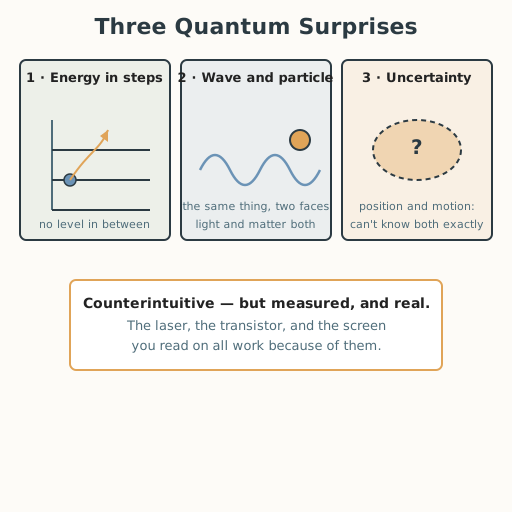
Learners meet the quantum scale, where intuition fails in three specific, measured ways: energy comes in fixed steps (it is quantized); light and matter behave as both wave and particle; and there is a built-in limit to how precisely position and motion can be known at once (the uncertainty principle). They meet these as real, tested behaviors — the deepest reason the very small is not simply a smaller version of the everyday.
Objectives
- Explain how matter and energy behave at the quantum scale and why this challenges everyday intuition. (D06.S3.11.01)
Connection
Think of a swing or a guitar string: it does not ring at any pitch at all, but only at certain allowed pitches. That small fact — that some things come only in allowed steps — turns out to be true deep inside the atom too: energy is absorbed and given off in fixed amounts, like stairs rather than a ramp. And at that scale, a “particle” of light sometimes acts like a wave, and a wave sometimes acts like a particle. The very small is not a miniature of our world; it runs by different, counterintuitive rules — rules that nonetheless power the lasers, screens, and electronics you use every day.
Materials
- Quantum-surprises organizer
- Science journal
Preparation
- Copy or draw the quantum-surprises organizer.
- Retrieval: from Lesson 9, the atom’s structure and its mostly-empty space. Today we ask how energy and matter behave at that scale.
- Prepare a rope for a standing-wave demonstration and a clear worked example of each surprise.
Facilitator note
This lesson is written to the learner (“you”). The ideas to land: at the quantum scale, (1) energy is quantized — absorbed and emitted in fixed steps tied to allowed energy levels in the atom; (2) light and matter show wave-particle duality; and (3) the uncertainty principle sets a fundamental limit on knowing position and motion at once (S-439, S-435). These are measured behaviors, not metaphors, and they are the reason quantum theory was needed — classical intuition simply fails at this scale. Teach each surprise explicitly with a worked example (S-011); the standing-wave demo makes “allowed patterns” concrete before the abstraction.
The intellectual lens: quantum theory is a triumph of holding a model even when it offends intuition, because it predicts correctly. The critical-thinking lens: “counterintuitive” is not “magical” — these behaviors are precisely described and tested. The technology lens: the transistor, the laser, and the screen you read on all work because quantum behavior is real — a concrete payoff of an abstract idea. The global lens: quantum mechanics was built by physicists across many countries (Planck, Einstein, Bohr, Heisenberg, Schrödinger, and others) correcting and extending one another’s work. Preview: Lesson 11 turns to thermodynamics — the physics of energy, heat, and order at the everyday scale.
Procedure
- Recall (5 min). From Lesson 9, what is inside an atom? Today we ask how energy and matter behave at that scale.
- Energy in steps (12 min). Shake a rope: it settles into whole, allowed wave patterns, not any pattern at all. Inside the atom, electrons occupy allowed energy levels — they can be on one level or another, but not in between, and they jump between levels by absorbing or giving off a fixed amount of energy (S-439). This is what “quantum” means: energy comes in steps.
- Wave and particle at once (12 min). Light, which you may have thought of as a wave, also behaves as a stream of particles (photons). And matter — electrons — which you may have thought of as particles, also behaves as waves (S-435). This wave-particle duality is measured, not imagined. Record it on your organizer.
- The uncertainty principle (10 min). At the quantum scale there is a built-in limit: the more exactly you pin down where a particle is, the less exactly you can know how it is moving, and vice versa (S-435). This is not a flaw in our tools — it is a fact about the world at that scale.
- Why intuition fails (10 min). Intuition is built from experience of the everyday — ramps, not stairs; things either a wave or a particle; positions we can measure exactly. The quantum scale breaks all three. That is why it took a new theory, and why the very small is not a smaller version of the large.
- Close (5 min). In your journal, write the three surprises in your own words and one everyday technology they make possible.
Differentiation
- Support: Feel the standing wave and the idea of “allowed patterns” only, then name the three surprises without deriving them.
- Extension: Explain why the uncertainty principle is a limit of the world, not a limit of measurement tools, and connect it to one consequence (e.g., why electrons do not spiral into the nucleus).
Assessment
- Formative (peer + self): Can the learner state the three quantum surprises (quantized energy, wave-particle duality, uncertainty) and explain why each breaks everyday intuition?
- Portfolio artifact (unit): The completed quantum-surprises organizer.
Home connection
Find one quantum-powered device at home — an LED light, a laser pointer, a phone screen — and write which of the three surprises it quietly depends on.
Resources
- On atomic structure and quantized energy levels: OpenStax, Chemistry 2e (S-439).
- On wave-particle duality and the uncertainty principle: OpenStax, College Physics (S-435).
- On worked examples and guided practice: Kirschner, Sweller & Clark (2006) (S-011).