Lesson 09 — Matter at the Atomic Scale
Learners meet matter at the atomic scale: everything is built of atoms, each a tiny nucleus of protons and neutrons surrounded by electrons. They learn that an element's identity is set by its proton number, and that the atomic world is mostly empty space — the first of several ways the very small breaks everyday intuition.
Objectives
Objectives
- D06.S3.11.01 Explain how matter and energy behave at atomic and quantum scales and why this challenges everyday intuition.
Essential question
What is matter made of at the atomic scale, and why does its behavior there challenge everyday intuition?
Key vocabulary
Materials
Standard materials
- Atomic-scale notes sheet · 1 per learner A labeled diagram of an atom with room to record scale and the surprises of the very small
- Science journal · 1 per learner
Low-tech / no-cost
- Paper and pencil Draw an atom by hand — nucleus, shells, electrons — and label its parts
- A handful of one thing (grains of sand, seeds, salt) Feel how "one substance" is really many tiny repeating parts
Enriched / lab & device
- An interactive atom model or periodic table (optional) · 1 per group To see element identity set by proton number, not by appearance
- A short scale-comparison video (optional) To feel how much of an atom is empty space
Works in different contexts
- large-group Draw and label one atom whole-class, then small groups each model one element and compare proton numbers
- multi-age Younger learners build an atom from counters; older learners explain proton number, shells, and the scale surprise
- self-directed A learner draws and labels an atom alone, then writes a paragraph on why the atomic scale surprises intuition
- level-grouped Group by comfort with models; a ready group compares two elements' structures and predicts a shared property
- outdoor-only Examine a handful of sand or soil and reason: what is it made of, all the way down?
Lesson 9 — Matter at the Atomic Scale
Summary
Learners meet matter at the atomic scale: everything is built of atoms, each a tiny nucleus of protons and neutrons surrounded by electrons. They learn that an element’s identity is set by its number of protons, and that the atomic world is mostly empty space — the first of several ways the very small breaks everyday intuition, which Lesson 10 deepens at the quantum scale.
Objectives
- Explain what matter is made of at the atomic scale and why its behavior there challenges everyday intuition. (D06.S3.11.01)
Connection
Pick up a handful of sand or salt: it looks like one smooth heap, but it is millions of tiny grains. Everything around you is like that, only the “grains” are atoms — so small that a single grain of sand holds more atoms than there are stars in our galaxy. And here is the first surprise: an atom is mostly empty space, with almost all its mass squeezed into a tiny center. The world that looks solid to your hand is, down at that scale, mostly emptiness held together by forces.
Materials
- Atomic-scale notes sheet
- Science journal
Preparation
- Copy or draw the atomic-scale notes sheet.
- Retrieval: from Grade 10, matter is made of particles and chemical reactions rearrange atoms (D06.S3.08.01, D06.S3.09.02). Today we look inside the atom.
- Prepare a labeled atom diagram and a scale comparison.
Facilitator note
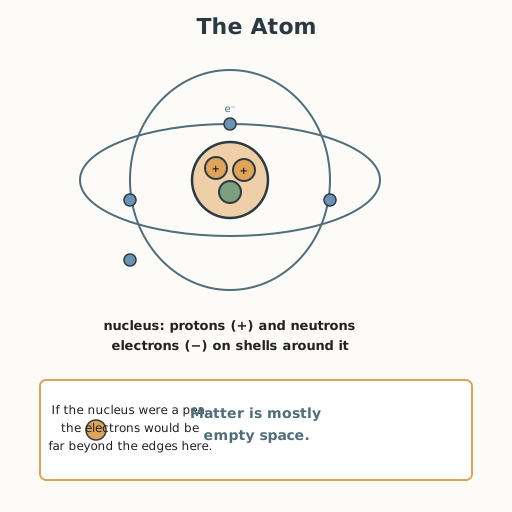
This lesson is written to the learner (“you”). The ideas to land: matter is made of atoms; each atom has a nucleus of protons (positive) and neutrons (neutral), with electrons (negative) arranged in shells around it; an element is defined by its number of protons, not by its appearance; and atoms are mostly empty space (S-359, S-439). Teach the structure explicitly with a worked, labeled diagram and guided practice (S-011). Emphasize the scale surprise — the atom’s nucleus is to the atom roughly as a pea to a stadium — because it sets up Lesson 10’s quantum surprises.
The intellectual lens: a model (the atom) lets us explain a huge range of behavior from a small set of parts — the power of a good model. The critical-thinking lens: the atomic model is a model, revised over a century as new evidence appeared; it is not a photograph. The global lens: atomic ideas grew from the work of scientists in many countries, building on one another’s experiments. The technology lens: understanding the atom is what made electronics, medicine, and much modern technology possible — and also what made nuclear power and weapons possible, a responsibility to weigh (previewing Lesson 12). Preview: Lesson 10 turns to the quantum scale, where the surprises grow sharper.
Procedure
- Recall (5 min). From Grade 10, what is an atom, and what happens to atoms in a chemical reaction? Today we look inside the atom.
- Parts of an atom (15 min). Draw and label an atom: a central nucleus made of protons (positive) and neutrons (neutral), with electrons (negative) arranged in shells around it (S-359, S-439). The whole atom is held together by the attraction between the positive nucleus and the negative electrons.
- Identity by proton number (10 min). What makes gold gold, and oxygen oxygen, is the number of protons in the nucleus. Change the proton number and you change the element — appearance has nothing to do with it. Two atoms with the same protons but different neutrons are the same element in slightly different forms.
- The scale surprise (12 min). An atom is mostly empty space: if the nucleus were the size of a pea, the electrons would be hundreds of meters away. Yet the world feels solid because the forces between atoms resist being pushed through. Write this surprise on your sheet.
- From parts to stuff (8 min). Everything you have ever touched is these few parts, arranged. A diamond and a pencil’s graphite are the same element — carbon — in different arrangements. The model explains the variety of the world from a handful of parts.
- Close (5 min). In your journal, write one sentence naming the parts of an atom and one sentence saying why the atomic scale surprises everyday intuition.
Differentiation
- Support: Build an atom from counters (protons, neutrons, electrons) and label its parts, leaving the scale comparison as a vivid image.
- Extension: Compare two elements by proton number and electron arrangement, and explain why they share or differ in chemical behavior.
Assessment
- Formative (peer + self): Can the learner name and place the parts of an atom, state that proton number sets element identity, and explain why the atom is “mostly empty space”?
- Portfolio artifact (unit): The completed atomic-scale notes sheet.
Home connection
Find one substance at home — salt, sugar, water, metal — and write what element(s) it is made of and how its atoms’ arrangement might explain a property you can see or feel.
Resources
- On atoms, elements, and their structure: BBC Bitesize, “Atoms, elements and compounds” (S-359); OpenStax, Chemistry 2e (S-439).
- On worked examples and guided practice: Kirschner, Sweller & Clark (2006) (S-011).