Lesson 12 — Energy and Material Costs of Technology
Learners evaluate the full energy and material cost of a technology across its life cycle — materials, making, use, and disposal. They meet embodied energy, renewable and nonrenewable inputs, and the real, growing burden of e-waste, and argue one concrete improvement. This closes the physical-systems strand by turning the physics of Lesson 11 into a judgment about real things.
Objectives
Objectives
- D06.S3.11.02 Apply thermodynamics to real systems and evaluate the energy and material costs of technology.
Essential question
How do I evaluate the full energy and material costs of a technology, from its making through its use and disposal?
Key vocabulary
Materials
Standard materials
- Technology life-cycle sheet · 1 per learner A four-stage table (materials, making, use, disposal) for recording the energy and material costs of one technology
- Science journal · 1 per learner
Low-tech / no-cost
- Paper and pencil Draw the life of one object from mine to landfill, marking each energy and material cost
- A common household object Examine a cup, tool, or piece of clothing and trace where its parts came from
Enriched / lab & device
- A life-cycle or e-waste data source (optional) · 1 per group e.g., the WHO e-waste fact sheet — to ground the disposal stage in real numbers
- An energy-source comparison (optional) To weigh renewable against nonrenewable inputs for the same device
Works in different contexts
- large-group Trace one shared technology whole-class through its life cycle, then small groups each trace another and report its heaviest cost
- multi-age Younger learners trace one object's journey from source to bin; older learners quantify a life-cycle cost and argue an improvement
- self-directed A learner traces one technology alone and writes a short life-cycle evaluation with one proposed improvement
- level-grouped Group by comfort with data; a ready group compares a renewable and a nonrenewable input for the same device on cost and impact
- outdoor-only Trace a natural-material object (a wooden tool, a clay pot, a woven basket) and compare its costs with an industrial substitute
Lesson 12 — Energy and Material Costs of Technology
Summary
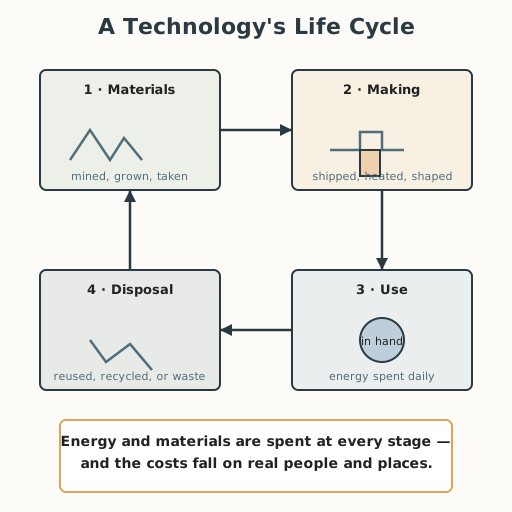
Learners evaluate the full energy and material cost of a technology across its life cycle — materials, making, use, and disposal. They meet embodied energy (the energy already spent making a thing), renewable and nonrenewable inputs, and the real, growing burden of e-waste (S-397). They argue one concrete improvement. This closes the physical-systems strand by turning Lesson 11’s physics into a judgment about real things.
Objectives
- Evaluate the energy and material costs of a technology across its life cycle. (D06.S3.11.02)
Connection
A phone, a cup, a pair of shoes did not begin in the shop. Each began as material pulled from the ground, was carried, heated, shaped, and assembled — all of it spending energy — and each will end somewhere, often as waste. The price tag hides all of this. Judging a technology honestly means asking about its whole life: what was taken, what was spent, what was thrown away — and who bore each cost, since the people who mine and the people who live near the dumps are rarely the people who enjoy the device.
Materials
- Technology life-cycle sheet
- Science journal
Preparation
- Copy or draw the technology life-cycle sheet.
- Retrieval: from Lesson 11, the second law and why every process loses some energy as heat — the physical root of every cost. Today we trace those costs across a whole product.
- Prepare one shared technology to trace and a worked example of a life-cycle stage.
Facilitator note
This lesson is written to the learner (“you”). The ideas to land: a technology’s true cost is its life-cycle cost — the energy and materials spent in extracting raw materials, manufacturing, using, and disposing of it; embodied energy is the energy already invested before use; renewable inputs (sun, wind, water) replenish, while nonrenewable inputs (fossil fuels, mined minerals) run down (S-095); and the disposal stage is a real, growing burden — e-waste is the world’s fastest-growing waste stream and carries health and environmental harms concentrated on poorer communities (S-397). Teach the four stages with a worked example (S-011), and hold the trade-off honestly: no technology is cost-free; the question is which costs, borne by whom, for what benefit.
The technology lens: this is the lesson’s center — judging tools by their full life, not their sticker price. The environment lens: every stage draws on Earth’s materials and returns waste and heat to it. The ethics lens: the costs and benefits are distributed unevenly — a justice question, not only an efficiency one. The egalitarianism lens: asking who mines, who disposes, and who benefits is how the evaluation becomes fair rather than merely technical. Preview: Lesson 13 turns from the physics of the very small and the everyday to the very large — the cosmos and its models.
Procedure
- Recall (5 min). From Lesson 11, why is every process less than perfectly efficient? Today we trace that cost across a whole product’s life.
- The four stages (10 min). Every technology lives through materials → making → use → disposal. At each stage energy is spent and materials are taken or returned. Draw the four boxes for one object (a phone, a cup, a shoe).
- Embodied energy and inputs (12 min). Embodied energy is all the energy already spent before you ever use the thing — mining, shipping, heating, shaping. Renewable inputs (sun, wind, water) replenish; nonrenewable inputs (coal, oil, mined metals) run down (S-095). Mark which inputs your object used.
- Disposal and e-waste (12 min). The last stage is real: e-waste is among the fastest-growing waste streams, and its toxic parts and unsafe recycling fall hardest on poorer communities (S-397). Where does your object end, and who bears that cost?
- Evaluate and improve (12 min). On your sheet, mark the heaviest cost of your object’s life, and write one concrete improvement — repair over replace, a renewable input, a cleaner disposal, a longer life — and one reason it is not yet universal (cost, habit, or who profits).
- Close (4 min). In your journal, write one sentence saying why the sticker price is not the true price.
Differentiation
- Support: Trace one object’s journey from source to bin in pictures, and name one improvement in plain words.
- Extension: Compare a renewable and a nonrenewable input for the same device on energy cost, material cost, and who bears each, and argue which a community should prefer.
Assessment
- Formative (peer + self): Can the learner trace all four life-cycle stages, name the embodied energy and inputs, account for disposal, and argue one improvement with a reason it is not yet universal?
- Portfolio artifact (unit): The completed technology life-cycle sheet.
Home connection
Choose one object at home and trace where it came from and where it will go. Write its heaviest cost and one change that would lighten it.
Resources
- On renewable and nonrenewable energy inputs: EIA Energy Kids, “Renewable and Nonrenewable Energy Sources” (S-095).
- On e-waste as a growing, unevenly distributed burden: WHO, “Electronic waste (e-waste)” fact sheet (S-397).
- On worked examples and guided practice: Kirschner, Sweller & Clark (2006) (S-011).