Lesson 13 — Cosmological Models: The Big Bang
Learners meet the Big Bang as a cosmological model: the universe began hot and dense and has been expanding ever since. They examine its main lines of evidence — the expansion seen in redshift, the cosmic microwave background, and the formation of the first atoms as the universe cooled — and practice holding it as a well-tested model, not a revealed certainty.
Objectives
Objectives
- D06.S4.11.01 Compare cosmological models and weigh the evidence for each, holding them as models rather than certainties.
Essential question
What is the Big Bang model, what evidence supports it, and how is a model different from a certainty?
Key vocabulary
Materials
Standard materials
- Big Bang evidence chart · 1 per learner Rows for each line of evidence (expansion/redshift, cosmic microwave background, first atoms) with a column for what each shows and its limit
- Science journal · 1 per learner
Low-tech / no-cost
- A balloon and ink dots (optional) Inflate a dotted balloon to feel how every point moves away from every other as space expands
- Paper and pencil Draw the expanding-universe idea and the three lines of evidence
Enriched / lab & device
- A short NASA or observatory visualization (optional) · 1 per group e.g., NASA's Big Bang overview or cosmic microwave background imagery — held as a model, not a photograph
- A spectrum or redshift diagram (optional) To see how light from receding galaxies shifts toward the red
Works in different contexts
- large-group Inflate one dotted balloon whole-class, then small groups each explain one line of evidence on the chart
- multi-age Younger learners retell the story of the expanding universe; older learners weigh the three lines of evidence and state each one's limit
- self-directed A learner completes the chart alone and writes a paragraph on why the Big Bang is a model, not a certainty
- level-grouped Group by reading comfort; a ready group compares two pieces of evidence and says what each adds that the other cannot
- outdoor-only Look at the night sky or the horizon and reason: what would expansion look like from here, and what evidence would we need?
Lesson 13 — Cosmological Models: The Big Bang
Summary
Learners meet the Big Bang as a cosmological model: the universe began hot and dense, and has been expanding ever since. They examine its main lines of evidence — the expansion read in redshift, the cosmic microwave background, and the formation of the first atoms as the universe cooled — and practice holding it as a well-tested model, not a revealed certainty (S-002, S-018).
Objectives
- Explain the Big Bang model and its supporting evidence, holding it as a model rather than a certainty. (D06.S4.11.01)
Connection
Blow up a balloon with dots on it: every dot moves away from every other dot, not from a single center, because the surface itself is stretching. Cosmologists tell a story about the whole universe that is a little like that — space itself has been expanding since a beginning that was hot and dense. The story is not a guess; it rests on specific, measured evidence. And it is a model — the best account we have, always open to revision — not a claim beyond question. Learning to tell a well-evidenced model from a certainty is the whole skill of this lesson.
Materials
- Big Bang evidence chart
- Science journal
Preparation
- Copy or draw the Big Bang evidence chart.
- Retrieval: from Grade 10, the Big Bang model and the age of the universe (D06.S4.10.01); from Grade 9, evidence for the age of Earth and universe (D06.S4.09.02). Today we weigh the model’s evidence and its status as a model.
- Prepare a balloon-and-dots demo and a redshift diagram.
Facilitator note
This lesson is written to the learner (“you”). The ideas to land: the Big Bang is a cosmological model in which the universe began hot and dense and has expanded since; its main evidence is (1) the expansion read from the redshift of receding galaxies, (2) the cosmic microwave background — the oldest observable light, and (3) the first atoms forming as the early universe cooled (S-018). The crucial stance: this is a model — the best-evidenced account we have, always open to revision — not a revealed certainty (philosophy §11). Present it as “scientists tell this story because…”, never as “this is the truth.” Teach each line of evidence with a worked example (S-011).
The intellectual lens: a model earns its place by predicting what we then observe, not by authority. The critical-thinking lens: learners ask of each line “what does this show, and what does it not show?” The global lens: the universe belongs to everyone; its story is told by observatories and traditions across the world. The ethics lens: honesty about what we know and what we do not is an intellectual virtue — overclaiming is a form of dishonesty. Preview: Lesson 14 places the Big Bang beside other cosmological models and weighs them all as models.
Procedure
- Recall (5 min). From Grade 10, what is the Big Bang? Today we weigh why scientists hold this model, and how they hold it.
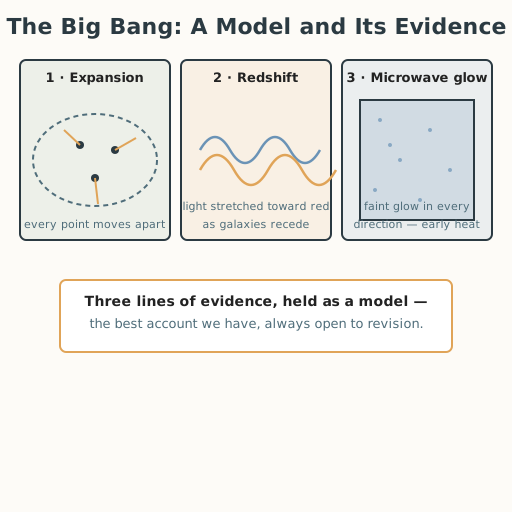
- A model of expansion (12 min). Inflate the dotted balloon: every dot recedes from every other, because space itself stretches. The Big Bang model says the universe began hot and dense and has been expanding in just this way (S-002). Record this on your chart.
- Three lines of evidence (15 min). (a) Redshift: light from distant galaxies is stretched toward the red as they recede — the expansion, measured. (b) The cosmic microwave background is the faint glow of the universe’s early heat, seen in every direction — the oldest observable light (S-002). (c) As the early universe cooled, its hot particles grouped into the first atoms (S-018) — the same cooling the model’s story tells. Record what each shows.
- What each line cannot show (10 min). Each line is strong, and each is partial: redshift shows motion, not the first instant; the background shows early heat, not what (if anything) came before; the formation of the first atoms shows the early cooling, not what set it in motion. Write one limit for each.
- Model, not certainty (8 min). A model is our best, well-tested account — revisable when new evidence demands. The Big Bang is that: powerful and evidence- backed, yet always open to revision. It answers how the universe developed, not why it exists or what it means.
- Close (5 min). In your journal, write one sentence naming the strongest piece of evidence, and one sentence on what “model, not certainty” means.
Differentiation
- Support: Retell the expanding-universe story in your own words from the balloon demo, and name the three lines of evidence without weighing their limits.
- Extension: Compare two lines of evidence and state precisely what each adds that the other cannot, and what a future observation could revise.
Assessment
- Formative (peer + self): Can the learner name the three lines of evidence for the Big Bang, state what each shows and one limit, and explain why it is held as a model rather than a certainty?
- Portfolio artifact (unit): The completed Big Bang evidence chart.
Home connection
Find one “certainty” in daily life — in the news, a product claim, a rumor — and write what evidence supports it and what would make you revise it.
Resources
- On the Big Bang and its evidence: NASA, “The Big Bang” (S-002); NASA Space Place, “What Is the Big Bang?” (S-018).
- On worked examples and guided practice: Kirschner, Sweller & Clark (2006) (S-011).