Lesson 16 — Climate, Ecology, and Society
Learners close the unit by reading climate, ecology, and human society as one coupled system. They explain the greenhouse effect and its human strengthening, see that the people who did least to cause change often feel it most, and propose hopeful, just responses — mitigation, adaptation, and restoration — carrying the unit's evidence-and-values discipline into a stance of agency, never despair.
Objectives
Objectives
- D06.S4.11.02 Explain how Earth's systems are coupled and how climate, ecology, and human society shape one another.
Essential question
How do climate, ecology, and human society shape one another, and how do I respond with hope and agency?
Key vocabulary
Materials
Standard materials
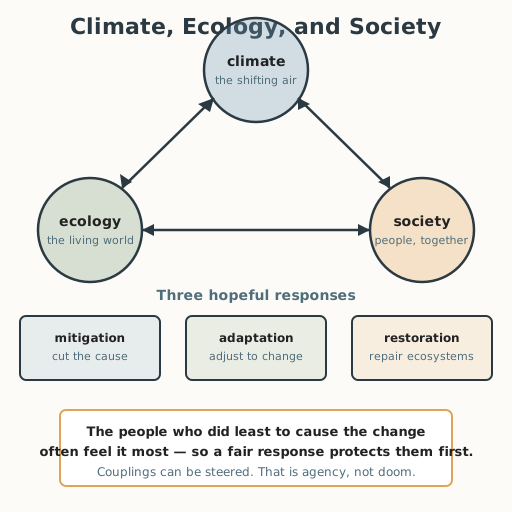
- Climate-ecology-society synthesis sheet · 1 per learner A three-way diagram (climate, ecology, society) with arrows, plus room to propose one hopeful, just response
- Science journal · 1 per learner
Low-tech / no-cost
- Paper and pencil Draw the three-way coupling and one proposed response
- A discussion circle Talk through who is affected, who can act, and what a fair response looks like
Enriched / lab & device
- A short climate-system or impacts overview (optional) · 1 per group e.g., IPCC or NOAA — to ground the coupling in authoritative science
- A case of a real, hopeful response (optional) e.g., a community restoration, a renewable transition, a coastal adaptation — to model agency
Works in different contexts
- large-group Build the three-way diagram whole-class, then small groups each propose one response and the class weighs them for fairness
- multi-age Younger learners name one way people can help the living world; older learners map the couplings and argue a just response
- self-directed A learner completes the synthesis sheet alone and writes a short response plan with reasons
- level-grouped Group by reading comfort; a ready group weighs a mitigation action against an adaptation action on effectiveness and justice
- outdoor-only Observe one local sign of the human–climate–ecology coupling, and design one small, real care action
Lesson 16 — Climate, Ecology, and Society
Summary
Learners close the unit by reading climate, ecology, and human society as one coupled system. They explain the greenhouse effect and its human strengthening (S-438), see that the people who did least to cause change often feel it most (S-005), and propose hopeful, just responses — mitigation, adaptation, and restoration — carrying the unit’s evidence-and-values discipline into a stance of agency, never despair (philosophy §12).
Objectives
- Explain how climate, ecology, and human society shape one another, and propose a hopeful, just response. (D06.S4.11.02)
Connection
The same coupling you traced in the last lesson now has a third partner: us. We burn fuels that warm the air; the warming air shifts the rains and the seasons; the shifting seasons change what grows and where people can live; and those changes fall hardest on people who contributed least to them — the very young, the poor, and communities already at the edge. This is not a doom story; it is a coupling story, and couplings can be steered. Understanding how the three shape one another is exactly what makes a fair and effective response possible.
Materials
- Climate-ecology-society synthesis sheet
- Science journal
Preparation
- Copy or draw the synthesis sheet.
- Retrieval: from Lesson 15, the four coupled spheres and feedback; from Grade 10, the greenhouse effect (D06.S4.10.02). Today we add the human partner and the response.
- Prepare a short, real example of a hopeful response to ground the lesson in agency.
Facilitator note
This lesson is written to the learner (“you”). The ideas to land: greenhouse gases trap heat near the surface, and human burning of fossil fuels has strengthened this effect (S-438); the resulting climate change is coupled to ecology and to human society — it shifts what grows, where water is, and where people can live (S-005); the burden is distributed unjustly — those who emitted least are often most exposed; and the responses are mitigation (cutting emissions), adaptation (adjusting to changes), and restoration (repairing ecosystems), which must be weighed for justice, not only effectiveness. Always connect difficulty to agency (facilitation): this lesson ends in action, not despair.
The environment lens: the living Earth is the lesson’s center. The ethics lens: who should act, and who should be protected first, are moral questions. The egalitarianism lens: a just response protects those least able to protect themselves and does not let the powerful offload the cost. The global lens: the coupling is planetary, and the response must be cooperative across every border. This lesson also gathers the unit’s portfolio into a whole — the closing artifact.
Procedure
- Recall (5 min). From Lesson 15, how do Earth’s four spheres couple? Today we add the human partner and the response.
- The greenhouse effect, strengthened (12 min). Certain gases trap heat near the surface — this is the natural greenhouse effect that keeps Earth warm. Human burning of coal, oil, and gas has added more of these gases, strengthening the effect (S-438). State this as evidence: measured, not assumed.
- The three-way coupling (12 min). Draw climate, ecology, society with arrows both ways: climate shifts what grows and where water is; ecology feeds back on climate (forests and oceans take up carbon); society both drives the change and suffers it. Trace one full loop end to end.
- Who feels it most (8 min). The change is not distributed fairly: the people and places that emitted the least greenhouse gas are often those most exposed to its harms (S-005). This is a justice fact, not only an ecological one. Write it on your sheet.
- Responses with agency (12 min). Mitigation cuts the cause (less fossil fuel); adaptation adjusts to the change (sea walls, new crops, early warnings); restoration repairs the living systems that cushion us (forests, wetlands, reefs). Propose one concrete response for the loop you traced — and one reason it is fair.
- Close (6 min). In your journal, write one sentence on how the three shape one another, and one thing you — with others — could actually do.
Differentiation
- Support: Name the three partners and one care action in plain words, leaving the full loop to others.
- Extension: Weigh a mitigation action against an adaptation action on effectiveness, cost, and justice, and argue which a community should prioritize first.
Assessment
- Formative (peer + self) + summative: Can the learner explain the strengthened greenhouse effect, trace the three-way coupling, name the unequal burden, and propose one hopeful, just response?
- Portfolio artifact (unit): The completed synthesis sheet, gathered with the whole unit’s artifacts into the science portfolio.
Home connection
Choose one small change in your household — one less car trip, one less wasted thing, one native plant — and write how it touches the climate-ecology-society loop, however small.
Resources
- On the greenhouse effect and its human strengthening: NASA, “What Is the Greenhouse Effect?” (S-438).
- On the coupled climate system and its unequal burdens: IPCC (S-005); NOAA Climate (S-309).
- On worked examples and guided practice: Kirschner, Sweller & Clark (2006) (S-011).