Lesson 15 — Earth's Coupled Systems
Learners meet Earth as a set of coupled systems — atmosphere, water, land, and life — linked so that a change in one moves through the others. They trace matter through the carbon cycle as the thread that binds the four spheres, and meet feedback as the reason couplings can amplify or damp change. This sets up the final lesson on climate, ecology, and society.
Objectives
Objectives
- D06.S4.11.02 Explain how Earth's systems are coupled and how climate, ecology, and human society shape one another.
Essential question
How are Earth's systems — atmosphere, ocean, land, and life — coupled, so that a change in one moves through the others?
Key vocabulary
Materials
Standard materials
- Coupled-systems diagram sheet · 1 per learner Four labeled spheres (air, water, land, life) with arrows to draw the couplings and feedbacks between them
- Science journal · 1 per learner
Low-tech / no-cost
- Paper and pencil Draw the four spheres and the arrows that link them
- Four containers or corners labeled air, water, land, life (optional) Move tokens between them to act out the carbon or water cycle
Enriched / lab & device
- A carbon-cycle or water-cycle diagram (optional) · 1 per group To trace matter moving through the coupled spheres
- A short climate-system overview (optional) To see the atmosphere–ocean–land–life couplings at global scale
Works in different contexts
- large-group Build the four-sphere diagram whole-class, then small groups each trace one coupling and report the chain it sets off
- multi-age Younger learners act out the water or carbon cycle moving between four corners; older learners map couplings and feedbacks on the diagram
- self-directed A learner draws the diagram alone and writes a paragraph tracing one coupling end to end
- level-grouped Group by comfort with systems; a ready group distinguishes a reinforcing feedback from a balancing one in a real example
- outdoor-only Stand in one place and name the air, water, land, and life around you, then trace how one affects the others
Lesson 15 — Earth’s Coupled Systems
Summary
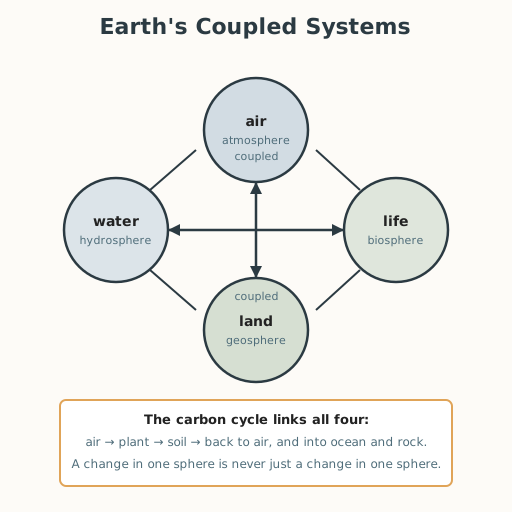
Learners meet Earth as a set of coupled systems — the atmosphere (air), the hydrosphere (water), the geosphere (land), and the biosphere (life) — linked so that a change in one moves through the others. They trace matter through the carbon cycle as the thread that binds the four spheres (S-253), and meet feedback as the reason couplings can amplify or damp a change. This sets up the final lesson on climate, ecology, and society.
Objectives
- Explain how Earth’s systems are coupled, tracing how a change in one moves through the others. (D06.S4.11.02)
Connection
On a hot day, the sun warms the ground; the warm ground warms the air; warm air lifts moisture from the sea and the soil; that moisture becomes cloud and then rain; the rain feeds the plants; the plants shade and cool the ground. Air, water, land, and life are not four separate subjects — they are four hands of one body, each touching the next. “Climate” and “ecology” are just names for how those couplings behave over time. Seeing the couplings is the first step to understanding — and to caring well for — the whole.
Materials
- Coupled-systems diagram sheet
- Science journal
Preparation
- Copy or draw the coupled-systems diagram sheet.
- Retrieval: from Grade 9–10, the carbon cycle and greenhouse gases (D06.S4.09.01, D06.S4.10.02). Today we read those as couplings among four spheres.
- Prepare a carbon-cycle trace and a worked example of a feedback loop.
Facilitator note
This lesson is written to the learner (“you”). The ideas to land: Earth’s four spheres — atmosphere, hydrosphere, geosphere, and biosphere — are coupled, so a change in one propagates to the others; the carbon cycle is a concrete thread linking all four (S-253); and feedbacks (reinforcing or balancing) determine whether a change grows or is damped. Teach the four-sphere map and one carbon trace explicitly with a worked example (S-011). Emphasize that “coupled” is not a metaphor but a measurable fact: carbon moves between air, life, land, and water in known amounts.
The environment lens: this is the lesson’s center — the living Earth as one system. The intellectual lens: systems thinking — naming parts and their links — is the organizing skill. The critical-thinking lens: learners ask “what else does this change touch?” before judging any single effect. The global lens: the same four spheres wrap every country and people; the couplings do not respect borders. Preview: Lesson 16 brings the human into the system — how climate, ecology, and society shape one another.
Procedure
- Recall (5 min). From Grade 10, what is the carbon cycle? Today we read it as the thread that couples Earth’s four systems.
- The four spheres (10 min). Draw and label the four: the atmosphere (air), the hydrosphere (water), the geosphere (land and rock), and the biosphere (life). They are not separate; they touch at every boundary.
- Trace the couplings (15 min). Follow the carbon cycle: carbon moves from the air into plants, from plants into soil and into animals, back to the air by respiration and decay, and into the ocean and rock over longer timescales (S-253). Draw these as arrows linking all four spheres. One element, touching everything.
- Feedback (12 min). A feedback is a loop: a change in one part comes back to change the original part again. A reinforcing feedback grows the change (warmer air melts ice, darker water absorbs more heat, warming more). A balancing feedback damps it (more plants grow in warmer, wetter air and take up more carbon). Find one of each in your diagram.
- One coupling, end to end (8 min). Choose one arrow and trace it fully: what starts it, what it touches next, and what comes back. Write the chain.
- Close (5 min). In your journal, write one sentence saying why a change in one sphere is never just a change in one sphere.
Differentiation
- Support: Act out carbon moving between four labeled corners (air, water, land, life), then draw the simplest loop.
- Extension: Distinguish a reinforcing from a balancing feedback in a climate example, and explain which one a given human action is most likely to set off.
Assessment
- Formative (peer + self): Can the learner name the four spheres, trace the carbon cycle as a coupling among them, and give one reinforcing and one balancing feedback?
- Portfolio artifact (unit): The completed coupled-systems diagram sheet.
Home connection
From where you are, find one coupling you can actually see — rain feeding plants, plants shading soil, a puddle evaporating into air — and write the chain it sets off.
Resources
- On the carbon cycle linking Earth’s spheres: National Geographic Education, “The Carbon Cycle” (S-253).
- On the coupled climate system: IPCC (S-005); NOAA Climate (S-309).
- On worked examples and guided practice: Kirschner, Sweller & Clark (2006) (S-011).