Lesson 01 — Art With a Purpose: Choosing the Issue
Learners open the unit by choosing a social or environmental issue that matters to them and turning it into an artistic intention: a clear statement of what they want an audience to feel, think, or do. They meet the unit's throughline — that art, music, performance, and design can be a deliberate, ethical voice — and see real examples of artists who worked in a series on a single issue, as living history to honor, never specimens.
Objectives
Objectives
- D07.S1.11.01 Create an artwork that addresses a social or environmental issue and explain its intended effect on an audience.
Essential question
How do I choose a social or environmental issue that matters to me, and turn it into an artistic intention that will move an audience?
Key vocabulary
Materials
Standard materials
- Issue-choosing worksheet · 1 per learner A two-column sheet: 'the issue' (what it is, who it affects, why it matters to me) and 'the intention' (what I want an audience to feel, think, or do)
- Sketchbook or blank paper · several pages per learner
- Art journal · 1 per learner
Low-tech / no-cost
- Found images, newspapers, or printed photos To notice how other people have used images to speak about issues, with no digital tools
- Charcoal, pencil, or a stick in the sand Any mark-making tool works for the first sketch
Enriched / lab & device
- Device with image search · 1 per pair To look at examples of issue-driven artwork and public art from many regions
- Digital art tool (Krita or Inkscape, free/open) To begin the artwork digitally where devices are available
Works in different contexts
- large-group Brainstorm a shared wall of issues whole-class, then each learner circles the three that matter most to them and picks one to carry through the unit
- multi-age Younger learners pick a local, concrete issue (litter, a broken thing to fix); older learners analyze who an issue affects and how, before choosing
- self-directed A learner works through the worksheet alone, then writes the first sketch and a one-sentence intention in their journal
- level-grouped Group by readiness to articulate intention; a ready group drafts a full artist statement, others work from sentence stems
- outdoor-only Walk and list issues in the local environment (waste, water, shade, noise), then choose one observed directly
Lesson 1 — Art With a Purpose: Choosing the Issue
Summary
Learners open the unit by choosing a social or environmental issue that matters to them and turning it into an intention: a clear statement of the intended effect they want their work to have on an audience. They meet the unit’s throughline — that art, music, performance, and design can be a deliberate, ethical voice — and they look at real artists who worked in a series on a single issue as living history to honor with questions, never as specimens. Their chosen issue will thread through every lesson that follows.
Objectives
- Choose a social or environmental issue, state an artistic intention for it, and explain the intended effect on an audience. (D07.S1.11.01)
Connection
A poster taped to a wall, a song that makes you stop, a mural painted over a blank concrete wall, a mask and a drum at a festival — all of them are made by someone for a reason, and all of them aim to do something to the people who see or hear them. The question behind every one is the same: what do I want this to make people feel, think, or do? That question is the difference between making a thing and making a thing that speaks.
Materials
- Issue-choosing worksheet
- Sketchbook or blank paper
- Art journal
Preparation
- Copy or draw the issue-choosing worksheet.
- Retrieval: from Grade 10 (D07.S1.10.02, D07.S2.10.02, D07.S3.10.02), the difference between appreciation and appropriation — the rule that will govern how we meet other cultures’ arts this unit.
- Prepare two or three images of issue-driven artworks or public art for a short, shared “what is it trying to make us do?” warm-up.
Facilitator note
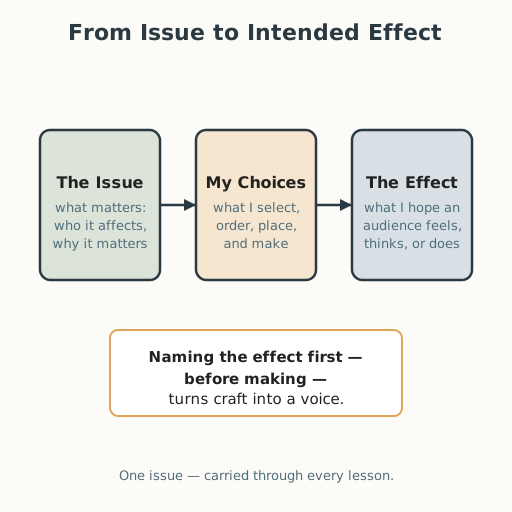
This lesson is written to the learner (“you”). The idea to land: an artwork addresses a social or environmental issue and is judged by its intended effect on an audience — and naming that effect first (before making) is what turns craft into a voice. This is the unit’s North Star; every later lesson returns to it. Hold “intended effect” as a value the learner chooses, not a fact to be right about (philosophy §5, §11).
The intellectual lens: an intention is a testable idea — after making, the learner asks “did it do what I meant?” The ethics lens: choosing an issue is a moral act; learners weigh consequences for others. The global lens: Jacob Lawrence painted a 60-panel series, The Migration Series (1940–41), on the Great Migration of African Americans from the rural South to the urban North — one artist’s sustained answer to a vast social question (S-363); Hokusai’s woodblock series Thirty-six Views of Mount Fuji (c. 1830–32) turned one mountain seen many ways into a meditation on a place (S-364). Meet both as documented history, not decoration. The egalitarianism lens: every learner’s issue matters equally; no issue is too small to be worth an artist’s voice.
Teach the move “issue → intention → intended effect” explicitly with a worked example (S-011), then let learners choose freely.
Procedure
- Recall (5 min). From Grade 10, what is the difference between honoring another culture’s art and taking it? That rule stays with us all unit.
- What does it make you do? (10 min). Look together at two or three images — a mural, a protest poster, a photograph. For each, ask only: what is it trying to make the viewer feel, think, or do? You are naming intended effect.
- Choose your issue (15 min). On your worksheet, list social and environmental issues that matter to you — things that make you angry, sad, hopeful, or determined. For each, write who it affects and why it matters to me. Then circle one to carry through this whole unit.
- Turn it into an intention (15 min). Write one sentence that completes this frame: “I want my audience to feel ______, think ______, and do ______.” That sentence is your intention. Worked example: an artist worried about plastic waste writes, “I want my audience to feel uneasy about how much we throw away, think it could be different, and do one thing — carry a reusable bag.”
- First sketch (8 min). Make a fast, rough first sketch for your issue in any form — image, sound-shape, movement, or made object. It can be terrible; it is a starting point, not a finished thing.
- Close (2 min). Say your intention aloud to a partner, and hear theirs. You are now co-authors of your own education, each with an issue worth a voice.
Differentiation
- Support: Use sentence stems (“I care about ______ because ______”) and a short list of example issues if choosing feels overwhelming.
- Extension: Draft a full three-sentence artist statement, and note one specific audience you want to reach (a neighborhood, a class, a decision-maker).
Assessment
- Formative (peer + self): Can the learner name one issue, state who it affects and why it matters to them, and write a clear intended-effect sentence?
- Portfolio artifact (unit): The completed worksheet and the intention sentence, saved as the spine of the unit portfolio.
Home connection
Ask one person at home: what is one thing in our neighborhood or in the world you wish someone would fix, and why? Write down their answer, and note whether it overlaps with your own issue.
Resources
- On working in a series on one issue: The Phillips Collection, Jacob Lawrence, The Migration Series (S-363); The Met, Hokusai, Thirty-six Views of Mount Fuji (S-364).
- On art as a deliberate, ethical voice and holding evidence distinct from values:
docs/philosophy.md(§5, §11). - On worked examples and guided practice: Kirschner, Sweller & Clark (2006), https://doi.org/10.1207/s15326985ep4102_1 (S-011).