Lesson 02 — Making an Image Speak: Craft & Intended Effect
Learners make their issue-driven artwork deliberately, choosing elements of art and principles of design — line, shape, color, balance, contrast, emphasis — to steer what a viewer notices and feels. They complete the work, then write and speak the reasoning that connects each choice to the intended effect, and revise once after feedback.
Objectives
Objectives
- D07.S1.11.01 Create an artwork that addresses a social or environmental issue and explain its intended effect on an audience.
Essential question
How do the elements and principles of art — line, shape, color, balance, contrast, and emphasis — let me steer what a viewer notices and feels?
Key vocabulary
Materials
Standard materials
- Artwork plan sheet · 1 per learner A guide for choosing one element and one principle to carry the message, with space to sketch before making
- Art-making supplies · shared Paper, pencil, charcoal, paint, pastel, or collage materials — whatever is at hand
- Art journal · 1 per learner
Low-tech / no-cost
- Found materials for collage Scraps, leaves, cloth, newsprint — to build an image by arrangement rather than drawing
- Natural pigments or charcoal To make marks with what the environment provides
Enriched / lab & device
- Digital art tool (Krita or Inkscape) · 1 per learner or pair Free/open tools (S-440, S-441) so the artwork can be made digitally where devices exist
- Camera or phone (optional) To make a photographic or mixed-media image
Works in different contexts
- large-group Run one shared "change one element, watch the feeling change" demonstration, then learners make individually and pair-share their intended effect
- multi-age Younger learners focus on one element (color or contrast); older learners deliberately combine an element and a principle and explain the pairing
- self-directed A learner follows the plan sheet, makes the artwork, then self-checks against their intention sentence and revises once
- level-grouped Group by making experience; a ready group adds a second principle and critiques with the full elements-and-principles vocabulary
- outdoor-only Make a land-art or found-material image on the spot, and photograph or sketch it to preserve it
Lesson 2 — Making an Image Speak: Craft & Intended Effect
Summary
Learners complete their issue-driven artwork by choosing elements of art (line, shape, form, color, value, texture, space) and principles of design (balance, contrast, emphasis, and more) deliberately, so the image steers what a viewer notices and feels. They then write the reasoning that connects each choice to the intended effect, and revise once after feedback — making, as artists do, with their heads as well as their hands.
Objectives
- Create an artwork that addresses a social or environmental issue, using elements and principles of art deliberately, and explain its intended effect on an audience. (D07.S1.11.01)
Connection
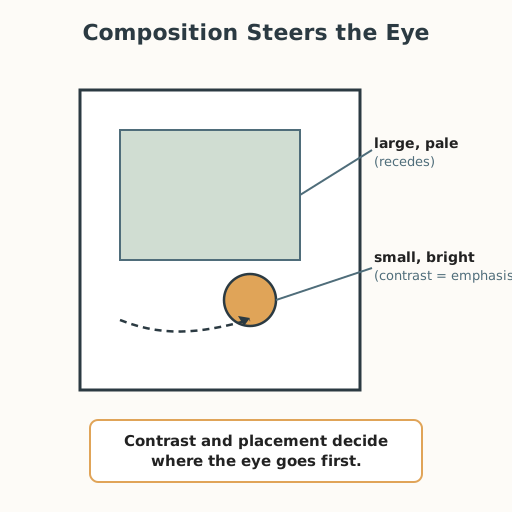
Two posters say “save water.” One is a gray wall of text; the other is a single cracked, dry leaf drawn huge against an empty blue sky, with no words at all. The first tells you; the second shows you — and your eye goes to the leaf before you can help it. That is not magic; it is composition: the artist chose size, color, and placement so that your eye and your feeling would land exactly where they wanted. Today you learn to make those choices on purpose instead of by accident.
Materials
- Artwork plan sheet
- Art-making supplies
- Art journal
Preparation
- Copy the artwork plan sheet.
- Retrieval: from Lesson 1, each learner’s issue and intention sentence; from Grade 10 (D07.S1.10.01), a personal style built from ideas and influences.
- Prepare one demonstration: the same simple subject drawn twice, with one element changed (size, color, or contrast), so the class can feel the difference.
Facilitator note
This lesson is written to the learner (“you”). The ideas to land: elements of art are the building blocks (line, shape, form, color, value, texture, space); principles of design are how they are arranged (balance, contrast, emphasis, and so on); and an artist uses both to direct attention and feeling (S-365). The skill — make a choice, then say why it produces the intended effect — is taught with a worked example and guided practice (S-011); the issue and the feeling stay the learner’s own.
The intellectual lens: every visual choice is a reason in image form; the written explanation makes that reasoning explicit. The critical-thinking lens: learners separate observation (“the leaf is large and centered”) from judgment (“it makes me feel small and worried”) — the move Grade 8 practiced (S-365). The global lens: the vocabulary of elements and principles is a shared tool across traditions, not one culture’s property; an Akan adinkra cloth, a Māori kōwhaiwhai rafter pattern, and a European engraving all make deliberate choices about line, shape, and repetition (S-114, S-115). The egalitarianism lens: any material — paint or leaves, screen or sand — can carry a serious message; no tool is more “real art” than another.
Procedure
- Recall (5 min). Re-read your intention sentence from Lesson 1. It names your intended effect. Everything you make today serves that sentence.
- Meet the tools (12 min). Elements are the building blocks: line, shape, form, color, value, texture, space. Principles are how you arrange them: balance, contrast, emphasis, movement, pattern, proportion, unity (S-365). Worked example: an artist making an image about loneliness places one small dark figure far to one side of a large empty field — contrast of size and placement create emphasis and a feeling of isolation.
- Plan your image (8 min). On the plan sheet, choose one element and one principle to carry your message, and sketch a quick layout. Write, in one line, what you expect that choice to make a viewer feel.
- Make it (20 min). Create the artwork. As you work, keep asking: where will the eye go first, and what will it feel there?
- Explain the reasoning (8 min). In your journal, write three sentences: (a) what issue the work addresses, (b) the element and principle you chose and where, and (c) the intended effect on the audience.
- Peer check and revise (7 min). Show a partner. Ask only two questions: what did you notice first? and what did it make you feel? If their answer differs from your intention, change one thing to close the gap. Art is revised, not just made.
Differentiation
- Support: Focus on a single principle (contrast or emphasis) with a single element (color or size), and give sentence frames for the written reasoning.
- Extension: Use two principles together, and write how the combination shapes the effect — then explain where a viewer might read it differently than intended.
Assessment
- Formative (peer + self): Can the learner name the element and principle they chose, point to where each appears in the work, and explain how each serves the intended effect?
- Portfolio artifact (unit): The completed artwork plus its three-sentence written explanation, saved for the Lesson 10 gallery.
Home connection
Look around home or your neighborhood for one image that is doing something to you — a sign, a wrapper, a photo. Name the element and principle it uses, and write one sentence about what it is trying to make you do.
Resources
- On the elements of art and principles of design: The Getty, Understanding Formal Analysis (S-365).
- On free/open digital art tools: Krita (S-440); Inkscape (S-441).
- On composition across traditions: The Met, Heilbrunn Timeline of Art History (S-114); Te Papa Tongarewa, Māori arts (S-115).
- On worked examples and guided practice: Kirschner, Sweller & Clark (2006), https://doi.org/10.1207/s15326985ep4102_1 (S-011).