Lesson 10 — The Gallery: Curating Our Voices Together
Learners gather the unit's made and curated works — the artwork, curated exhibition, composed piece, listening program, performance, directed program, prototype, and life-cycle evaluation — into one coherent showcase, present them to an audience, and write a reflection on what they intended and what actually happened. The lesson is a spaced-retrieval pass over the whole unit and a hand-off to Grade 12.
Objectives
Objectives
- D07.S1.11.02 Curate a small exhibition of artworks, their own or others', and write the reasoning behind the selection and order.
- D07.S2.11.02 Curate a listening program of works from several cultures and write the reasoning behind the selection.
- D07.S3.11.02 Direct or curate a short performance program and write the reasoning behind the selection and staging.
Essential question
How do I gather my made and curated works into one coherent showcase, present them to an audience, and reflect on what I intended and what actually happened?
Key vocabulary
Materials
Standard materials
- Portfolio checklist · 1 per learner A list of the unit's artifacts — artwork, curated exhibition, composed piece, listening program, performance, directed program, prototype, life-cycle evaluation — with space to tick each and note its intended effect
- Display and staging space Wall, table, and open floor to present the works as one show
- Art journal · 1 per learner
Low-tech / no-cost
- Paper, string, and found stands To hang and prop the works with no special equipment
- Voices and bodies The performances and listening program need no technology to be shared
Enriched / lab & device
- A digital portfolio or slideshow · 1 per learner or group To assemble the works into a shareable digital record
- A simple audio or video recording (optional) To capture the performances and listening program for the record
Works in different contexts
- large-group Arrange a rotating gallery: half the class presents while the other half visits, then they switch, so every voice is heard and seen
- multi-age Younger learners present one favorite work and say its intended effect; older learners present the full set and reflect across it
- self-directed A learner assembles the portfolio alone, writes the reflective statement, and shares it with at least one other person (in person or at a distance)
- level-grouped Group by presentation readiness; a ready group presents the full showcase with written statements, others present a chosen few works with sentence stems
- outdoor-only Lay the works along a path or against a wall outdoors, and walk the "gallery" as a group, pausing at each stop for the maker to speak
Lesson 10 — The Gallery: Curating Our Voices Together
Summary
Learners gather the unit’s made and curated works — the artwork, curated exhibition, composed piece, listening program, performance, directed program, prototype, and life-cycle evaluation — into one coherent showcase, present them to an audience, and write a reflection on what they intended and what actually happened. The lesson is a spaced-retrieval pass over the whole unit, and a hand-off of a growing artistic voice to Grade 12.
Objectives
- Present the curated exhibition, listening program, and performance program together as one coherent showcase, with written reasoning for each, and reflect on intended versus actual effect. (D07.S1.11.02, D07.S2.11.02, D07.S3.11.02)
Connection
A single picture is a voice; a whole show is a conversation. When you hang your artwork next to someone’s listening corner and someone else’s performance, the room itself starts to speak — about the issues you each chose, and about what a group of people, working together, can make the world feel. Today you stop making and start showing, and you notice that the showing is itself the last work of art.
Materials
- Portfolio checklist
- Display and staging space
- Art journal
Preparation
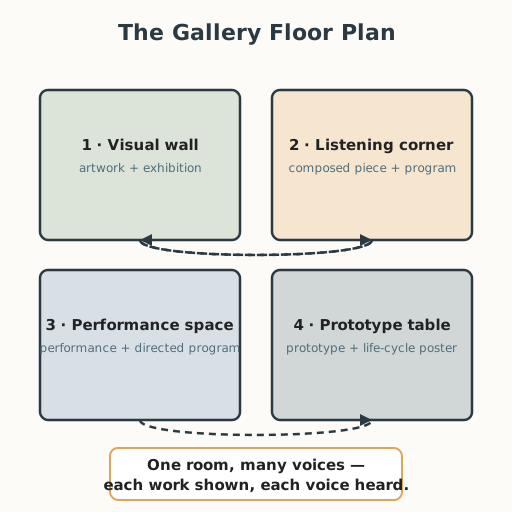
- Set the room (or outdoor path) with zones for the visual wall, the listening corner, the performance space, and the prototype/life-cycle table.
- Retrieval: this lesson is a spaced-retrieval pass — each artifact is recalled and re-explained, which is itself evidence-backed for learning (S-039).
- Prepare the portfolio checklist and a short reflective-statement frame.
Facilitator note
This lesson is written to the learner (“you”). The idea to land: a portfolio is not a pile; it is a curated whole — the learner selects, arranges, and explains their works as one statement, then reflects on intended versus actual effect. This is the unit’s capstone and its spaced-retrieval payoff (S-039); keep it a celebration of mastery, never a ranking (philosophy §8).
The intellectual lens: the reflection asks the learner to compare intention with outcome — the same evidence-versus-judgment discipline the unit has practiced. The community lens: the gallery is for an audience; learners practice giving and receiving feedback that is honest and kind. The global lens: learners see, side by side, that their classmates’ issues and traditions are many — and that a room of different voices is stronger than a single one. The egalitarianism lens: every work is shown, every voice heard; no work is “better,” only different in what it intended.
Preview: Grade 12 (D07.S1.12.01, D07.S2.12.01, D07.S3.12.01, D07.S4.12.01) asks for a sustained body of work with a coherent vision — the seed of that is planted today.
Procedure
- Gather (10 min). Use the checklist to collect your artifacts: the artwork and its explanation, the curated exhibition and its wall text, the composed piece and its notes, the listening program and its program notes, the performance and its explanation, the directed program and its staging reasoning, the prototype and its impact statement, and the life-cycle evaluation. Tick each and write its intended effect in one line.
- Arrange (15 min). Place your works in the shared space: the visual wall, the listening corner, the performance space, the prototype table. Decide a simple order for a visitor to meet them, and set up so an audience can see and hear each one.
- Present and visit (20 min). Take turns presenting and visiting. When you present, say your issue, point to one work, and state its intended effect. When you visit, ask only: what did it make you feel or think? and what did you notice first?
- Reflect (10 min). In your journal, write a short artist statement for the whole unit: (a) the issue you carried through, (b) the one work you are proudest of and why, and (c) one place where the actual effect differed from what you intended — and what that taught you.
- Hand off (5 min). Read one sentence of your statement aloud to the group. This is your voice, carried forward.
Differentiation
- Support: Present one favorite work with a sentence stem (“I wanted my audience to…”), and write a two-sentence reflection.
- Extension: Write a full reflective statement that names two places intention and effect diverged, and one skill you want to build in Grade 12.
Assessment
- Summative (portfolio): Does the learner present a complete set of artifacts with written reasoning for each, and a reflection that honestly compares intended and actual effect?
- Portfolio artifact (unit): The completed checklist and reflective artist statement, closing the unit portfolio and handing it toward Grade 12.
Home connection
Show your portfolio (or tell its story) to one person at home or in your community. Ask them which work moved them most, and write down their answer beside your own intention.
Resources
- On retrieval practice and spacing as the unit’s capstone structure: Dunlosky et al. (2013), https://doi.org/10.1177/1529100612453266 (S-039).
- On cooperation over competition and mastery without ranking:
docs/philosophy.md(§8). - On worked examples and guided practice: Kirschner, Sweller & Clark (2006), https://doi.org/10.1207/s15326985ep4102_1 (S-011).