Lesson 09 — The Life of a Made Thing: Full-Cycle Evaluation
Learners evaluate the full life cycle of a designed object — raw materials, making, use, and disposal — and propose improvements at each stage, including the move from a linear "make-use-throw away" path toward a circular one that keeps materials in use. They learn that every object has a story, and that good design asks where that story begins and ends.
Objectives
Objectives
- D07.S4.11.02 Evaluate the full life cycle of a designed object, from materials and making through use and disposal, and propose improvements.
Essential question
How do I evaluate the full life cycle of a designed object — from materials and making through use and disposal — and propose improvements?
Key vocabulary
Materials
Standard materials
- Life-cycle evaluation sheet · 1 per learner or small group A five-stage table — raw materials, making, use, disposal, and back to materials — with space to note impacts and propose improvements at each stage
- One everyday object to examine · 1 per learner or group A bottle, a shoe, a phone, a chair, a bag — any made thing whose story can be traced
- Art journal · 1 per learner
Low-tech / no-cost
- A found or locally made object A clay pot, a woven basket, a wooden tool — objects whose materials and making are visible and local
- Paper and pencil To map the life-cycle stages by hand as a diagram
Enriched / lab & device
- Internet access (optional) To research a specific material's origin and disposal path with care for accuracy
- A second object for comparison To compare two versions of the same kind of thing (glass vs. plastic bottle) across the cycle
Works in different contexts
- large-group Small groups each trace one object's life cycle and present one stage with an improvement; the class assembles a shared wall map of all five stages
- multi-age Younger learners trace the visible stages (made from what, thrown away where); older learners evaluate impacts and propose circular improvements
- self-directed A learner traces one object through all five stages alone, writes the evaluation, and proposes two improvements
- level-grouped Group by analysis readiness; a ready group compares two materials' footprints and argues for a change, others work from a scaffold
- outdoor-only Trace a natural or found object's whole story in place — where it came from, how it is used, where it will go — and propose a return to the loop
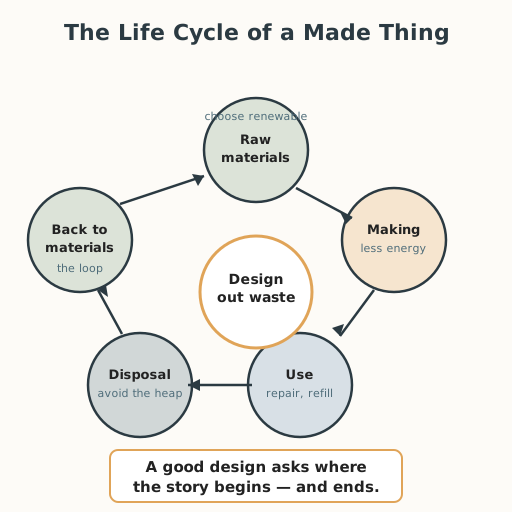
Lesson 9 — The Life of a Made Thing: Full-Cycle Evaluation
Summary
Learners evaluate the full life cycle of a designed object — raw materials, making, use, and disposal — and propose improvements at each stage, including the move from a linear “make–use–throw away” path toward a circular one that keeps materials in use. They learn that every object has a story, and that good design asks where that story begins and where it ends.
Objectives
- Evaluate the full life cycle of a designed object, from materials and making through use and disposal, and propose improvements. (D07.S4.11.02)
Connection
Pick up any one thing near you — a bottle, a shoe, a phone, a chair. Before it reached your hand, someone took materials out of the ground or the forest, shaped them in a workshop or a factory, and shipped the result to you; after you are done with it, it will go somewhere — a bin, a heap, a river, a recycler, a repair bench. That whole journey is the object’s life cycle. A designer who never asks about it has only seen half the object.
Materials
- Life-cycle evaluation sheet
- One everyday object to examine
- Art journal
Preparation
- Copy the evaluation sheet and gather the objects.
- Retrieval: from Lesson 8, the prototype and its intended impact — today we widen the lens from “does it work?” to “what does its whole life cost?”
- Model one worked example: tracing a single object through all five stages.
Facilitator note
This lesson is written to the learner (“you”). The ideas to land: a designed object’s footprint spans its whole life cycle — raw material acquisition, materials manufacture, production, use/reuse/maintenance, and waste management (S-371); evaluating each stage and proposing improvements is the discipline, and the deepest improvement is designing for a circular path that keeps materials in use rather than throwing them away (S-452). Teach the five-stage trace with a worked example and guided practice (S-011); the object and its improvements stay the learner’s own.
The intellectual lens: the evaluation separates what can be observed and known about a material’s path from what the learner values about it. The critical-thinking lens: learners ask at every stage “what is left out of this story?” — the energy, the water, the people, the waste we don’t see. The environment lens: the life-cycle view is how a “clean” product can hide a heavy footprint, and how design-for-repair and design-for-reuse lighten it (S-371, S-452). The egalitarianism lens: the costs of a life cycle are rarely paid by the same people who enjoy the object — extraction and waste often land on poorer and more marginalized places; ask who pays, and who benefits? — held as a justice question, not a statistic to be asserted without evidence (philosophy §5).
Procedure
- Recall (5 min). From Lesson 8, your prototype. It worked — but what does its whole life cost? Today you find out.
- Meet the five stages (12 min). A designed object’s life cycle runs raw materials → making → use → disposal — and, in a circular economy, back to materials again (S-371, S-452). Worked example: a glass bottle. Raw materials: sand and minerals mined and melted at high heat. Making: factory forming, shipping. Use: refilled or recycled. Disposal: if recycled, melted again (a loop); if dumped, it sits for centuries. The improvement is in the loop: design so the bottle returns.
- Trace your object (15 min). On your sheet, walk your object through each stage. For each, note one real thing you can observe or reasonably infer, and one question you cannot yet answer. Be honest about what you don’t know.
- Find the heaviest stage (8 min). Mark which stage seems to carry the biggest cost — materials, energy, water, waste, or harm to people. Your judgment is provisional; say so.
- Propose improvements (10 min). Write two improvements: one small (change a material, add a repair path, cut an amount) and one circular (how could the object return to the loop instead of leaving it?).
- Close (5 min). Share your object’s story and one improvement with a partner. Ask: who would pay less, and who would gain?
Differentiation
- Support: Trace only the visible stages (what is it made of; where does it go when broken?) and propose one small improvement.
- Extension: Compare two versions of the same kind of object (glass vs. plastic bottle) across the cycle, and argue which has the lighter footprint — and where the answer is not simple.
Assessment
- Formative (peer + self): Can the learner name all five stages, point to a real impact at each, and propose one small and one circular improvement?
- Portfolio artifact (unit): The completed evaluation sheet with its proposed improvements, saved for the Lesson 10 gallery.
Home connection
Choose one object at home and trace three stages of its life: what it is made of, how it is used, and where it will go when it is done. Write one improvement that would keep it in use longer.
Resources
- On the life-cycle perspective: U.S. EPA, Sustainable Materials Management (S-371).
- On the circular economy: Ellen MacArthur Foundation (S-452).
- On worked examples and guided practice: Kirschner, Sweller & Clark (2006), https://doi.org/10.1207/s15326985ep4102_1 (S-011).