Lesson 10 — A Problem We Can't Solve Alone
Learners analyze a global collective-action problem: a shared resource — the climate, the air, the oceans — that each person and nation has a reason to use freely and a reason to protect, but that can be used up when everyone acts alone. They meet the free-rider temptation and the coordination that answers it, ground the idea in real emissions data (who emits, who suffers), and reason about what coordination across nations requires.
Objectives
Objectives
- D09.S3.11.01 Analyze a global collective-action problem, such as climate change or labor rights, and the coordination needed to solve it.
Essential question
Why do some problems need the whole world to solve them, and what kind of coordination do they require?
Key vocabulary
Materials
Standard materials
- Collective-action organizer · 1 per learner A three-part frame (the shared resource, the temptation to free-ride, the coordination that solves it) to fill in
- Justice journal · 1 per learner
Low-tech / no-cost
- A simple commons game with tokens and a shared "pond" Learners draw from a shared pool with a rule that changes halfway, then compare outcomes
- Paper and pencil To draw the organizer by hand
Enriched / lab & device
- One-page emissions data (Our World in Data, S-006) and IPCC summary (S-005) · 1 per group To ground climate change as a real collective-action problem with uneven who-emits / who-suffers
Works in different contexts
- large-group Run the commons game whole-class in rounds, then debrief what made cooperation hold or break
- multi-age Younger learners play the commons game and say what happened; older learners name the free-rider problem and design a rule
- self-directed A learner reads the emissions data, fills the organizer, and writes why individual good choices are not enough alone
- level-grouped A ready group also reads Elinor Ostrom's finding that communities can govern commons with their own rules (S-416) and weighs it
- outdoor-only Use a real shared thing (a patch of plants, a water source) as the "commons"; discuss how it could be used up and what rule would protect it
Lesson 10 — A Problem We Can’t Solve Alone
Summary
Learners analyze a global collective-action problem: a shared resource — the climate, the air, the oceans — that each person and nation has a reason to use freely and a reason to protect, but that can be used up when everyone acts alone. They meet the free-rider temptation and the coordination that answers it, ground the idea in real emissions data (who emits, who suffers), and reason about what coordination across nations requires.
Objectives
- Analyze a global collective-action problem, such as climate change, and the coordination needed to solve it. (D09.S3.11.01)
Connection
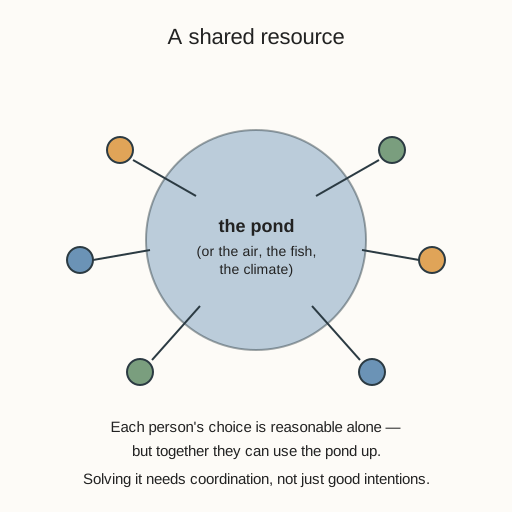
A pond is shared by many families. Each family, alone, has a good reason to take a little extra water for its own fields — and each family’s “a little extra” is small. But if every family reasons the same way, the pond runs dry, and everyone loses. This is a collective-action problem: what is sensible for each person alone is ruinous for everyone together. The climate, the air, and the oceans are ponds on a planetary scale. Solving them cannot be done by good intentions alone; it needs coordination — agreements, rules, and institutions that change what each actor finds sensible.
Materials
- Collective-action organizer
- Justice journal
- Commons game tokens + shared pond (low-tech)
Preparation
- Prepare the commons game (a shared pool of tokens; a rule introduced halfway).
- Copy or draw the organizer.
- Retrieval: from Lesson 9, applying theories of justice to a current issue. Today we scale up to problems only the whole world can solve.
- Prepare the facts (general data authorities): historical emitters and present emitters differ; the places that emitted most over two centuries are often not the places that suffer worst today (Our World in Data, S-006; IPCC, S-005).
Facilitator note
This lesson is written to the learner (“you”). The idea to land: a collective-action problem is one where each actor’s reasonable self-interested choice produces a collective ruin — the commons is used up — and the answer is coordination (rules and institutions), not just virtue. Ground it: climate change is a real collective- action problem, and who emitted most historically is not the same as who suffers most today (Our World in Data, S-006; IPCC, S-005) — so coordination raises a fairness question, not just a technical one. The commons game is the worked example; play it before the abstraction (S-011).
The ethics lens: what each of us owes the shared world is a moral question. The egalitarianism lens: the who-emits / who-suffers gap is the fairness heart of the climate problem — coordination that ignores it is not just. The global lens: the commons is planetary; no single nation’s action, however large, is enough alone. The environment lens: the “pond” is the real biosphere — atmosphere, ocean, forest, soil. The critical-thinking lens: distinguishing the facts (who emits, who suffers) from the values (what each owes). Preview: Lesson 11 applies the same frame to workers and supply chains.
Procedure
- Recall (5 min). From Lesson 9, what did your three-lens verdict leave unsettled? Today we meet problems no individual — however just — can fix alone.
- Play the commons (12 min). A shared pond of tokens. Round 1: take freely each turn. Round 2: a rule is agreed that limits each turn. Compare what happens to the pond, and to the group, in each round.
- Name the problem (10 min). What you saw is a collective-action problem: the sensible choice alone (take more) ruins the shared thing. The temptation to take while others protect is free-riding. What answered it? A rule — coordination.
- Scale it up (12 min). The climate is the same problem at planetary scale. Each nation has reason to burn fuel for its own growth; all together we warm the planet. Note the fairness gap: the places that emitted most over two centuries are often not the places suffering worst now (S-006; S-005).
- Design coordination (10 min). In your organizer, name one shared rule or institution that could coordinate nations on climate — and one reason it is hard.
- Close (4 min). Say, in your own words, why “everyone should just do the right thing” is not enough — and what coordination adds.
Differentiation
- Support: Play the game and name the free-rider temptation; leave the global scaling to discussion.
- Extension: Read Ostrom’s finding that communities can govern commons with their own rules (S-416) and argue what it teaches for a global commons.
Assessment
- Formative (peer + self): Can the learner name the collective-action structure (shared resource, free-rider, coordination), ground it in the climate facts, and propose a coordination rule with one obstacle?
- Portfolio artifact (unit): The completed collective-action organizer — the unit’s collective-action-problem analysis.
Home connection
Ask someone at home about a shared thing (a kitchen, a water source, a budget) that took coordination to protect. Write one sentence on the rule that worked and one on what happened without it.
Resources
- On climate as a collective-action problem and the who-emits / who-suffers gap: Our World in Data (S-006); IPCC (S-005).
- On communities governing commons with their own rules: Ostrom, Governing the Commons (S-416).
- On worked examples and guided practice: Kirschner, Sweller & Clark (2006) (S-011).