Lesson 09 — Three Lenses on One Issue
Learners bring the three theories of justice — freedom, equality, and care — to bear on one current issue (access to education, digital access, housing, health care, or clean water). They run each lens's question across the same evidence, notice what each reveals and hides, and defend a reasoned verdict about which lens is most convincing for that issue — conceding a counterargument along the way.
Objectives
Objectives
- D09.S2.11.02 Evaluate competing theories of justice (such as those centered on freedom, equality, or care) and apply them to a current issue.
Essential question
How do freedom, equality, and care each judge the same current issue — and which is most convincing?
Key vocabulary
Materials
Standard materials
- Three-lens application sheet · 1 per learner Three columns (freedom, equality, care) each asking its question of one current issue, with a bottom row for a verdict
- Justice journal · 1 per learner
Low-tech / no-cost
- Issue cards on paper Current issues to choose from (access to education, digital access, housing, health care, clean water) with a short fact base each
- Paper and pencil To draw the three columns by hand
Enriched / lab & device
- One short data note per issue (UNDP, World Bank digital divide, WHO water) · 1 per group A factual anchor so the application is evidence-grounded, not impressionistic
Works in different contexts
- large-group Choose one issue whole-class, run all three lenses on the board, then pairs each write their verdict
- multi-age Younger learners say what each issue needs; older learners run the three lenses and defend a verdict
- self-directed A learner chooses an issue, runs all three lenses in writing, and writes a verdict with one counterargument conceded
- level-grouped A ready group also argues which *single* lens is most convincing for their issue, and must concede a counterargument
- outdoor-only Three stations (freedom, equality, care); walk one issue through each station, jot a note, then decide in a circle
Lesson 9 — Three Lenses on One Issue
Summary
Learners bring the three theories of justice — freedom, equality, and care — to bear on one current issue (access to education, digital access, housing, health care, or clean water). They run each lens’s question across the same evidence, notice what each reveals and hides, and defend a reasoned verdict about which lens is most convincing for that issue — conceding a counterargument along the way.
Objectives
- Evaluate competing theories of justice and apply them to a current issue. (D09.S2.11.02)
Connection
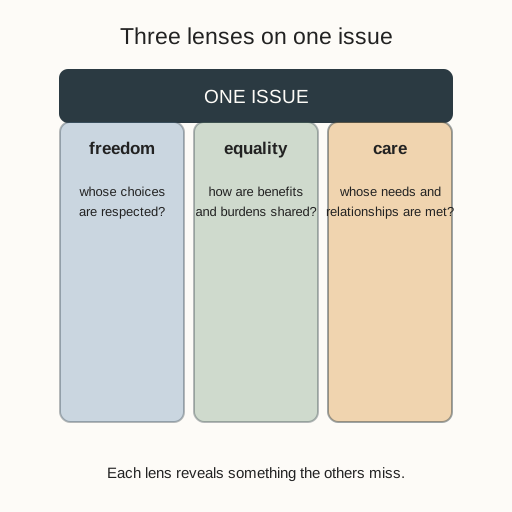
A theory of justice is not a museum piece; it is a lens you can pick up and look through. Take a live question — who gets a decent education, a home, health care, a phone connection, clean water — and each theory asks a different question of it. Freedom asks, “whose choices are respected?” Equality asks, “how are benefits and burdens shared?” Care asks, “whose needs and relationships are met?” The same facts look different through each lens, and a good argument tries all three before it decides.
Materials
- Three-lens application sheet
- Justice journal
- Issue cards (low-tech: paper)
Preparation
- Copy or draw the three-column application sheet; prepare the issue cards with short fact bases.
- Retrieval: from Lessons 7 and 8, the three lenses — freedom (capability), equality (fair shares), care (meeting needs). Today we apply them.
- Prepare the issue fact bases accurately (general data authorities): education access and digital divide (World Bank, S-281), health and clean water (WHO, S-003 / S-049), inequality and poverty (UNDP, S-283).
Facilitator note
This lesson is written to the learner (“you”). The idea to land: theories of justice are applied, not just admired — freedom, equality, and care each ask a different question of the same issue, and each reveals something the others hide (Rawls S-459; Sen S-460; SEP Distributive Justice S-388). The methodological point: application is a skill — run the lens, cite the fact, state the verdict, concede the counterargument — and it is modeled before it is assigned (worked examples, S-011). Keep the issues factual and non-sensational; the goal is reasoning, not outrage.
The ethics lens: each verdict is a moral judgment, opened and defended, not imposed. The egalitarianism lens: the equality lens is applied to the others — ask of every lens who it leaves out. The global lens: the issues (education, water, digital access, health) are global in reach; learners may choose any, and none is the default. The technology lens: digital access is one issue on the table — who gets a connection shapes who can learn, work, and be heard (S-281). The critical-thinking lens: distinguishing the facts (evidence) from the verdict (value), and conceding a counterargument honestly. Preview: Lesson 10 scales from individual issues to problems only the whole world can solve.
Procedure
- Recall (5 min). Name the three lenses and each one’s question: freedom (“whose choices are respected?”), equality (“how are shares shared?”), care (“whose needs are met?”).
- Choose an issue (5 min). Pick one issue card — education, digital access, housing, health care, or clean water — and read its short fact base.
- Model one lens (8 min). Work a model together (S-011): run one lens on your issue — name the fact, state what the lens reveals, and what it misses.
- Run all three (15 min). Fill the three columns: for each lens, what question does it ask, what fact does it highlight, and what does it hide?
- Write the verdict (12 min). In your justice journal, write which lens is most convincing for your issue, with one reason and one counterargument you concede.
- Close (4 min). Say, in your own words, why a just answer to a hard issue needs more than one lens — and what your verdict still left unsettled.
Differentiation
- Support: Run two lenses (freedom and care) and write a one-sentence verdict.
- Extension: Write a full short essay applying all three lenses to a second issue of your choice, with two counterarguments conceded.
Assessment
- Formative (peer + self): Can the learner run each lens on the same evidence, name what each reveals and hides, and defend a verdict with a conceded counterargument?
- Portfolio artifact (unit): The completed three-lens application sheet with the written verdict — the unit’s theories-of-justice application.
Home connection
Ask someone at home what they think a hard local issue is, and which of freedom, equality, or care they would put first in solving it. Write one sentence on their answer and one on yours.
Resources
- On the lenses: Rawls (S-459); Sen (S-460); SEP, Distributive Justice (S-388).
- On the issues’ fact bases: World Bank digital divide (S-281); WHO (S-003) and WHO drinking water (S-049); UNDP Human Development Reports (S-283).
- On worked examples and guided practice for application: Kirschner, Sweller & Clark (2006) (S-011).