Lesson 12 — Solidarity Across Distance
Learners evaluate solidarity — acting with others across difference and distance — and argue for what it requires of citizens. They distinguish solidarity from mere sympathy, meet real practices of mutual aid and humanitarian solidarity from around the world, and defend a position on why (and how far) a citizen's care should extend to people unlike and far from themselves.
Objectives
Objectives
- D09.S3.11.02 Evaluate solidarity (acting with others across difference and distance) and argue for what it requires of citizens.
Essential question
What does solidarity require of citizens, and why does it extend to people unlike us?
Key vocabulary
Materials
Standard materials
- Solidarity organizer · 1 per learner A bridge diagram (near me, like me ↔ far away, different from me) with space to name what citizens owe
- Justice journal · 1 per learner
Low-tech / no-cost
- Example cards on paper Acts of solidarity across difference and distance (a mutual-aid network, the Red Cross/Red Crescent, a workers' alliance across borders, the Green Belt Movement)
- Paper and pencil To draw the bridge by hand
Enriched / lab & device
- Short notes on mutual-aid traditions and the Red Cross/Red Crescent (S-329) · 1 per group To ground solidarity as a real, practiced, global thing, not a slogan
Works in different contexts
- large-group Build a "web of solidarity" with string — each learner names one person or group they are connected to who is unlike them
- multi-age Younger learners name one person they help and why; older learners argue what solidarity requires of citizens toward distant others
- self-directed A learner reads the example cards, fills the bridge, and writes what solidarity requires of them and one thing that makes it hard
- level-grouped A ready group also weighs whether we owe solidarity to strangers when our own community is struggling, and defends a position
- outdoor-only Form a human chain across a space — each person a link — and discuss what would make the chain hold or break
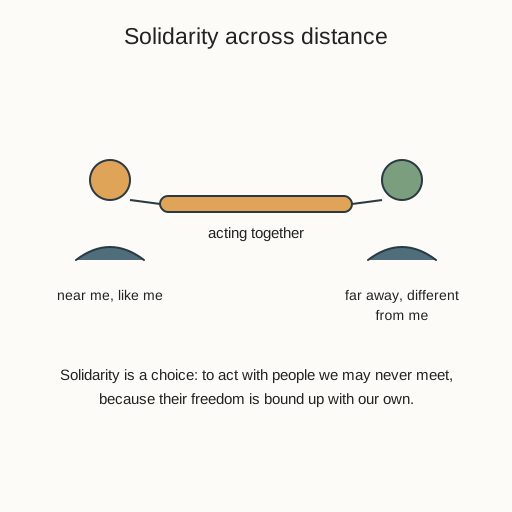
Lesson 12 — Solidarity Across Distance
Summary
Learners evaluate solidarity — acting with others across difference and distance — and argue for what it requires of citizens. They distinguish solidarity from mere sympathy, meet real practices of mutual aid and humanitarian solidarity from around the world, and defend a position on why (and how far) a citizen’s care should extend to people unlike and far from themselves.
Objectives
- Evaluate solidarity (acting with others across difference and distance) and argue for what it requires of citizens. (D09.S3.11.02)
Connection
It is easy to act with people who look like us, live near us, and share our lives. It is harder to act with a stranger across a border, an ocean, or a difference we do not understand — harder, and often exactly where it matters most. Solidarity is not feeling sorry for someone far away; it is acting with them, as if their cause were our own, even when we will never meet. This lesson asks what that actually costs a citizen, and why the answer has real consequences for how we live together in one shared world.
Materials
- Solidarity organizer
- Justice journal
- Example cards (low-tech: paper)
Preparation
- Copy or draw the bridge organizer; prepare the example cards.
- Retrieval: from Lesson 11, the supply chain that links a far-away worker to a nearby buyer — solidarity is the human bond that makes that coordination possible.
- Prepare the examples: the Red Cross/Red Crescent movement (neutral, voluntary humanitarian aid in crises, S-329); the Green Belt Movement (a grassroots movement that spread across African countries and planted over thirty million trees, S-059); mutual-aid traditions and worker alliances across borders.
Facilitator note
This lesson is written to the learner (“you”). The idea to land: solidarity is acting with others across difference and distance — not feeling for them, but acting with them — and it is a practiced, documented thing, not a slogan (Red Cross/Red Crescent, S-329; Green Belt Movement, S-059). The argument at the center: what solidarity requires of citizens — time, risk, sharing power, listening, refusing to look away — and how far that requirement extends is a live question, held open. Do not answer it for them; the skill is arguing a position and conceding a counterargument.
The ethics lens: what we owe strangers is a moral question, opened not closed. The egalitarianism lens: solidarity is the answer to the who-benefits/who-is-left- out questions of the last two lessons — it refuses to accept that distance or difference ends our responsibility. The global lens: the examples span continents; solidarity is planetary by nature. The community lens: solidarity begins near home (a mutual-aid network, a neighbor) and extends outward — it is not either/or. The critical-thinking lens: distinguishing the fact that solidarity happens (evidence) from the value that it should (commitment). Preview: Lesson 13 turns to conflict — the test where solidarity and justice are hardest.
Procedure
- Recall (5 min). From Lesson 11, what links a far-away worker to a nearby buyer? Today: what makes that link a bond of obligation, not just a chain of goods?
- Distinguish solidarity from sympathy (8 min). Sympathy feels for someone. Solidarity acts with them. Name the difference with one example each.
- Meet real solidarity (12 min). Read the example cards. The Red Cross/Red Crescent gives neutral, voluntary aid in crises (S-329). The Green Belt Movement grew from one person’s planting to over thirty million trees across African countries (S-059). Notice: in each, people acted with strangers across distance.
- Argue the requirement (12 min). With a partner, argue: what does solidarity require of a citizen — time, money, risk, listening, sharing power? And how far should it extend — to the neighbor, the stranger, the future generation?
- Write it (10 min). In your justice journal, write one thing solidarity requires of you, one thing that makes it hard, and one counterargument to your own position that you can honestly concede.
- Close (4 min). Say, in your own words, why solidarity with people unlike ourselves is not a luxury — and what it would ask of you this year.
Differentiation
- Support: Distinguish sympathy from solidarity and name one real example of each.
- Extension: Argue whether we owe solidarity to distant strangers when our own community is struggling, conceding a counterargument.
Assessment
- Formative (peer + self): Can the learner distinguish solidarity from sympathy, name what it requires of citizens, and defend a position with a conceded counterargument?
- Portfolio artifact (unit): The written argument on what solidarity requires — the unit’s solidarity evaluation.
Home connection
Ask someone at home about a time they helped a stranger, or a stranger helped them. Write one sentence on what happened and one on what it cost them.
Resources
- On humanitarian solidarity in practice: IFRC Red Cross/Red Crescent (S-329); on grassroots cross-border action: Green Belt Movement / Wangari Maathai (S-059).
- On worked examples and guided practice for argument: Kirschner, Sweller & Clark (2006) (S-011).