Lesson 13 — One Conflict, Many Sides
Learners analyze a real conflict from multiple perspectives — a land-and-water dispute between farmers and herders — and propose a just and peaceful path forward. They map each party's needs and interests, distinguish needs from positions, meet restorative justice as a tradition of repair rather than revenge, and craft a path that names every party's needs and the obstacles it must overcome.
Objectives
Objectives
- D09.S4.11.01 Analyze a real or historical conflict from multiple perspectives and propose a just and peaceful path forward.
Essential question
How do I analyze a conflict from multiple perspectives and propose a just and peaceful path forward?
Key vocabulary
Materials
Standard materials
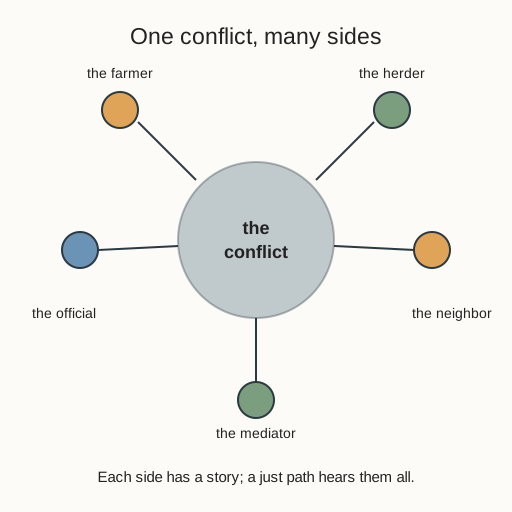
- Multi-perspective conflict map · 1 per learner A central circle ("the conflict") surrounded by the parties' viewpoints, with a space to write a path forward
- Justice journal · 1 per learner
Low-tech / no-cost
- Conflict case cards on paper One real or historical conflict, told in neutral outline (a land-and-water dispute between farmers and herders), to analyze without a preselected villain
- Paper and pencil To draw the map by hand
Enriched / lab & device
- Short background on restorative justice and truth-and-reconciliation practice · 1 per group To ground the "just and peaceful path" in a real tradition of repair (Zehr, S-161; IIRP, S-022)
Works in different contexts
- large-group Assign each group one party's perspective; each speaks its piece, then the class builds a single path forward that names every party's needs
- multi-age Younger learners retell the conflict as a story with two sides; older learners map all the parties and propose a path that is both just and peaceful
- self-directed A learner reads the case, fills the map with each party's view, and writes a path forward with one obstacle it must overcome
- level-grouped A ready group also weighs whether a "just" path and a "peaceful" path ever conflict, and argues what to do when they do
- outdoor-only Stand in the positions of the parties around a marked center; each speaks in role, then the group proposes a shared path
Lesson 13 — One Conflict, Many Sides
Summary
Learners analyze a real conflict from multiple perspectives — a land-and-water dispute between farmers and herders — and propose a just and peaceful path forward. They map each party’s needs and interests, distinguish needs from positions, meet restorative justice as a tradition of repair rather than revenge, and craft a path that names every party’s needs and the obstacles it must overcome.
Objectives
- Analyze a real or historical conflict from multiple perspectives and propose a just and peaceful path forward. (D09.S4.11.01)
Connection
Most conflicts look simple from one side and impossible from none. The farmer sees the herders’ animals trampling the crops; the herders see the fences closing off the water their animals have always needed; the official sees two groups who will not talk; the neighbor sees a dispute that is now everyone’s danger. Each side is partly right and partly blind. Analyzing a conflict honestly means holding all the stories at once — and then asking not “who wins?” but “what would be both just and peaceful for everyone here?”
Materials
- Multi-perspective conflict map
- Justice journal
- Conflict case cards (low-tech: paper)
Preparation
- Copy or draw the conflict map; prepare the case cards (a neutral outline of the dispute, with no preselected villain).
- Retrieval: from Lesson 12, what solidarity requires of citizens. Today we test it in the hardest place — conflict.
- Prepare the concepts: needs (what a party cannot do without — water, safety, a livelihood) vs positions (what a party demands); restorative justice (repairing harm and relationships rather than only punishing, S-161, S-022).
Facilitator note
This lesson is written to the learner (“you”). The idea to land: a conflict is best analyzed from all its sides at once — each party has needs and interests, and the distinction between needs and positions is the key that unlocks a path forward (conceptual tool, modeled with a worked example, S-011). Then the constructive turn: a just and peaceful path is one that names every party’s needs and repairs harm, drawing on restorative justice as a real tradition (Zehr, S-161; IIRP, S-022). The case is deliberately neutral and non-sensational; the skill is analysis and proposal, not taking sides or assigning blame.
The ethics lens: “what is just here?” is the question, opened not closed. The egalitarianism lens: a just path must not silently favor the stronger party — ask who has more power and whose needs are heard. The global lens: this kind of land-and-water dispute recurs across the world’s drylands and farmlands; it is no one region’s problem and no one region’s fault. The critical-thinking lens: distinguishing the facts of the case (evidence) from the judgment of what is just (value), and separating needs (shared ground) from positions (the obstacle). Preview: Lesson 14 closes the unit by evaluating nonviolence and peacekeeping as the instruments of a just peace.
Procedure
- Recall (5 min). From Lesson 12, what does solidarity require of a citizen? Today: what happens when solidarity breaks — a conflict — and how do we find a way back?
- Meet the case (8 min). Read the neutral outline: farmers and herders dispute land and water in a season of scarcity. Note who is involved, what each wants, and what is at stake.
- Map the sides (12 min). Fill the conflict map: for each party — farmer, herder, official, neighbor — write their needs (what they cannot do without) and their positions (what they demand). Notice where needs overlap even when positions clash.
- Distinguish needs from positions (10 min). With a partner, find one need the farmer and herder actually share (water, safety, a future) and one position that blocks them from seeing it.
- Propose a path (12 min). In your justice journal, write a path forward that is both just and peaceful: what would be repaired, who would be heard, what rule or agreement could hold, and one obstacle it must overcome. (Consider repair, not only punishment — S-161, S-022.)
- Close (4 min). Say, in your own words, why “who wins?” is the wrong question — and what the right one is.
Differentiation
- Support: Map two parties’ needs and positions and write a one-sentence path forward.
- Extension: Weigh whether a “just” path and a “peaceful” path ever conflict, and argue what to do when they do, conceding a counterargument.
Assessment
- Formative (peer + self): Can the learner map every party’s needs and positions, separate needs from positions, and propose a just and peaceful path with one obstacle?
- Portfolio artifact (unit): The completed conflict map and written path — the unit’s multi-perspective conflict analysis.
Home connection
Ask someone at home about a disagreement they once saw settled peacefully. Write one sentence on what made it peaceful and one on whether it was also fair.
Resources
- On restorative justice and repair: Zehr, Changing Lenses (S-161); IIRP (S-022).
- On conflict and structural violence (context): Galtung (1969) (S-462); on a shared commitment to peace and justice: UN SDG 16 (S-463).
- On worked examples and guided practice for analysis: Kirschner, Sweller & Clark (2006) (S-011).