Lesson 14 — Nonviolence and Peacekeeping
Learners evaluate the ethics of nonviolence and of peacekeeping, arguing about when and how each can succeed. They meet nonviolent civil resistance through documented campaigns (the Salt March, the Defiance Campaign, the Montgomery bus boycott, the Chipko movement) and peacekeeping as an impartial third party standing between sides, and weigh the strengths and limits of both — including the difference between the absence of war and a just peace.
Objectives
Objectives
- D09.S4.11.02 Evaluate the ethics of nonviolence and of peacekeeping, and argue about when and how they can succeed.
Essential question
When and how can nonviolence and peacekeeping succeed — and where do they fall short?
Key vocabulary
Materials
Standard materials
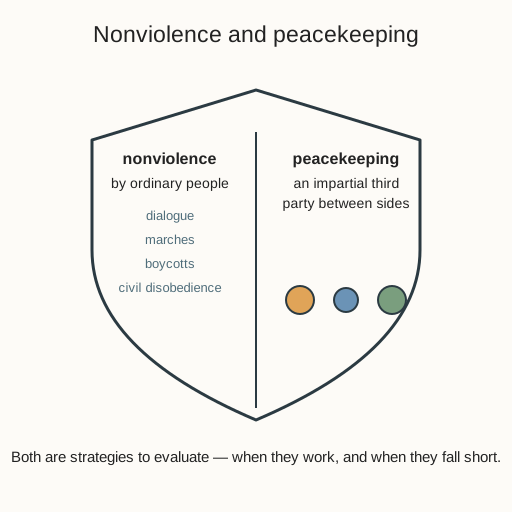
- Nonviolence-and-peacekeeping organizer · 1 per learner Two columns (nonviolence by ordinary people / peacekeeping by an impartial third party) with space to weigh when each succeeds and falls short
- Justice journal · 1 per learner
Low-tech / no-cost
- Case cards on paper Nonviolent campaigns (the Salt March, the Defiance Campaign, the Montgomery bus boycott, the Chipko movement) and peacekeeping's aims, to weigh
- Paper and pencil To draw the organizer by hand
Enriched / lab & device
- Short notes on Gandhi's satyagraha (S-205) and on peace and positive peace (Galtung, S-462) · 1 per group To ground nonviolence and peace as concepts with real content and real limits
Works in different contexts
- large-group Weigh the cases whole-class on a "succeeded / fell short" continuum, then pairs write one reasoned judgment each
- multi-age Younger learners name a way to solve a fight without hitting; older learners evaluate when nonviolence and peacekeeping succeed and argue the limits
- self-directed A learner reads the case cards, weighs each, and writes an argument about when nonviolence works — with one counterexample conceded
- level-grouped A ready group also debates whether peacekeeping can ever be truly impartial, and defends a position
- outdoor-only Act out the difference between nonviolence (ordinary people acting) and peacekeeping (a third party standing between); discuss when each is right
Lesson 14 — Nonviolence and Peacekeeping
Summary
Learners evaluate the ethics of nonviolence and of peacekeeping, arguing about when and how each can succeed. They meet nonviolent civil resistance through documented campaigns (the Salt March, the Defiance Campaign, the Montgomery bus boycott, the Chipko movement) and peacekeeping as an impartial third party standing between sides, and weigh the strengths and limits of both — including the difference between the absence of war and a just peace.
Objectives
- Evaluate the ethics of nonviolence and of peacekeeping, and argue about when and how they can succeed. (D09.S4.11.02)
Connection
There are two ways people refuse violence without being passive. One is nonviolent resistance: ordinary people act — march, boycott, refuse to obey an unjust law — and accept the cost, so that the injustice cannot hide. The other is peacekeeping: an impartial third party stands between two sides so that violence cannot restart while the two learn to talk. Both are strategies, not magic — they succeed in some conditions and fall short in others. Judging when and how they work is the last, and one of the hardest, questions of this unit.
Materials
- Nonviolence-and-peacekeeping organizer
- Justice journal
- Case cards (low-tech: paper)
Preparation
- Copy or draw the organizer; prepare the case cards.
- Retrieval: from Lesson 13, the just and peaceful path you proposed. Today we examine the instruments that walk it.
- Prepare the cases accurately: the Salt March (S-390); the Defiance Campaign (S-146); the Montgomery bus boycott (S-324); the Chipko movement (S-328); Gandhi’s satyagraha (“truth-force,” nonviolent insistence on truth, S-205). Prepare peacekeeping plainly: a third party, invited and impartial, that monitors, separates, and protects while parties negotiate — with the honest caveat that it has also failed.
Facilitator note
This lesson is written to the learner (“you”). The idea to land: nonviolence and peacekeeping are two real strategies for meeting conflict without violence — nonviolent resistance by ordinary people (Salt March S-390; Defiance Campaign S-146; Montgomery S-324; Chipko S-328; Gandhi’s satyagraha, S-205), and peacekeeping by an impartial third party — and both are to be evaluated, not idealized. The honest caveat: they succeed under some conditions and have failed in others; and “no war” is not yet “just peace” (Galtung’s positive/negative peace, S-462). Hold the question open: when nonviolence is right and when it is enough is a judgment, not a settled fact.
The ethics lens: the morality of refusing violence — and of standing between armed sides — is the lesson’s core. The egalitarianism lens: ask of nonviolence whether it can work for the powerless, and of peacekeeping whether it truly protects the weak or only freezes an unfair peace. The global lens: the campaigns span India, South Africa, the USA, and India again (Chipko) — nonviolence is no single nation’s tradition. The critical-thinking lens: distinguishing the fact that a campaign succeeded (evidence) from the value that nonviolence is always right (a value to argue). This lesson closes the unit; tie it back to Lesson 1’s question about structure and choice — nonviolence is one way people change structures.
Procedure
- Recall (5 min). From Lesson 13, what path forward did you propose — and what obstacle stood in its way? Today: what instruments walk that path?
- Meet nonviolent resistance (12 min). Read the case cards. In each, ordinary people acted without violence — marched (S-390), defied unjust laws (S-146), boycotted (S-324), embraced trees to protect a forest (S-328) — and accepted the cost. Gandhi called this satyagraha, “truth-force” (S-205).
- Meet peacekeeping (8 min). Peacekeeping is different: a third party, invited and impartial, stands between sides — monitoring, separating, protecting — while the two negotiate. Its aim is to stop violence so a just peace can be built.
- Weigh success and failure (12 min). With a partner, place each strategy on a “when it succeeds / when it falls short” line. Name one condition that helps each (e.g., nonviolence needs discipline and numbers; peacekeeping needs consent and resources).
- Distinguish peace from just peace (8 min). No war is not yet justice. Galtung calls the mere absence of fighting “negative peace,” and a peace with justice “positive peace” (S-462). Which do the cases you read move toward?
- Close (4 min). Say, in your own words, why nonviolence is not weakness — and why peacekeeping is not the same as peace.
Differentiation
- Support: Name one nonviolent action and one thing peacekeeping does, leaving the conditions debate aside.
- Extension: Argue whether nonviolence can work against a ruler who answers protest with force, using a real case and conceding a counterargument.
Assessment
- Formative (peer + self): Can the learner describe nonviolence and peacekeeping, name a condition for each’s success and failure, and distinguish negative from positive peace?
- Portfolio artifact (unit): The completed organizer with the written judgment — the unit’s ethics-of-nonviolence evaluation.
Home connection
Ask someone at home about a conflict they saw resolved without violence — by people standing together, or by someone stepping between the sides. Write one sentence on what happened and one on whether it lasted.
Resources
- On nonviolent campaigns: Britannica, Salt March (S-390); South African History Online, Defiance Campaign (S-146); Britannica, Montgomery bus boycott (S-324); Britannica, Chipko movement (S-328); on satyagraha: Nobel Prize, Mahatma Gandhi (S-205).
- On negative vs positive peace: Galtung (1969) (S-462); on a shared commitment to peace: UN SDG 16 (S-463).
- On worked examples and guided practice for evaluation: Kirschner, Sweller & Clark (2006) (S-011).