Lesson 01 — Who Decides the Rules for Technology?
Learners name the three overlapping ways a technology is governed — law, standards, and markets — and trace how each shapes who may use a technology, how, and at what cost. They begin the unit's first analysis: that "governance" is not one ruler but a set of forces that often pull against one another.
Objectives
Objectives
- D10.S1.11.01 Analyze how technologies are governed — by law, standards, and markets — and evaluate a debate over regulating one.
Essential question
How are technologies governed — by law, standards, and markets — and who actually decides?
Key vocabulary
Materials
Standard materials
- Governance map · 1 per learner A three-column organizer — law, standards, markets — to record who decides and what each form of governance can and cannot do
- Stewardship journal · 1 per learner The unit-long notebook for reflections, arguments, and portfolio artifacts
Low-tech / no-cost
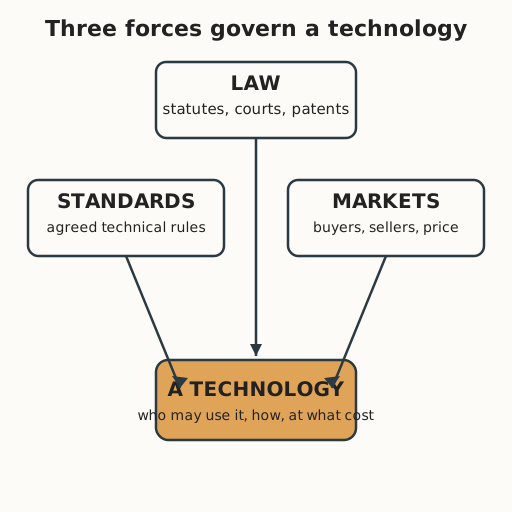
- Three role cards on paper One card each for law (statutes, courts, patents), standards (agreed technical rules), and markets (buyers, sellers, price), to read and sort
- Paper and pencil To draw the map by hand when no printed organizer is available
Enriched / lab & device
- One short case summary (the sewing-machine 'patent thicket' of the 1850s, or mobile-phone standards today) · 1 per pair A brief, faithful account of a real technology tangled in law, standards, and markets at once
Works in different contexts
- large-group Brainstorm the three forms of governance whole-class into three columns, then pairs each map one everyday technology through all three
- multi-age Younger learners name one rule about a device; older learners map law, standards, and markets behind several technologies and argue about the gaps between them
- self-directed A learner reads the three cards, fills the map for a technology they use, and writes one paragraph on which force shapes it most
- level-grouped A ready group also asks where the three forces conflict (a patent vs. an open standard) and what happens in the gap
- outdoor-only Three stations outdoors — law, standards, markets; learners rotate and record one example at each, then share in a circle
Lesson 1 — Who Decides the Rules for Technology?
Summary
Learners name the three overlapping ways a technology is governed — law, standards, and markets — and trace how each shapes who may use a technology, how, and at what cost. They begin the unit’s first analysis: “governance” is not one ruler but a set of forces that often pull against one another.
Objectives
- Analyze how technologies are governed by law, standards, and markets. (D10.S1.11.01)
Connection
Think of one technology you touch every day — a phone, a bus, a medicine, a way to send money. It feels like a thing, but it is also a stack of decisions other people made: a law said what it must not do, a standard made its parts fit with other parts, and a market set its price and who could buy it. The phone in your hand works because thousands of people agreed on invisible rules long before you bought it. Naming those rules is the first move of this unit — because a rule you cannot see is a rule you cannot question or change.
Materials
- Governance map
- Stewardship journal
- Three role cards (low-tech: paper)
Preparation
- Copy or draw the governance map; prepare the three role cards.
- Retrieval: from Grade 10 (D10), media ownership and platform power; from Unit 3 this year (D09), power and accountability. Today we name the mechanisms — law, standards, markets — through which power over technology is actually exercised.
- Prepare plain definitions: law (statutes and courts and property rights like patents), standards (agreed technical rules that let parts work together), and markets (buyers, sellers, and price). Model each with a worked example first (Kirschner, Sweller & Clark, S-011).
Facilitator note
This lesson is written to the learner (“you”). The idea to land: a technology is governed by more than one force — law, standards, and markets — and these forces overlap, conflict, and leave gaps (Britannica’s social-media article documents platforms setting rules and moderating content, S-481; the World Bank’s Digital Dividends report frames regulation as one of the “analog complements” that decide whether technology spreads benefit or widens gaps, S-281). A concrete, age-safe worked example of law governing technology is the 1850s sewing-machine patent disputes — several rival patents over one device, resolved only when the holders pooled them (Britannica, S-062). Hold “governance” as description — who actually decides — not yet as recommendation (that comes in Lesson 2).
The ethics lens: every governance choice is a choice about who is protected and who is not. The egalitarianism lens: notice whose rules get written down and whose do not. The global lens: standards and markets cross borders while laws often stop at them — a mismatch worth naming, not resolving yet. The technology lens is the core here: the artifact and its rules are one thing. The critical-thinking lens: distinguishing who decides (evidence) from who should decide (value). Preview: Lesson 2 takes up the debate over regulating one.
Procedure
- Recall (5 min). From Grade 10: who owned and shaped the media you studied? Today we ask a finer question: by what mechanisms is a technology governed?
- Meet three forces (12 min). Law — statutes, courts, and property rights such as patents. Standards — agreed technical rules that let parts fit together. Markets — buyers, sellers, and price. Work a model example first (S-011): the sewing machine of the 1850s. Several inventors held rival patents on one device; the machines could not be freely made until the holders pooled their patents (S-062). Which forces do you see at work?
- Map a familiar technology (15 min). Choose one you use daily. In your journal’s governance map, write one real example in each column: a law that shapes it, a standard that makes it work with other things, and a market that sets its price or its buyers.
- Find the gap (10 min). With a partner, ask: where do the three forces conflict? (A patent against an open standard; a law that stops at a border while a market crosses it.) Write one gap and one sentence on who fills it — if anyone.
- Argue a quick case (8 min). Whose voice is easiest to hear in each force — a government, a company, or an ordinary user? Say why, in one sentence per force.
- Close (5 min). Say, in your own words, why “who governs this technology?” has more than one answer.
Differentiation
- Support: Map only two forces for one technology and name one example each, leaving the gap analysis aside.
- Extension: Compare the governance of one technology in two different countries and name which force — law, standards, or markets — differs most and why.
Assessment
- Formative (peer + self): Can the learner define law, standards, and markets, map a real technology through all three, and name one gap or conflict?
- Portfolio artifact (unit): The completed governance map with the written gap reflection, opened in the stewardship journal.
Home connection
Ask someone at home about a rule, standard, or price that shapes a technology they use for work or daily life. Write one sentence on what they told you and one on which of the three forces it belonged to.
Resources
- On platform rules and content moderation: Encyclopaedia Britannica, “Social media” (S-481); on the sewing-machine patents: Encyclopaedia Britannica, “Sewing Machine” (S-062).
- On regulation as a condition for technology to spread benefit: World Bank, World Development Report 2016: Digital Dividends (S-281).
- On worked examples and guided practice for a new analytical skill: Kirschner, Sweller & Clark (2006) (S-011).
- On retrieval practice and spacing across the unit: Dunlosky et al. (2013) (S-039).