Lesson 02 — The Debate Over Regulating a Technology
Learners take a real debate over regulating a technology and map the strongest arguments on both sides — reasons to regulate more and reasons to regulate less — then weigh who carries each risk. They practice evaluating a debate without reducing it to "good vs. bad," naming where the disagreement is about facts and where it is about values.
Objectives
Objectives
- D10.S1.11.01 Analyze how technologies are governed — by law, standards, and markets — and evaluate a debate over regulating one.
Essential question
How should we decide whether — and how much — to regulate a technology?
Key vocabulary
Materials
Standard materials
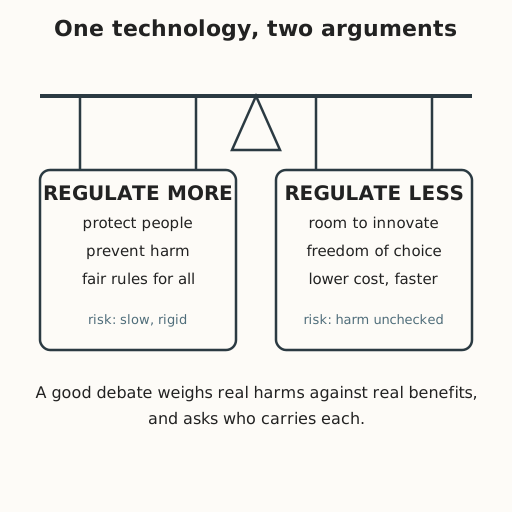
- Regulation-debate organizer · 1 per learner A two-sided organizer — reasons to regulate more, reasons to regulate less — with a space to name who carries each risk
- Stewardship journal · 1 per learner
Low-tech / no-cost
- A one-page case brief on a real regulation debate (e.g., content moderation on large platforms) · 1 per pair A short, faithful summary of a current debate with named arguments on both sides, ready to read aloud
- Paper and pencil To draw the organizer by hand
Enriched / lab & device
- Two short primary excerpts (a regulator's statement and a company's statement on the same technology) · 1 per group So learners meet each side in its own words, not only in summary
Works in different contexts
- large-group Introduce the debate briefly whole-class, then small groups each take one side and argue it in a structured exchange
- multi-age Younger learners name one thing that should be safer; older learners weigh both sides and locate where they disagree on evidence versus values
- self-directed A learner reads the case brief, fills both sides of the organizer, and writes which argument they find strongest and why
- level-grouped A ready group also maps which arguments are about facts (evidence) and which are about priorities (values), and argues about the line
- outdoor-only Two marked sides outdoors; learners physically stand where their strongest argument sits, then someone from each side speaks and everyone may move
Lesson 2 — The Debate Over Regulating a Technology
Summary
Learners take a real debate over regulating a technology and map the strongest arguments on both sides — reasons to regulate more and reasons to regulate less — then weigh who carries each risk. They practice evaluating a debate without reducing it to “good vs. bad,” naming where the disagreement is about facts and where it is about values.
Objectives
- Evaluate a debate over regulating a technology, weighing arguments on both sides. (D10.S1.11.01)
Connection
Every time a new technology appears — a drug, an app, a way to fish, a way to move goods — someone asks the same question: should there be a rule, and how strict? You have lived inside this question without hearing it asked. The age you can drive, the warnings on a medicine, the age limits and content rules on the apps you use — each is the residue of a regulation debate that someone, somewhere, already had. This lesson makes you the one asking it, with both sides in front of you and no easy answer.
Materials
- Regulation-debate organizer
- Stewardship journal
- Case brief (low-tech: paper)
Preparation
- Copy or draw the organizer; prepare the case brief.
- Retrieval: from Lesson 1, the three forces of governance (law, standards, markets). Today we evaluate how strict the law should be.
- Choose a real, age-appropriate regulation debate. A strong current example is content moderation on large social platforms: platforms already set rules and remove content, and the live debate is whether and how law should constrain or require this (Britannica, S-481). Keep both sides faithful, not caricatured.
Facilitator note
This lesson is written to the learner (“you”). The idea to land: a regulation debate is a weighing of real harms against real benefits, and the disagreement is partly about facts and partly about values (World Bank, S-281). The skill is evaluation: state the strongest version of each side, then locate the disagreement. Two common errors to guard against: reducing regulation to “freedom vs. control” (too simple), and assuming one side is self-evidently right (too settled). The mature move at this age is to hold that both a failure to regulate and a bad regulation can harm people — the question is who carries each risk.
The ethics lens: a regulation is a claim about who should be protected and who should bear a burden. The egalitarianism lens: ask whose harms get written into law and whose get ignored — the debate is not neutral between powerful and powerless. The global lens: the same technology is regulated differently in different places; none is the default. The technology lens is core: the artifact’s design shapes what any rule can even reach. The critical-thinking lens: separating “what the facts show” (evidence) from “what I prioritize” (value) is the whole skill. Preview: Lessons 3–4 ask how a technology’s benefits and harms are distributed unevenly, which is often why people argue over regulation.
Procedure
- Recall (5 min). From Lesson 1: what were the three forces that govern a technology? Today we evaluate the hardest one to get right — law.
- Meet the debate (10 min). Read the case brief on content moderation. One side: platforms that rank and amplify content can spread harm quickly, so there should be clear, enforceable rules (S-481). The other side: heavy-handed rules can silence legitimate speech, slow innovation, and concentrate power in whoever writes the rules (S-281). Restate each side in your own words before judging.
- Map both sides (12 min). In your organizer, list the two strongest reasons to regulate more and the two strongest to regulate less. For each reason, write who carries the risk if that side loses.
- Locate the disagreement (10 min). With a partner, sort the reasons into facts (things that could be checked) and values (things people prioritize differently). Where does the real disagreement live?
- Take a stand, then move (12 min). Write your position in one sentence, with your single strongest reason. Then listen as a partner argues the other side; note the one point that genuinely makes you think.
- Close (6 min). Say, in your own words, what a good regulation debate looks like — and what a bad one looks like.
Differentiation
- Support: Use two reasons total (one per side) and name who carries the risk, leaving the facts/values sort aside.
- Extension: Write the regulation you would propose — its rule, its reach, and one predictable cost — and defend it against the strongest objection you mapped.
Assessment
- Formative (peer + self): Can the learner state the strongest case on each side, name who carries each risk, and distinguish factual from value disagreements?
- Portfolio artifact (unit): The completed organizer with the “take a stand” and “one point that made me think” reflections, opened in the stewardship journal.
Home connection
Ask someone at home about a rule they think is too strict or too loose — for a device, a medicine, a road, or a workplace. Write one sentence on their reasoning and one on whether it leaned on facts or values.
Resources
- On platform rules, moderation, and the debate over them: Encyclopaedia Britannica, “Social media” (S-481).
- On regulation as one condition for technology to spread benefit or widen gaps: World Bank, World Development Report 2016: Digital Dividends (S-281).
- On worked examples and guided practice for evaluation: Kirschner, Sweller & Clark (2006) (S-011).